6FWW | pdb_00006fww

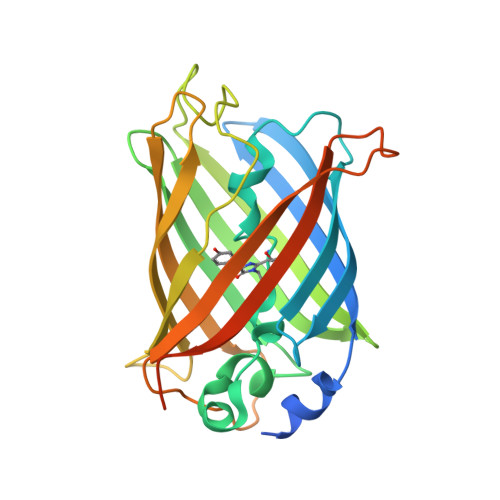
GFP/KKK. A redesigned GFP with improved solubility


Experimental Data Snapshot

  • Method: X-RAY DIFFRACTION
  • Resolution: 1.13 Å
  • R-Value Free: 
    0.203 (Depositor), 0.201 (DCC) 
  • R-Value Work: 
    0.184 (Depositor), 0.178 (DCC) 
  • R-Value Observed: 
    0.185 (Depositor) 

Starting Model: experimental
View more details

wwPDB Validation 3D Report Full Report

Validation slider image for 6FWW

This is version 1.3 of the entry. See complete history

Literature

Combining Structural Aggregation Propensity and Stability Predictions To Redesign Protein Solubility.

Gil-Garcia, M.Bano-Polo, M.Varejao, N.Jamroz, M.Kuriata, A.Diaz-Caballero, M.Lascorz, J.Morel, B.Navarro, S.Reverter, D.Kmiecik, S.Ventura, S.

(2018) Mol Pharm 15: 3846-3859

  • DOI: https://doi.org/10.1021/acs.molpharmaceut.8b00341
  • Primary Citation Related Structures: 
    6FWW

  • PubMed Abstract: 

    The aggregation propensity of each particular protein seems to be shaped by evolution according to its natural abundance in the cell. The production and downstream processing of recombinant polypeptides implies attaining concentrations that are orders of magnitude above their natural levels, often resulting in their aggregation; a phenomenon that precludes the marketing of many globular proteins for biomedical or biotechnological applications. Therefore, there is a huge interest in methods aimed to increase the proteins solubility above their natural limits. Here, we demonstrate that an updated version of our AGGRESCAN 3D structural aggregation predictor, that now takes into account protein stability, allows for designing mutations at specific positions in the structure that improve the solubility of proteins without compromising their conformation. Using this approach, we have designed a highly soluble variant of the green fluorescent protein and a human single-domain VH antibody displaying significantly reduced aggregation propensity. Overall, our data indicate that the solubility of unrelated proteins can be easily tuned by in silico-designed nondestabilizing amino acid changes at their surfaces.


  • Organizational Affiliation
    • Institut de Biotecnologia i de Biomedicina and Departament de Bioquímica i Biologia Molecular , Universitat Autònoma de Barcelona , Bellaterra (Barcelona) 08193 , Spain.

Macromolecule Content 

  • Total Structure Weight: 29.85 kDa 
  • Atom Count: 2,182 
  • Modeled Residue Count: 227 
  • Deposited Residue Count: 264 
  • Unique protein chains: 1

Macromolecules

Find similar proteins by:|  3D Structure
Entity ID: 1
MoleculeChains  Sequence LengthOrganismDetailsImage
Green fluorescent protein264Aequorea victoriaMutation(s): 8 
Gene Names: GFP
UniProt
Find proteins for P42212 (Aequorea victoria)
Explore P42212 
Go to UniProtKB:  P42212
Entity Groups
Sequence Clusters30% Identity50% Identity70% Identity90% Identity95% Identity100% Identity
UniProt GroupP42212
Sequence Annotations
Expand
Reference Sequence

Small Molecules

Modified Residues  1 Unique
IDChains TypeFormula2D DiagramParent
CRO
Query on CRO
A
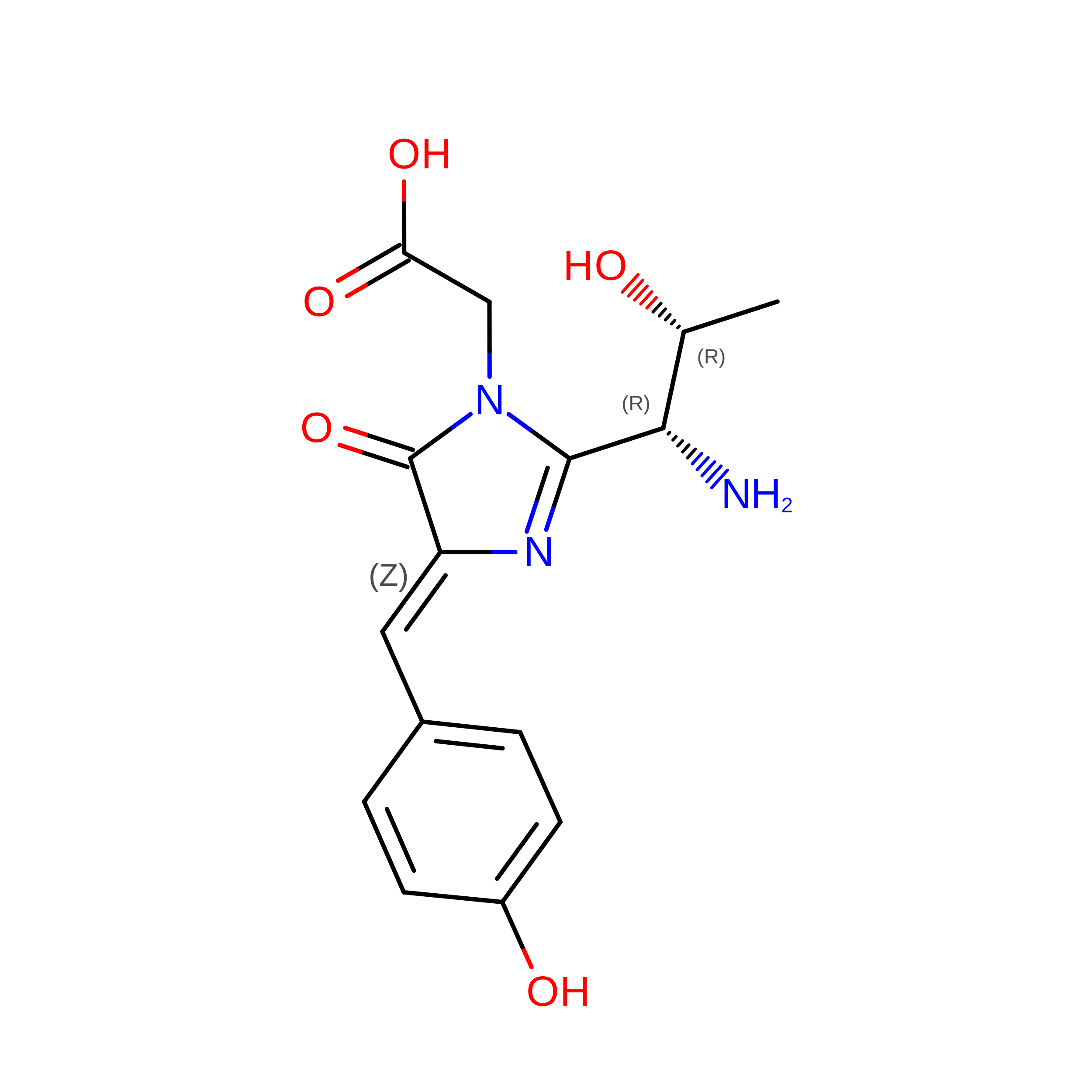
L-PEPTIDE LINKINGC15 H17 N3 O5THR, TYR, GLY

Experimental Data & Validation

Experimental Data

  • Method: X-RAY DIFFRACTION
  • Resolution: 1.13 Å
  • R-Value Free:  0.203 (Depositor), 0.201 (DCC) 
  • R-Value Work:  0.184 (Depositor), 0.178 (DCC) 
  • R-Value Observed: 0.185 (Depositor) 
Space Group: P 21 21 21
Unit Cell:
Length ( Å )Angle ( ˚ )
a = 31.814α = 90
b = 60.861β = 90
c = 106.401γ = 90
Software Package:
Software NamePurpose
Aimlessdata scaling
PHENIXrefinement
PDB_EXTRACTdata extraction
XDSdata reduction
PHASERphasing

Structure Validation

View Full Validation Report


Entry History 

Deposition Data

Revision History  (Full details and data files)

  • Version 1.0: 2018-08-01
    Type: Initial release
  • Version 1.1: 2018-09-12
    Changes: Data collection, Database references
  • Version 1.2: 2024-01-17
    Changes: Data collection, Database references, Refinement description
  • Version 1.3: 2024-11-13
    Changes: Structure summary