6F7H | pdb_00006f7h

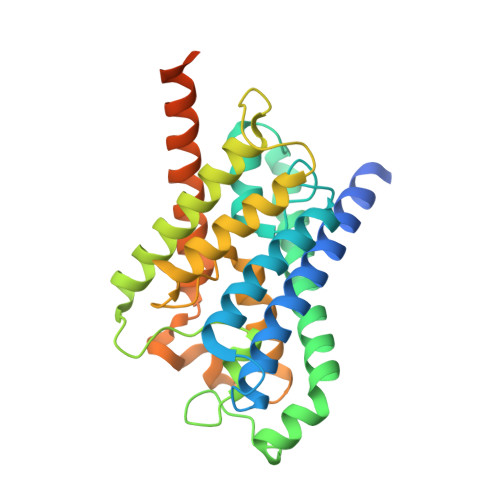
Crystal structure of human AQP10


Experimental Data Snapshot

  • Method: X-RAY DIFFRACTION
  • Resolution: 2.30 Å
  • R-Value Free: 
    0.212 (Depositor), 0.216 (DCC) 
  • R-Value Work: 
    0.189 (Depositor), 0.193 (DCC) 
  • R-Value Observed: 
    0.190 (Depositor) 

wwPDB Validation 3D Report Full Report

Validation slider image for 6F7H

Ligand Structure Quality Assessment 


This is version 1.2 of the entry. See complete history

Literature

Human adipose glycerol flux is regulated by a pH gate in AQP10.

Gotfryd, K.Mosca, A.F.Missel, J.W.Truelsen, S.F.Wang, K.Spulber, M.Krabbe, S.Helix-Nielsen, C.Laforenza, U.Soveral, G.Pedersen, P.A.Gourdon, P.

(2018) Nat Commun 9: 4749-4749

  • DOI: https://doi.org/10.1038/s41467-018-07176-z
  • Primary Citation Related Structures: 
    6F7H

  • PubMed Abstract: 

    Obesity is a major threat to global health and metabolically associated with glycerol homeostasis. Here we demonstrate that in human adipocytes, the decreased pH observed during lipolysis (fat burning) correlates with increased glycerol release and stimulation of aquaglyceroporin AQP10. The crystal structure of human AQP10 determined at 2.3 Å resolution unveils the molecular basis for pH modulation-an exceptionally wide selectivity (ar/R) filter and a unique cytoplasmic gate. Structural and functional (in vitro and in vivo) analyses disclose a glycerol-specific pH-dependence and pinpoint pore-lining His80 as the pH-sensor. Molecular dynamics simulations indicate how gate opening is achieved. These findings unravel a unique type of aquaporin regulation important for controlling body fat mass. Thus, targeting the cytoplasmic gate to induce constitutive glycerol secretion may offer an attractive option for treating obesity and related complications.


  • Organizational Affiliation
    • University of Copenhagen, Department of Biomedical Sciences, Nørre Allé 14, DK-2200, Copenhagen N, Denmark.

Macromolecule Content 

  • Total Structure Weight: 132.59 kDa 
  • Atom Count: 8,148 
  • Modeled Residue Count: 1,012 
  • Deposited Residue Count: 1,204 
  • Unique protein chains: 1

Macromolecules

Find similar proteins by:|  3D Structure
Entity ID: 1
MoleculeChains  Sequence LengthOrganismDetailsImage
Aquaporin-10
A, B, C, D
301Homo sapiensMutation(s): 0 
Gene Names: AQP10
Membrane Entity: Yes 
UniProt & NIH Common Fund Data Resources
Find proteins for Q96PS8 (Homo sapiens)
Explore Q96PS8 
Go to UniProtKB:  Q96PS8
PHAROS:  Q96PS8
GTEx:  ENSG00000143595 
Entity Groups
Sequence Clusters30% Identity50% Identity70% Identity90% Identity95% Identity100% Identity
UniProt GroupQ96PS8
Sequence Annotations
Expand
Reference Sequence

Small Molecules

Ligands 2 Unique
IDChains Name / Formula / InChI Key2D Diagram3D Interactions
BNG

Query on BNG


Download:Ideal Coordinates CCD File
E [auth A]
F [auth A]
G [auth A]
J [auth B]
K [auth B]
E [auth A],
F [auth A],
G [auth A],
J [auth B],
K [auth B],
L [auth B],
M [auth B],
N [auth B],
O [auth B],
R [auth C],
S [auth C],
T [auth C],
U [auth C],
W [auth D],
X [auth D],
Y [auth D]
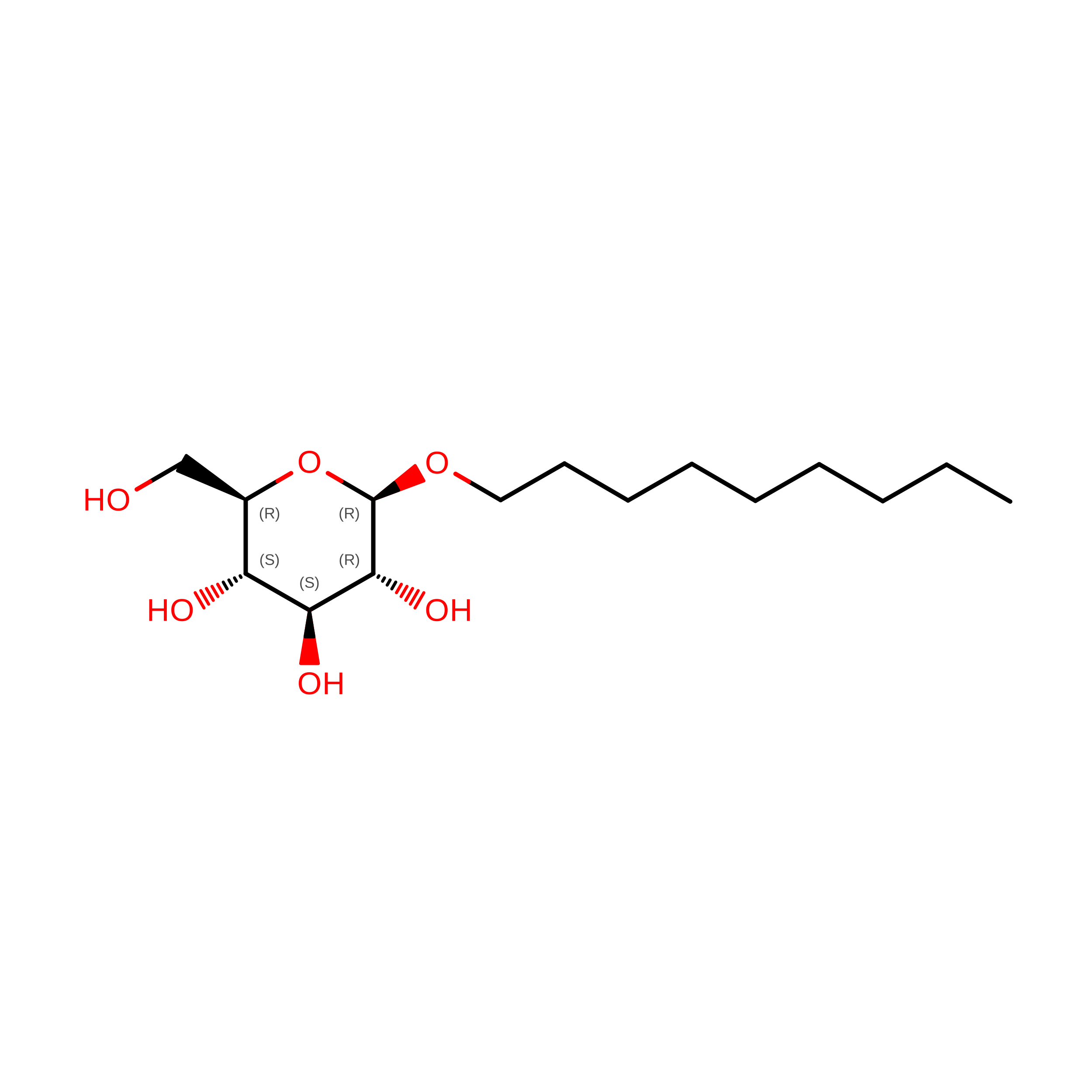
nonyl beta-D-glucopyranoside
C15 H30 O6
QFAPUKLCALRPLH-UXXRCYHCSA-N
GOL

Query on GOL


Download:Ideal Coordinates CCD File
H [auth A]
I [auth A]
P [auth B]
Q [auth B]
V [auth C]
H [auth A],
I [auth A],
P [auth B],
Q [auth B],
V [auth C],
Z [auth D]
GLYCEROL
C3 H8 O3
PEDCQBHIVMGVHV-UHFFFAOYSA-N

Experimental Data & Validation

Experimental Data

  • Method: X-RAY DIFFRACTION
  • Resolution: 2.30 Å
  • R-Value Free:  0.212 (Depositor), 0.216 (DCC) 
  • R-Value Work:  0.189 (Depositor), 0.193 (DCC) 
  • R-Value Observed: 0.190 (Depositor) 
Space Group: P 21 21 21
Unit Cell:
Length ( Å )Angle ( ˚ )
a = 97.071α = 90
b = 116.844β = 90
c = 138.549γ = 90
Software Package:
Software NamePurpose
PHENIXrefinement
XDSdata reduction
XDSdata scaling
PHASESphasing

Structure Validation

View Full Validation Report


Ligand Structure Quality Assessment 


Entry History 

Deposition Data

Revision History  (Full details and data files)

  • Version 1.0: 2018-11-21
    Type: Initial release
  • Version 1.1: 2020-07-29
    Type: Remediation
    Reason: Carbohydrate remediation
    Changes: Data collection, Derived calculations, Structure summary
  • Version 1.2: 2024-05-08
    Changes: Data collection, Database references, Structure summary