6BJC | pdb_00006bjc

TPX2_mini decorated GMPCPP-microtubule

  • Classification: CELL CYCLE
  • Organism(s): Sus scrofa, Homo sapiens
  • Expression System: Spodoptera aff. frugiperda 2 RZ-2014
  • Mutation(s): No 

  • Deposited: 2017-11-05 Released: 2017-11-22 
  • Deposition Author(s): Zhang, R., Nogales, E.
  • Funding Organization(s): National Institutes of Health/National Institute of General Medical Sciences (NIH/NIGMS), Howard Hughes Medical Institute (HHMI), Cancer Research UK, Medical Research Council (MRC, United Kingdom), Wellcome Trust

Experimental Data Snapshot

  • Method: ELECTRON MICROSCOPY
  • Resolution: 3.30 Å
  • Aggregation State: HELICAL ARRAY 
  • Reconstruction Method: HELICAL 

wwPDB Validation 3D Report Full Report

Validation slider image for 6BJC

This is version 1.4 of the entry. See complete history

Literature

Structural insight into TPX2-stimulated microtubule assembly.

Zhang, R.Roostalu, J.Surrey, T.Nogales, E.

(2017) Elife 6

  • DOI: https://doi.org/10.7554/eLife.30959
  • Primary Citation Related Structures: 
    6BJC

  • PubMed Abstract: 

    During mitosis and meiosis, microtubule (MT) assembly is locally upregulated by the chromatin-dependent Ran-GTP pathway. One of its key targets is the MT-associated spindle assembly factor TPX2. The molecular mechanism of how TPX2 stimulates MT assembly remains unknown because structural information about the interaction of TPX2 with MTs is lacking. Here, we determine the cryo-electron microscopy structure of a central region of TPX2 bound to the MT surface. TPX2 uses two flexibly linked elements ('ridge' and 'wedge') in a novel interaction mode to simultaneously bind across longitudinal and lateral tubulin interfaces. These MT-interacting elements overlap with the binding site of importins on TPX2. Fluorescence microscopy-based in vitro reconstitution assays reveal that this interaction mode is critical for MT binding and facilitates MT nucleation. Together, our results suggest a molecular mechanism of how the Ran-GTP gradient can regulate TPX2-dependent MT formation.


  • Organizational Affiliation
    • Molecular Biophysics and Integrative Bioimaging Division, Lawrence Berkeley National Laboratory, Berkeley, United States.

Macromolecule Content 

  • Total Structure Weight: 778.85 kDa 
  • Atom Count: 41,136 
  • Modeled Residue Count: 5,204 
  • Deposited Residue Count: 6,870 
  • Unique protein chains: 3

Macromolecules

Find similar proteins by:|  3D Structure
Entity ID: 1
MoleculeChains  Sequence LengthOrganismDetailsImage
Tubulin alpha-1B chain451Sus scrofaMutation(s): 0 
EC: 3.6.5
UniProt
Find proteins for Q2XVP4 (Sus scrofa)
Explore Q2XVP4 
Go to UniProtKB:  Q2XVP4
Entity Groups
Sequence Clusters30% Identity50% Identity70% Identity90% Identity95% Identity100% Identity
UniProt GroupQ2XVP4
Sequence Annotations
Expand
Reference Sequence
Find similar proteins by:|  3D Structure
Entity ID: 2
MoleculeChains  Sequence LengthOrganismDetailsImage
Tubulin beta chain445Sus scrofaMutation(s): 0 
UniProt
Find proteins for P02554 (Sus scrofa)
Explore P02554 
Go to UniProtKB:  P02554
Entity Groups
Sequence Clusters30% Identity50% Identity70% Identity90% Identity95% Identity100% Identity
UniProt GroupP02554
Sequence Annotations
Expand
Reference Sequence
Find similar proteins by:|  3D Structure
Entity ID: 3
MoleculeChains  Sequence LengthOrganismDetailsImage
Targeting protein for Xklp2E [auth T],
N [auth P]
747Homo sapiensMutation(s): 0 
Gene Names: TPX2C20orf1C20orf2DIL2HCA519
UniProt & NIH Common Fund Data Resources
Find proteins for Q9ULW0 (Homo sapiens)
Explore Q9ULW0 
Go to UniProtKB:  Q9ULW0
PHAROS:  Q9ULW0
GTEx:  ENSG00000088325 
Entity Groups
Sequence Clusters30% Identity50% Identity70% Identity90% Identity95% Identity100% Identity
UniProt GroupQ9ULW0
Sequence Annotations
Expand
Reference Sequence

Small Molecules

Ligands 3 Unique
IDChains Name / Formula / InChI Key2D Diagram3D Interactions
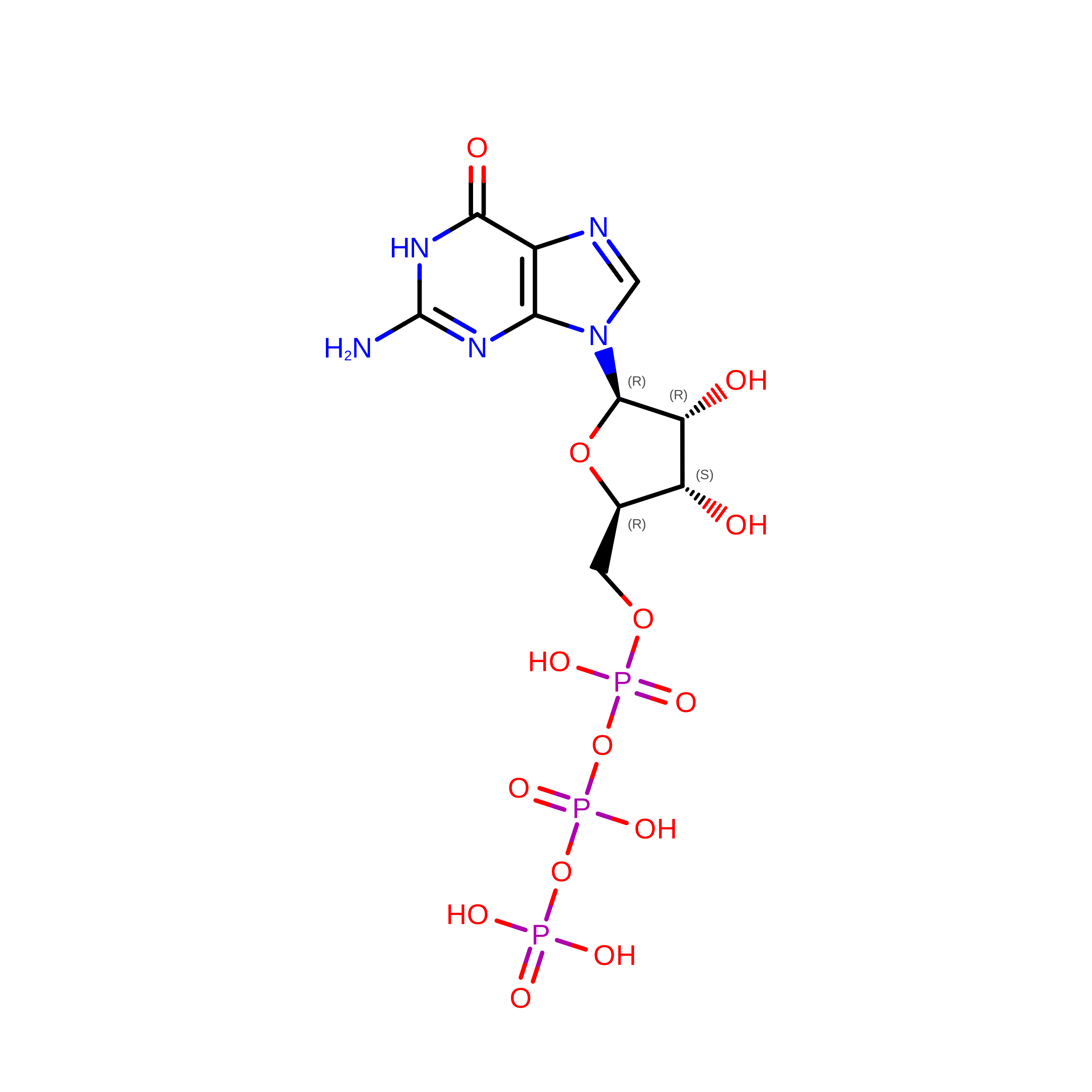
GTP

Query on GTP


Download:Ideal Coordinates CCD File
AA [auth J]
EA [auth L]
IA [auth K]
O [auth A]
S [auth C]
AA [auth J],
EA [auth L],
IA [auth K],
O [auth A],
S [auth C],
W [auth E]
GUANOSINE-5'-TRIPHOSPHATE
C10 H16 N5 O14 P3
XKMLYUALXHKNFT-UUOKFMHZSA-N
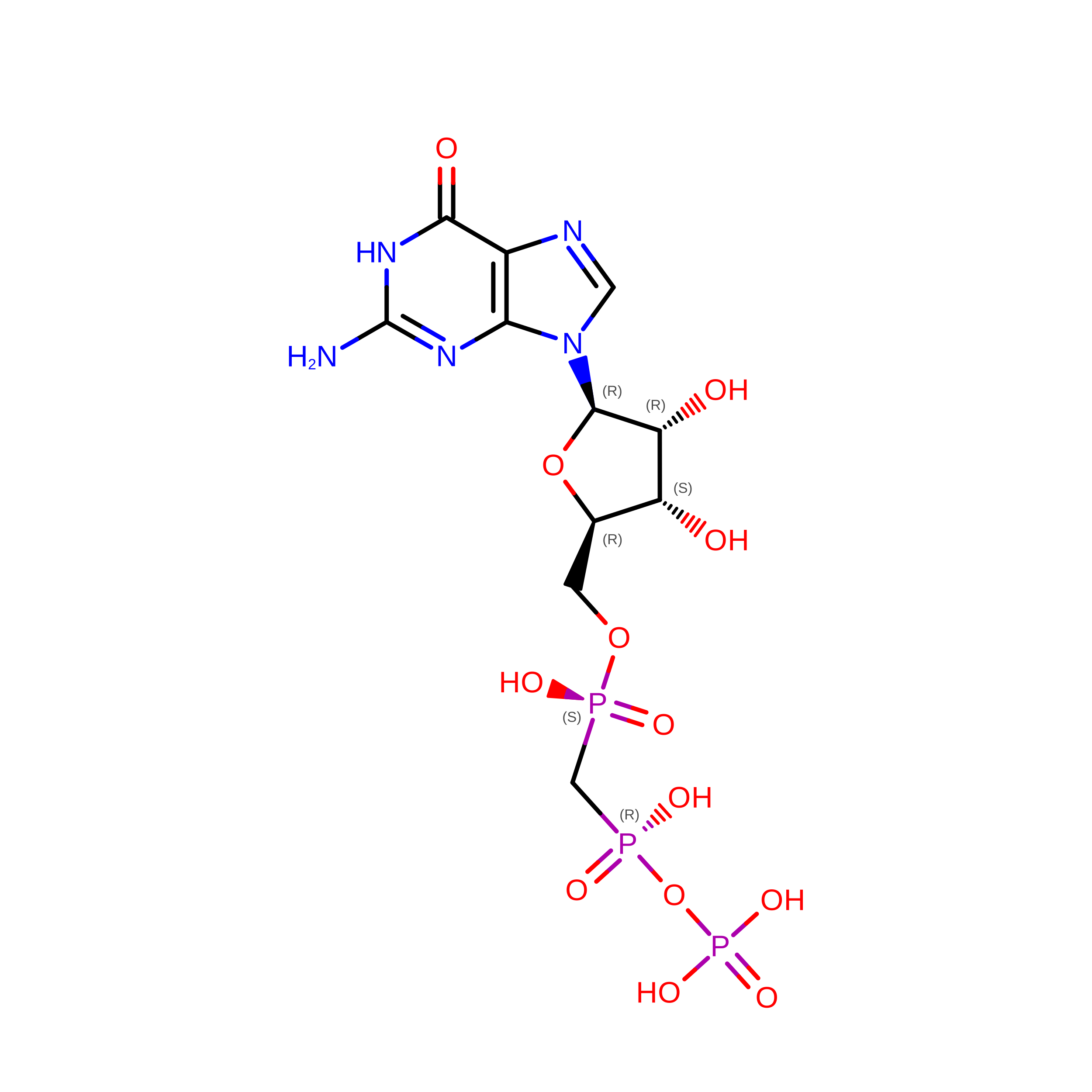
G2P

Query on G2P


Download:Ideal Coordinates CCD File
CA [auth H]
GA [auth G]
KA [auth I]
Q [auth B]
U [auth D]
CA [auth H],
GA [auth G],
KA [auth I],
Q [auth B],
U [auth D],
Y [auth F]
PHOSPHOMETHYLPHOSPHONIC ACID GUANYLATE ESTER
C11 H18 N5 O13 P3
GXTIEXDFEKYVGY-KQYNXXCUSA-N
MG

Query on MG


Download:Ideal Coordinates CCD File
BA [auth J]
DA [auth H]
FA [auth L]
HA [auth G]
JA [auth K]
BA [auth J],
DA [auth H],
FA [auth L],
HA [auth G],
JA [auth K],
LA [auth I],
P [auth A],
R [auth B],
T [auth C],
V [auth D],
X [auth E],
Z [auth F]
MAGNESIUM ION
Mg
JLVVSXFLKOJNIY-UHFFFAOYSA-N

Experimental Data & Validation

Experimental Data

  • Method: ELECTRON MICROSCOPY
  • Resolution: 3.30 Å
  • Aggregation State: HELICAL ARRAY 
  • Reconstruction Method: HELICAL 
EM Software:
TaskSoftware PackageVersion
RECONSTRUCTIONFREALIGN
MODEL REFINEMENTREFMAC

Structure Validation

View Full Validation Report


Entry History 

& Funding Information

Deposition Data


Funding OrganizationLocationGrant Number
National Institutes of Health/National Institute of General Medical Sciences (NIH/NIGMS)United StatesGM051487
Howard Hughes Medical Institute (HHMI)United States--
Cancer Research UKUnited KingdomFC001163
Medical Research Council (MRC, United Kingdom)United KingdomFC001163
Wellcome TrustUnited KingdomFC001163

Revision History  (Full details and data files)

  • Version 1.0: 2017-11-22
    Type: Initial release
  • Version 1.1: 2018-10-03
    Changes: Data collection, Other, Refinement description
  • Version 1.2: 2019-11-20
    Changes: Author supporting evidence
  • Version 1.3: 2019-12-18
    Changes: Author supporting evidence, Other
  • Version 1.4: 2024-03-13
    Changes: Data collection, Database references, Refinement description