5Z8F | pdb_00005z8f

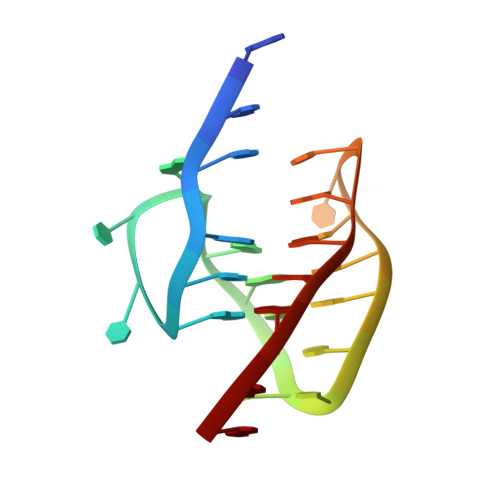
Solution structure for the unique dimeric 4:2 complex of a platinum(II)-based tripod bound to a hybrid-1 human telomeric G-quadruplex


Experimental Data Snapshot

  • Method: SOLUTION NMR
  • Conformers Calculated: 100 
  • Conformers Submitted: 10 
  • Selection Criteria: structures with the lowest energy 

wwPDB Validation 3D Report Full Report

Validation slider image for 5Z8F

This is version 1.2 of the entry. See complete history

Literature

Solution structures of multiple G-quadruplex complexes induced by a platinum(II)-based tripod reveal dynamic binding

Liu, W.Zhong, Y.F.Liu, L.Y.Shen, C.T.Zeng, W.Wang, F.Yang, D.Mao, Z.W.

(2018) Nat Commun 9: 3496-3496

  • DOI: https://doi.org/10.1038/s41467-018-05810-4
  • Primary Citation Related Structures: 
    5Z80, 5Z8F

  • PubMed Abstract: 

    DNA G-quadruplexes are not only attractive drug targets for cancer therapeutics, but also have important applications in supramolecular assembly. Here, we report a platinum(II)-based tripod (Pt-tripod) specifically binds the biological relevant hybrid-1 human telomeric G-quadruplex (Tel26), and strongly inhibits telomerase activity. Further investigations illustrate Pt-tripod induces the formation of monomeric and multimeric Pt-tripod‒Tel26 complex structures in solution. We solve the 1:1 and the unique dimeric 4:2 Pt-tripod-Tel26 complex structures by NMR. The structures indicate preferential binding of Pt-tripod to the 5'-end of Tel26 at a low Pt-tripod/Tel26 ratio of 0-1.0. After adding more Pt-tripod, the Pt-tripod binds the 3'-end of Tel26, unexpectedly inducing a unique dimeric 4:2 structure interlocked by an A:A non-canonical pair at the 3'-end. Our structures provide a structural basis for understanding the dynamic binding of small molecules with G-quadruplex and DNA damage mechanisms, and insights into the recognition and assembly of higher-order G-quadruplexes.


  • Organizational Affiliation
    • MOE Key Laboratory of Bioinorganic and Synthetic Chemistry, School of Chemistry, Sun Yat-Sen University, Guangzhou, 510275, China.

Macromolecule Content 

  • Total Structure Weight: 21.96 kDa 
  • Atom Count: 1,342 
  • Modeled Residue Count: 52 
  • Deposited Residue Count: 52 
  • Unique nucleic acid chains: 1

Macromolecules

Find similar nucleic acids by:  (by identity cutoff) 
Entity ID: 1
MoleculeChains LengthOrganismImage
G-quadruplex DNA (26-MER)
A, B
26Homo sapiens
Sequence Annotations
Expand
Reference Sequence

Small Molecules

Ligands 1 Unique
IDChains Name / Formula / InChI Key2D Diagram3D Interactions
9F0
(Subject of Investigation/LOI)

Query on 9F0


Download:Ideal Coordinates CCD File
C [auth A],
D [auth A],
E [auth B],
F [auth B]
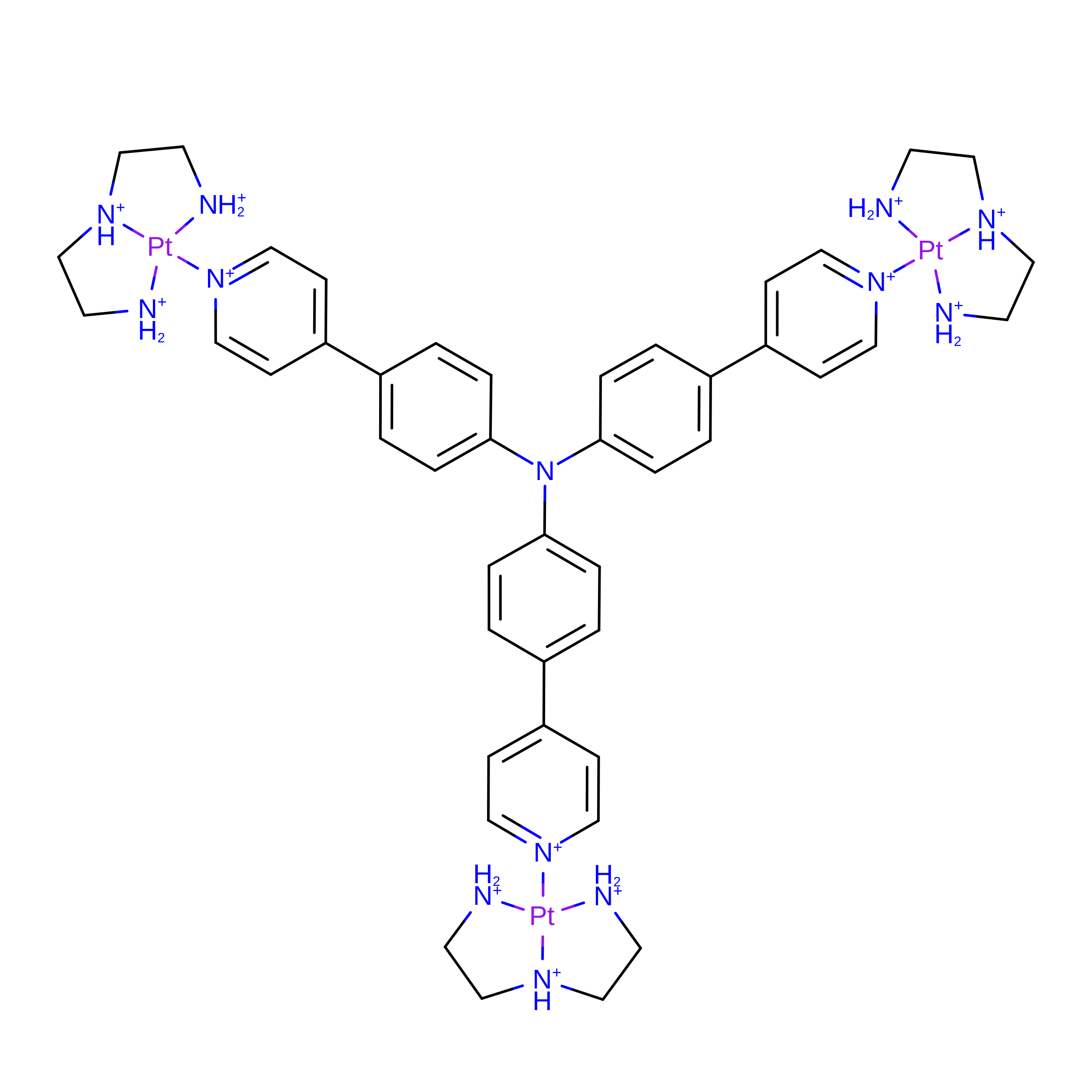
4-[1-(2,5,8-triazonia-1$l^4-platinabicyclo[3.3.0]octan-1-yl)pyridin-1-ium-4-yl]-N,N-bis[4-[1-(2,5,8-triazonia-1$l^4-platinabicyclo[3.3.0]octan-1-yl)pyridin-1-ium-4-yl]phenyl]aniline
C45 H63 N13 Pt3
HWOQXVGDGHJZJY-UHFFFAOYSA-N

Experimental Data & Validation

Experimental Data

  • Method: SOLUTION NMR
  • Conformers Calculated: 100 
  • Conformers Submitted: 10 
  • Selection Criteria: structures with the lowest energy 

Structure Validation

View Full Validation Report


Entry History 

& Funding Information

Deposition Data


Funding OrganizationLocationGrant Number
973 programChina2014CB845604 and 2015CB856301
National Science Foundation of ChinaChina21231007 and 21572282
Ministry of Education of ChinaChinaIRT-17R111
Science and Technology Planning Project of Guangdong ProvinceChina2013B051000047 and 207999

Revision History  (Full details and data files)

  • Version 1.0: 2018-09-19
    Type: Initial release
  • Version 1.1: 2023-06-14
    Changes: Data collection, Database references, Other
  • Version 1.2: 2024-05-15
    Changes: Data collection, Database references