5XVF | pdb_00005xvf

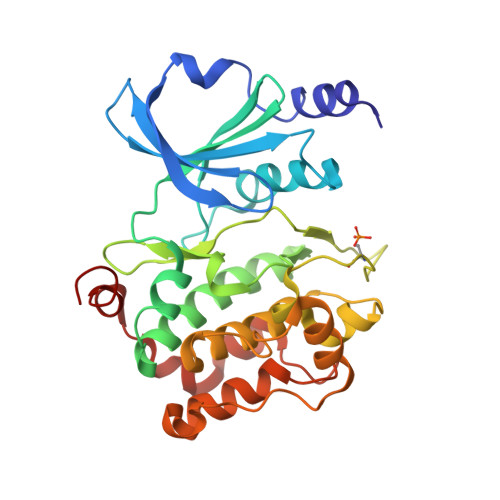
Crystal Structure of PAK4 in complex with inhibitor CZH062


Experimental Data Snapshot

  • Method: X-RAY DIFFRACTION
  • Resolution: 2.65 Å
  • R-Value Free: 
    0.251 (Depositor), 0.254 (DCC) 
  • R-Value Work: 
    0.194 (Depositor) 
  • R-Value Observed: 
    0.197 (Depositor) 

Starting Model: experimental
View more details

wwPDB Validation 3D Report Full Report

Validation slider image for 5XVF

Ligand Structure Quality Assessment 


This is version 1.2 of the entry. See complete history

Literature

Structure-Based Design of 6-Chloro-4-aminoquinazoline-2-carboxamide Derivatives as Potent and Selective p21-Activated Kinase 4 (PAK4) Inhibitors.

Hao, C.Zhao, F.Song, H.Guo, J.Li, X.Jiang, X.Huan, R.Song, S.Zhang, Q.Wang, R.Wang, K.Pang, Y.Liu, T.Lu, T.Huang, W.Wang, J.Lin, B.He, Z.Li, H.Li, F.Zhao, D.Cheng, M.

(2018) J Med Chem 61: 265-285

  • DOI: https://doi.org/10.1021/acs.jmedchem.7b01342
  • Primary Citation Related Structures: 
    5XVA, 5XVF, 5XVG

  • PubMed Abstract: 

    Herein, we report the discovery and characterization of a novel class of PAK4 inhibitors with a quinazoline scaffold. Based on the shape and chemical composition of the ATP-binding pocket of PAKs, we chose a 2,4-diaminoquinazoline series of inhibitors as a starting point. Guided by X-ray crystallography and a structure-based drug design (SBDD) approach, a series of novel 4-aminoquinazoline-2-carboxamide PAK4 inhibitors were designed and synthesized. The inhibitors' selectivity, therapeutic potency, and pharmaceutical properties were optimized. One of the best compounds, 31 (CZh226), showed remarkable PAK4 selectivity (346-fold vs PAK1) and favorable kinase selectivity profile. Moreover, this compound potently inhibited the migration and invasion of A549 tumor cells by regulating the PAK4-directed downstream signaling pathways in vitro. Taken together, these data support the further development of 31 as a lead compound for PAK4-targeted anticancer drug discovery and as a valuable research probe for the further biological investigation of group II PAKs.


  • Organizational Affiliation
    • Key Laboratory of Structure-Based Drug Design & Discovery of Ministry of Education, Shenyang Pharmaceutical University , Shenyang 110016, China.

Macromolecule Content 

  • Total Structure Weight: 33.04 kDa 
  • Atom Count: 2,322 
  • Modeled Residue Count: 290 
  • Deposited Residue Count: 290 
  • Unique protein chains: 1

Macromolecules

Find similar proteins by:|  3D Structure
Entity ID: 1
MoleculeChains  Sequence LengthOrganismDetailsImage
Serine/threonine-protein kinase PAK 4290Homo sapiensMutation(s): 0 
Gene Names: PAK4KIAA1142
EC: 2.7.11.1
UniProt & NIH Common Fund Data Resources
Find proteins for O96013 (Homo sapiens)
Explore O96013 
Go to UniProtKB:  O96013
PHAROS:  O96013
GTEx:  ENSG00000130669 
Entity Groups
Sequence Clusters30% Identity50% Identity70% Identity90% Identity95% Identity100% Identity
UniProt GroupO96013
Sequence Annotations
Expand
Reference Sequence

Small Molecules

Ligands 1 Unique
IDChains Name / Formula / InChI Key2D Diagram3D Interactions
8FR

Query on 8FR


Download:Ideal Coordinates CCD File
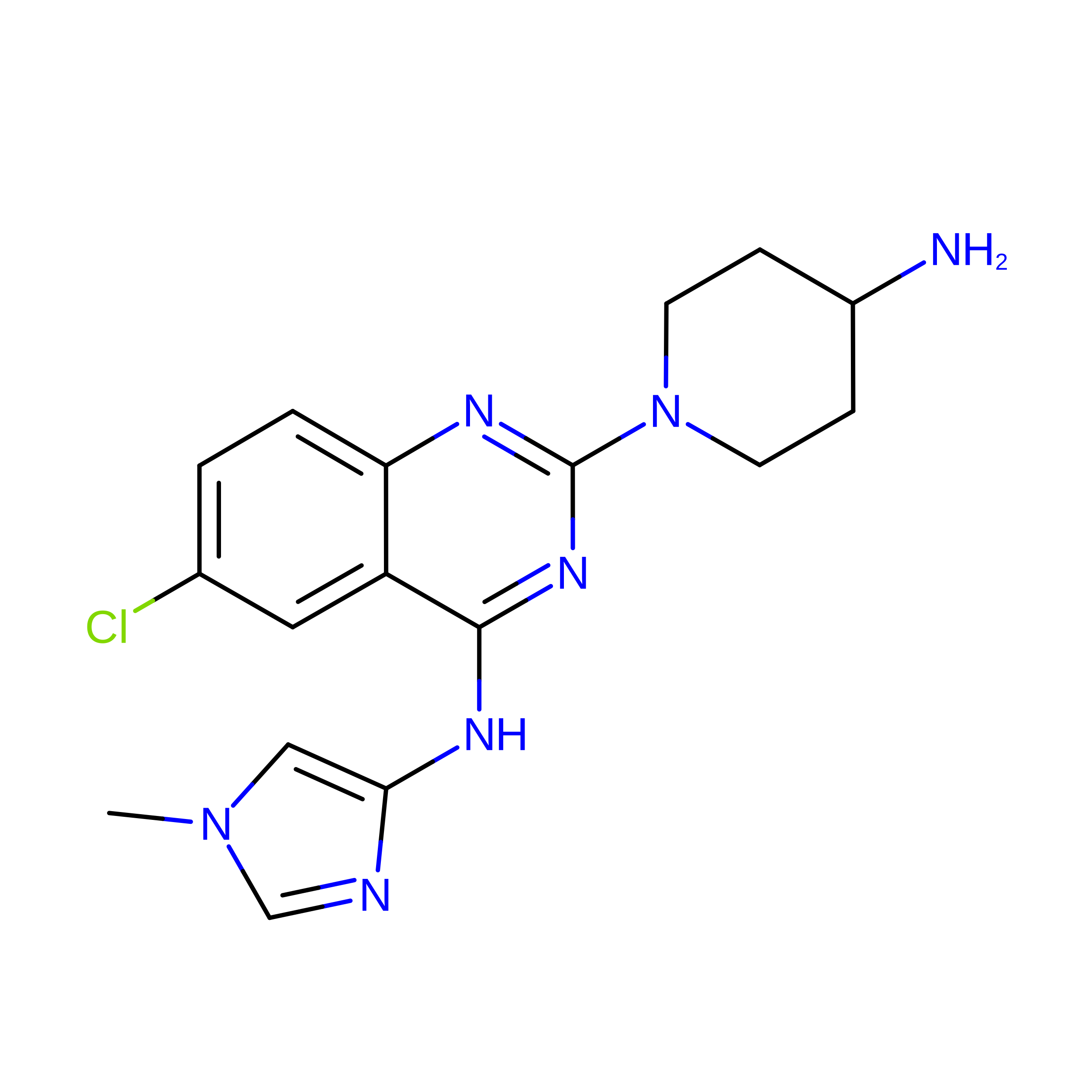
B [auth A]2-(4-azanylpiperidin-1-yl)-6-chloranyl-N-(1-methylimidazol-4-yl)quinazolin-4-amine
C17 H20 Cl N7
FFRWUFYTZPMLTK-UHFFFAOYSA-N
Modified Residues  1 Unique
IDChains TypeFormula2D DiagramParent
SEP
Query on SEP
A
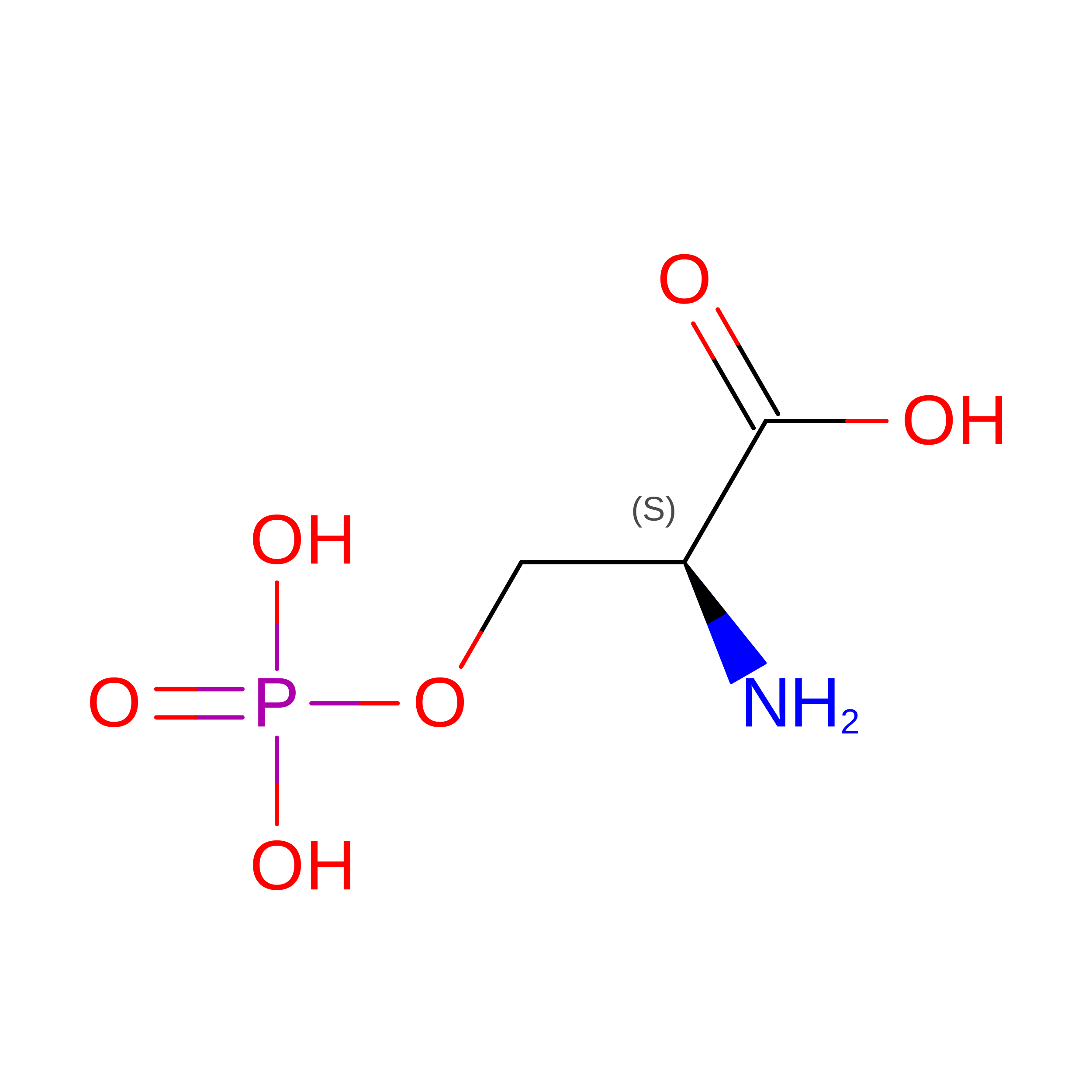
L-PEPTIDE LINKINGC3 H8 N O6 PSER
Binding Affinity Annotations 
IDSourceBinding Affinity
8FR BindingDB:  5XVF Ki: 710 (nM) from 1 assay(s)
Kd: 156 (nM) from 1 assay(s)

Experimental Data & Validation

Experimental Data

  • Method: X-RAY DIFFRACTION
  • Resolution: 2.65 Å
  • R-Value Free:  0.251 (Depositor), 0.254 (DCC) 
  • R-Value Work:  0.194 (Depositor) 
  • R-Value Observed: 0.197 (Depositor) 
Space Group: P 41 21 2
Unit Cell:
Length ( Å )Angle ( ˚ )
a = 65.404α = 90
b = 65.404β = 90
c = 180.863γ = 90
Software Package:
Software NamePurpose
PHENIXrefinement
DENZOdata collection
HKL-2000data scaling
PDB_EXTRACTdata extraction

Structure Validation

View Full Validation Report


Ligand Structure Quality Assessment 


Entry History 

Deposition Data

Revision History  (Full details and data files)

  • Version 1.0: 2018-02-07
    Type: Initial release
  • Version 1.1: 2023-11-22
    Changes: Data collection, Database references, Refinement description
  • Version 1.2: 2024-10-23
    Changes: Structure summary