5V4M | pdb_00005v4m

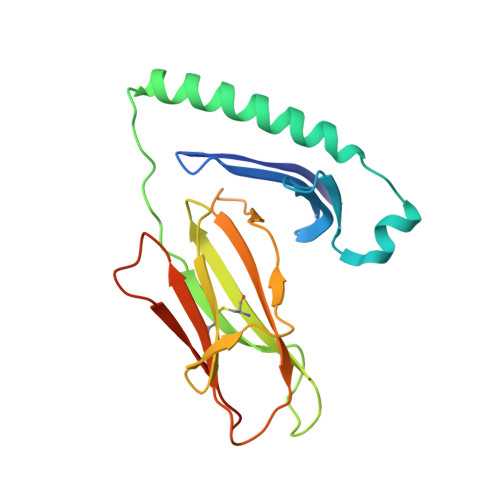
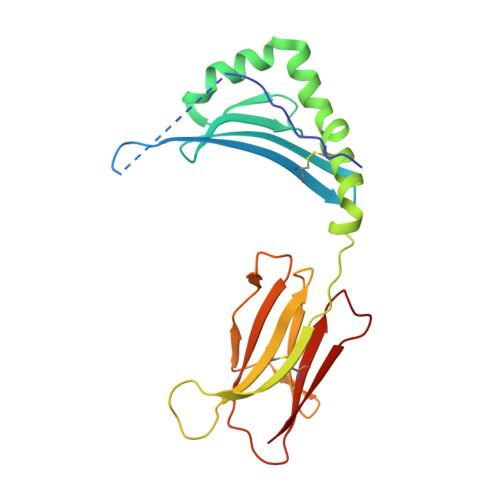
Structure of HLA-DR15 with bound alpha3(135-145) peptide


Experimental Data Snapshot

  • Method: X-RAY DIFFRACTION
  • Resolution: 2.10 Å
  • R-Value Free: 
    0.244 (Depositor), 0.244 (DCC) 
  • R-Value Work: 
    0.217 (Depositor), 0.218 (DCC) 
  • R-Value Observed: 
    0.217 (Depositor) 

wwPDB Validation 3D Report Full Report

Validation slider image for 5V4M

Ligand Structure Quality Assessment 


This is version 2.1 of the entry. See complete history

Literature

Dominant protection from HLA-linked autoimmunity by antigen-specific regulatory T cells.

Ooi, J.D.Petersen, J.Tan, Y.H.Huynh, M.Willett, Z.J.Ramarathinam, S.H.Eggenhuizen, P.J.Loh, K.L.Watson, K.A.Gan, P.Y.Alikhan, M.A.Dudek, N.L.Handel, A.Hudson, B.G.Fugger, L.Power, D.A.Holt, S.G.Coates, P.T.Gregersen, J.W.Purcell, A.W.Holdsworth, S.R.La Gruta, N.L.Reid, H.H.Rossjohn, J.Kitching, A.R.

(2017) Nature 545: 243-247

  • DOI: https://doi.org/10.1038/nature22329
  • Primary Citation Related Structures: 
    5V4M, 5V4N

  • PubMed Abstract: 

    Susceptibility and protection against human autoimmune diseases, including type I diabetes, multiple sclerosis, and Goodpasture disease, is associated with particular human leukocyte antigen (HLA) alleles. However, the mechanisms underpinning such HLA-mediated effects on self-tolerance remain unclear. Here we investigate the molecular mechanism of Goodpasture disease, an HLA-linked autoimmune renal disorder characterized by an immunodominant CD4 + T-cell self-epitope derived from the α3 chain of type IV collagen (α3 135-145 ). While HLA-DR15 confers a markedly increased disease risk, the protective HLA-DR1 allele is dominantly protective in trans with HLA-DR15 (ref. 2). We show that autoreactive α3 135-145 -specific T cells expand in patients with Goodpasture disease and, in α3 135-145 -immunized HLA-DR15 transgenic mice, α3 135-145 -specific T cells infiltrate the kidney and mice develop Goodpasture disease. HLA-DR15 and HLA-DR1 exhibit distinct peptide repertoires and binding preferences and present the α3 135-145 epitope in different binding registers. HLA-DR15-α3 135-145 tetramer + T cells in HLA-DR15 transgenic mice exhibit a conventional T-cell phenotype (T conv ) that secretes pro-inflammatory cytokines. In contrast, HLA-DR1-α3 135-145 tetramer + T cells in HLA-DR1 and HLA-DR15/DR1 transgenic mice are predominantly CD4 + Foxp3 + regulatory T cells (T reg cells) expressing tolerogenic cytokines. HLA-DR1-induced T reg cells confer resistance to disease in HLA-DR15/DR1 transgenic mice. HLA-DR15 + and HLA-DR1 + healthy human donors display altered α3 135-145 -specific T-cell antigen receptor usage, HLA-DR15-α3 135-145 tetramer + Foxp3 - T conv and HLA-DR1-α3 135-145 tetramer + Foxp3 + CD25 hi CD127 lo T reg dominant phenotypes. Moreover, patients with Goodpasture disease display a clonally expanded α3 135-145 -specific CD4 + T-cell repertoire. Accordingly, we provide a mechanistic basis for the dominantly protective effect of HLA in autoimmune disease, whereby HLA polymorphism shapes the relative abundance of self-epitope specific T reg cells that leads to protection or causation of autoimmunity.


  • Organizational Affiliation
    • Centre for Inflammatory Diseases, Monash University Department of Medicine, Monash Medical Centre, Clayton, Victoria 3168, Australia.

Macromolecule Content 

  • Total Structure Weight: 189.02 kDa 
  • Atom Count: 13,349 
  • Modeled Residue Count: 1,512 
  • Deposited Residue Count: 1,620 
  • Unique protein chains: 2

Macromolecules

Find similar proteins by:|  3D Structure
Entity ID: 1
MoleculeChains  Sequence LengthOrganismDetailsImage
HLA-DRA1A [auth D],
C [auth A],
E [auth G],
G [auth J]
189Homo sapiensMutation(s): 0 
Gene Names: HLA-DRAHLA-DRA1
UniProt & NIH Common Fund Data Resources
Find proteins for P01903 (Homo sapiens)
Explore P01903 
Go to UniProtKB:  P01903
PHAROS:  P01903
GTEx:  ENSG00000204287 
Entity Groups
Sequence Clusters30% Identity50% Identity70% Identity90% Identity95% Identity100% Identity
UniProt GroupP01903
Glycosylation
Glycosylation Sites: 2Go to GlyGen: P01903-1
Sequence Annotations
Expand
Reference Sequence
Find similar proteins by:|  3D Structure
Entity ID: 2
MoleculeChains  Sequence LengthOrganismDetailsImage
alpha3(135-145)-HLA-DRB1*15:01B [auth F],
D [auth C],
F [auth I],
H [auth L]
216Homo sapiensMutation(s): 0 
Gene Names: HLA-DRB1HLA-DRB2
UniProt & NIH Common Fund Data Resources
Find proteins for P01911 (Homo sapiens)
Explore P01911 
Go to UniProtKB:  P01911
PHAROS:  P01911
GTEx:  ENSG00000196126 
Entity Groups
Sequence Clusters30% Identity50% Identity70% Identity90% Identity95% Identity100% Identity
UniProt GroupP01911
Sequence Annotations
Expand
Reference Sequence

Oligosaccharides

Help  
Entity ID: 3
MoleculeChains Length2D Diagram GlycosylationD Interactions
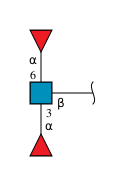
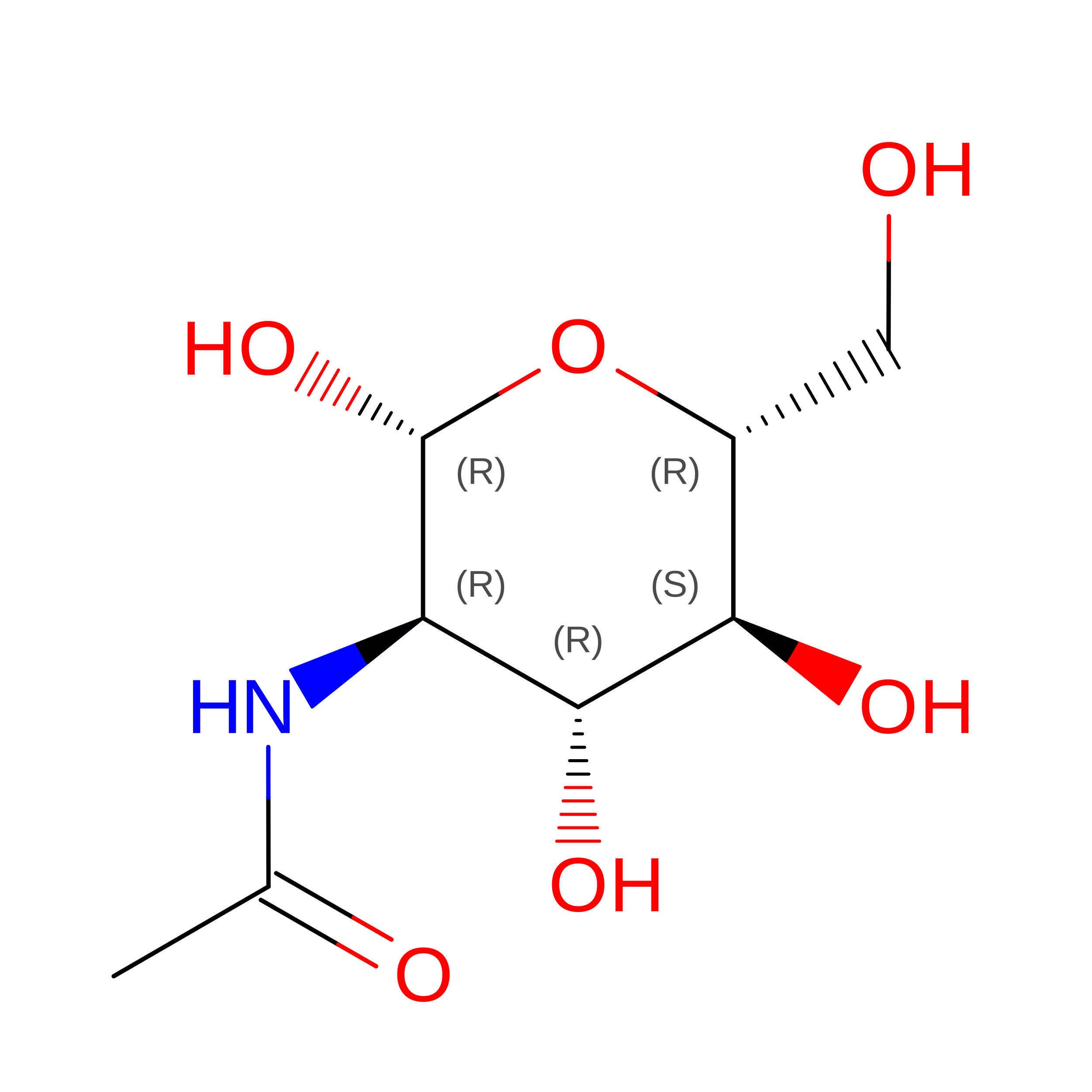
alpha-L-fucopyranose-(1-3)-[alpha-L-fucopyranose-(1-6)]2-acetamido-2-deoxy-beta-D-glucopyranoseI [auth B],
K [auth H]
3N-Glycosylation
Glycosylation Resources
GlyTouCan: G04836KE
GlyCosmos: G04836KE
GlyGen: G04836KE
Entity ID: 4
MoleculeChains Length2D Diagram GlycosylationD Interactions
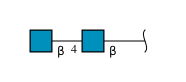
2-acetamido-2-deoxy-beta-D-glucopyranose-(1-4)-2-acetamido-2-deoxy-beta-D-glucopyranoseJ [auth E],
L [auth K]
2N-Glycosylation
Glycosylation Resources
GlyTouCan: G42666HT
GlyCosmos: G42666HT
GlyGen: G42666HT

Experimental Data & Validation

Experimental Data

  • Method: X-RAY DIFFRACTION
  • Resolution: 2.10 Å
  • R-Value Free:  0.244 (Depositor), 0.244 (DCC) 
  • R-Value Work:  0.217 (Depositor), 0.218 (DCC) 
  • R-Value Observed: 0.217 (Depositor) 
Space Group: P 1
Unit Cell:
Length ( Å )Angle ( ˚ )
a = 67.59α = 87.64
b = 79.01β = 73.29
c = 95.821γ = 89.97
Software Package:
Software NamePurpose
PHENIXrefinement
iMOSFLMdata reduction
SCALAdata scaling
PHASERphasing

Structure Validation

View Full Validation Report


Ligand Structure Quality Assessment 


Entry History 

Deposition Data

Revision History  (Full details and data files)

  • Version 1.0: 2017-05-03
    Type: Initial release
  • Version 1.1: 2017-05-17
    Changes: Database references
  • Version 1.2: 2017-05-24
    Changes: Database references
  • Version 2.0: 2020-07-29
    Type: Remediation
    Reason: Carbohydrate remediation
    Changes: Advisory, Atomic model, Data collection, Derived calculations, Structure summary
  • Version 2.1: 2024-10-09
    Changes: Data collection, Database references, Derived calculations, Structure summary