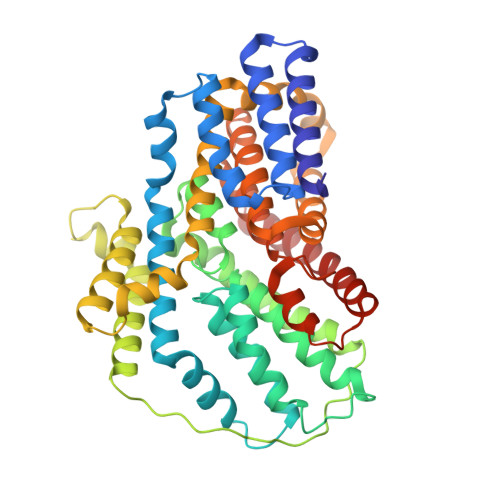
5UL9 | pdb_00005ul9

Structure and function of the divalent anion/Na+ symporter from Vibrio cholerae and a humanized variant


Experimental Data Snapshot

  • Method: X-RAY DIFFRACTION
  • Resolution: 2.78 Å
  • R-Value Free: 
    0.261 (Depositor), 0.266 (DCC) 
  • R-Value Work: 
    0.242 (Depositor), 0.256 (DCC) 
  • R-Value Observed: 
    0.243 (Depositor) 

wwPDB Validation 3D Report Full Report

Validation slider image for 5UL9

This is version 1.1 of the entry. See complete history

Literature

Structure and function of the divalent anion/Na(+) symporter from Vibrio cholerae and a humanized variant.

Nie, R.Stark, S.Symersky, J.Kaplan, R.S.Lu, M.

(2017) Nat Commun 8: 15009-15009

  • DOI: https://doi.org/10.1038/ncomms15009
  • Primary Citation Related Structures: 
    5UL7, 5UL9, 5ULD, 5ULE

  • PubMed Abstract: 

    Integral membrane proteins of the divalent anion/Na + symporter (DASS) family translocate dicarboxylate, tricarboxylate or sulphate across cell membranes, typically by utilizing the preexisting Na + gradient. The molecular determinants for substrate recognition by DASS remain obscure, largely owing to the absence of any substrate-bound DASS structure. Here we present 2.8-Å resolution X-ray structures of VcINDY, a DASS from Vibrio cholerae that catalyses the co-transport of Na + and succinate. These structures portray the Na + -bound VcINDY in complexes with succinate and citrate, elucidating the binding sites for substrate and two Na + ions. Furthermore, we report the structures of a humanized variant of VcINDY in complexes with succinate and citrate, which predict how a human citrate-transporting DASS may interact with its bound substrate. Our findings provide insights into metabolite transport by DASS, establishing a molecular basis for future studies on the regulation of this transport process.


  • Organizational Affiliation
    • Department of Biochemistry and Molecular Biology, Rosalind Franklin University of Medicine and Science, 3333 Green Bay Road, North Chicago, Illinois 60064, USA.

Macromolecule Content 

  • Total Structure Weight: 191.1 kDa 
  • Atom Count: 13,408 
  • Modeled Residue Count: 1,780 
  • Deposited Residue Count: 1,780 
  • Unique protein chains: 1

Macromolecules

Find similar proteins by:|  3D Structure
Entity ID: 1
MoleculeChains  Sequence LengthOrganismDetailsImage
Transporter, NadC family
A, B, C, D
445Vibrio cholerae O1 biovar El Tor str. N16961Mutation(s): 0 
Gene Names: VC_A0025
Membrane Entity: Yes 
UniProt
Find proteins for Q9KNE0 (Vibrio cholerae serotype O1 (strain ATCC 39315 / El Tor Inaba N16961))
Explore Q9KNE0 
Go to UniProtKB:  Q9KNE0
Entity Groups
Sequence Clusters30% Identity50% Identity70% Identity90% Identity95% Identity100% Identity
UniProt GroupQ9KNE0
Sequence Annotations
Expand
Reference Sequence

Small Molecules

Ligands 2 Unique
IDChains Name / Formula / InChI Key2D Diagram3D Interactions
CIT

Query on CIT


Download:Ideal Coordinates CCD File
G [auth A],
J [auth B],
M [auth C],
P [auth D]
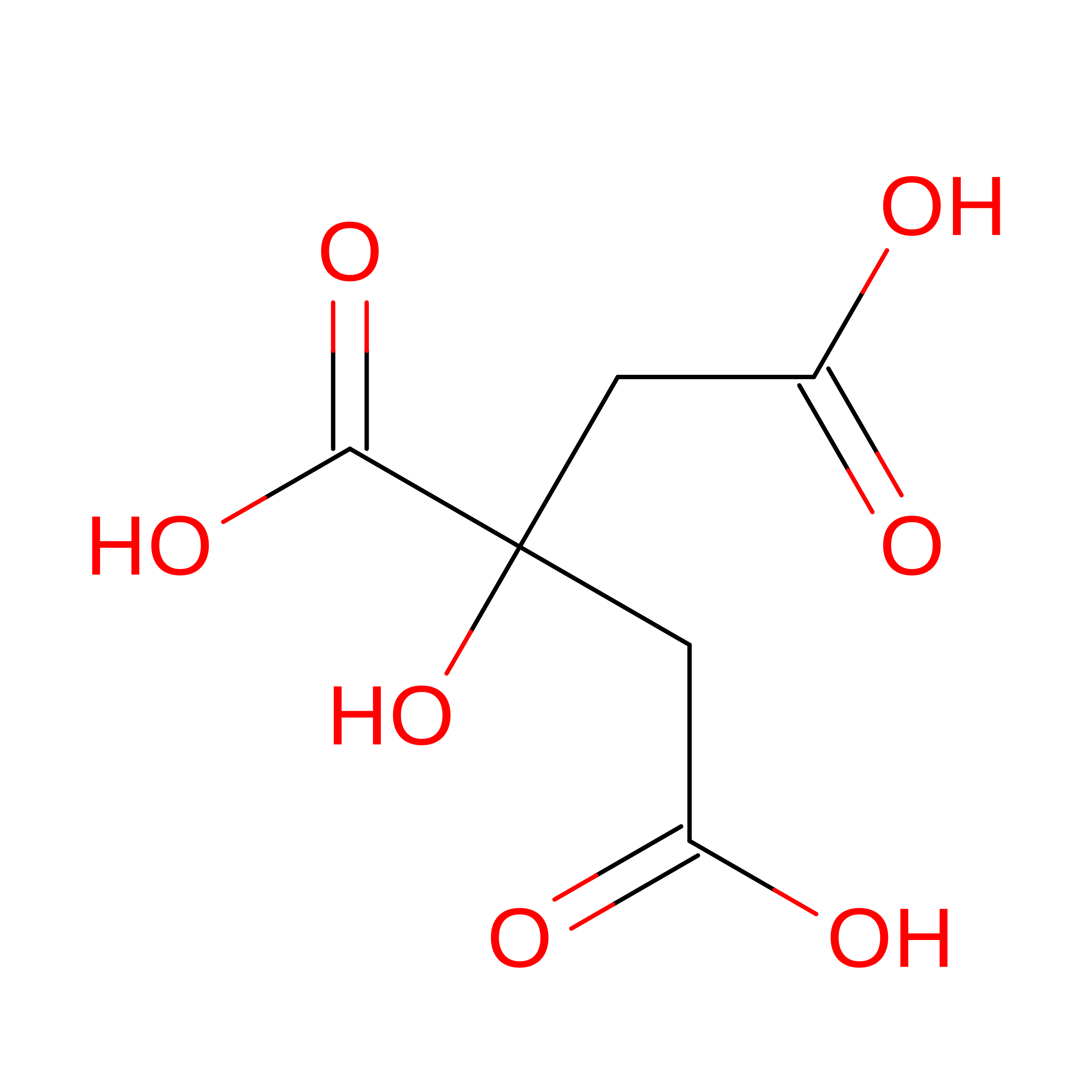
CITRIC ACID
C6 H8 O7
KRKNYBCHXYNGOX-UHFFFAOYSA-N
NA

Query on NA


Download:Ideal Coordinates CCD File
E [auth A]
F [auth A]
H [auth B]
I [auth B]
K [auth C]
E [auth A],
F [auth A],
H [auth B],
I [auth B],
K [auth C],
L [auth C],
N [auth D],
O [auth D]
SODIUM ION
Na
FKNQFGJONOIPTF-UHFFFAOYSA-N

Experimental Data & Validation

Experimental Data

  • Method: X-RAY DIFFRACTION
  • Resolution: 2.78 Å
  • R-Value Free:  0.261 (Depositor), 0.266 (DCC) 
  • R-Value Work:  0.242 (Depositor), 0.256 (DCC) 
  • R-Value Observed: 0.243 (Depositor) 
Space Group: P 1 21 1
Unit Cell:
Length ( Å )Angle ( ˚ )
a = 106.125α = 90
b = 102.112β = 99.52
c = 167.991γ = 90
Software Package:
Software NamePurpose
REFMACrefinement
HKL-2000data reduction
HKL-2000data scaling
SHARPphasing

Structure Validation

View Full Validation Report


Entry History 

Deposition Data

  • Released Date: 2017-05-17 
  • Deposition Author(s): Lu, M.

Revision History  (Full details and data files)

  • Version 1.0: 2017-05-17
    Type: Initial release
  • Version 1.1: 2024-03-06
    Changes: Data collection, Database references, Refinement description