5HHO | pdb_00005hho

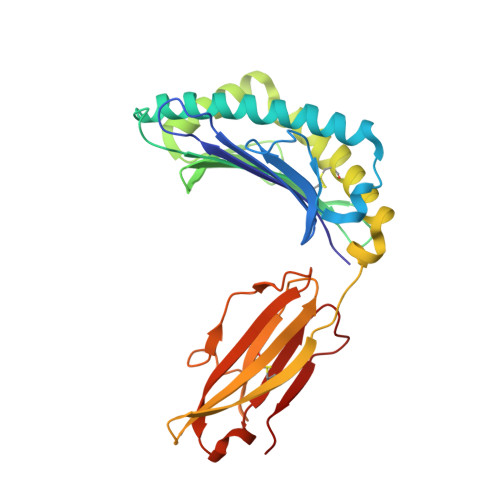
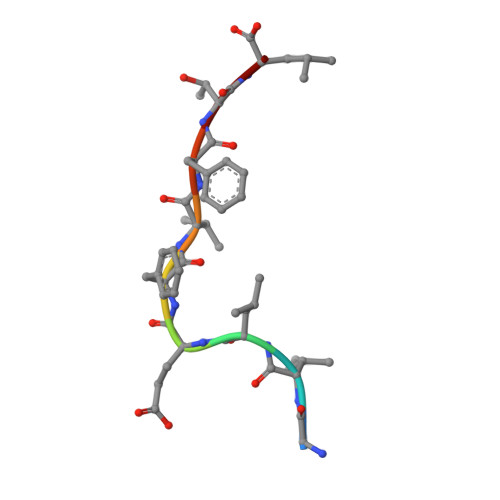
Crystal Structure of the JM22 TCR in complex with HLA-A*0201 in complex with M1-G4E


Experimental Data Snapshot

  • Method: X-RAY DIFFRACTION
  • Resolution: 2.95 Å
  • R-Value Free: 
    0.279 (Depositor), 0.277 (DCC) 
  • R-Value Work: 
    0.236 (Depositor), 0.239 (DCC) 
  • R-Value Observed: 
    0.238 (Depositor) 

Starting Model: experimental
View more details

wwPDB Validation 3D Report Full Report

Validation slider image for 5HHO

This is version 1.5 of the entry. See complete history

Literature

Molecular basis for universal HLA-A*0201-restricted CD8+ T-cell immunity against influenza viruses.

Valkenburg, S.A.Josephs, T.M.Clemens, E.B.Grant, E.J.Nguyen, T.H.Wang, G.C.Price, D.A.Miller, A.Tong, S.Y.Thomas, P.G.Doherty, P.C.Rossjohn, J.Gras, S.Kedzierska, K.

(2016) Proc Natl Acad Sci U S A 113: 4440-4445

  • DOI: https://doi.org/10.1073/pnas.1603106113
  • Primary Citation Related Structures: 
    5HHM, 5HHN, 5HHO, 5HHP, 5HHQ

  • PubMed Abstract: 

    Memory CD8(+)T lymphocytes (CTLs) specific for antigenic peptides derived from internal viral proteins confer broad protection against distinct strains of influenza A virus (IAV). However, immune efficacy can be undermined by the emergence of escape mutants. To determine how T-cell receptor (TCR) composition relates to IAV epitope variability, we used ex vivo peptide-HLA tetramer enrichment and single-cell multiplex analysis to compare TCRs targeted to the largely conserved HLA-A*0201-M158and the hypervariable HLA-B*3501-NP418antigens. The TCRαβs for HLA-B*3501-NP418 (+)CTLs varied among individuals and across IAV strains, indicating that a range of mutated peptides will prime different NP418-specific CTL sets. Conversely, a dominant public TRAV27/TRBV19(+)TCRαβ was selected in HLA-A*0201(+)donors responding to M158 This public TCR cross-recognized naturally occurring M158variants complexed with HLA-A*0201. Ternary structures showed that induced-fit molecular mimicry underpins TRAV27/TRBV19(+)TCR specificity for the WT and mutant M158peptides, suggesting the possibility of universal CTL immunity in HLA-A*0201(+)individuals. Combined with the high population frequency of HLA-A*0201, these data potentially explain the relative conservation of M158 Moreover, our results suggest that vaccination strategies aimed at generating broad protection should incorporate variant peptides to elicit cross-reactive responses against other specificities, especially those that may be relatively infrequent among IAV-primed memory CTLs.


  • Organizational Affiliation
    • Department of Microbiology and Immunology, University of Melbourne, at the Peter Doherty Institute for Infection and Immunity, Melbourne, VIC 3000, Australia;

Macromolecule Content 

  • Total Structure Weight: 94.1 kDa 
  • Atom Count: 6,592 
  • Modeled Residue Count: 820 
  • Deposited Residue Count: 825 
  • Unique protein chains: 5

Macromolecules

Find similar proteins by:|  3D Structure
Entity ID: 1
MoleculeChains  Sequence LengthOrganismDetailsImage
HLA class I histocompatibility antigen, A-2 alpha chain276Homo sapiensMutation(s): 0 
Gene Names: HLA-AHLAA
UniProt & NIH Common Fund Data Resources
Find proteins for P04439 (Homo sapiens)
Explore P04439 
Go to UniProtKB:  P04439
PHAROS:  P04439
GTEx:  ENSG00000206503 
Entity Groups
Sequence Clusters30% Identity50% Identity70% Identity90% Identity95% Identity100% Identity
UniProt GroupP04439
Sequence Annotations
Expand
Reference Sequence
Find similar proteins by:|  3D Structure
Entity ID: 2
MoleculeChains  Sequence LengthOrganismDetailsImage
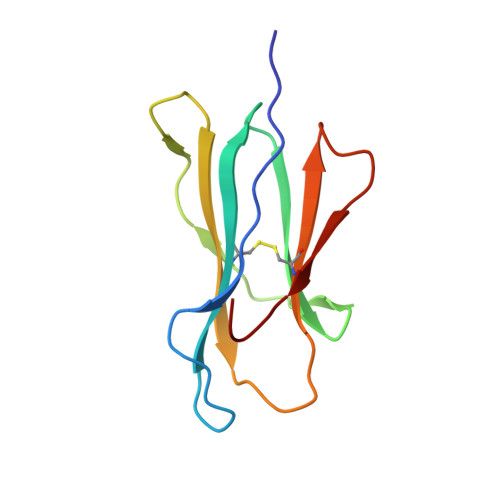
Beta-2-microglobulin100Homo sapiensMutation(s): 0 
Gene Names: B2MCDABP0092HDCMA22P
UniProt & NIH Common Fund Data Resources
Find proteins for P61769 (Homo sapiens)
Explore P61769 
Go to UniProtKB:  P61769
PHAROS:  P61769
GTEx:  ENSG00000166710 
Entity Groups
Sequence Clusters30% Identity50% Identity70% Identity90% Identity95% Identity100% Identity
UniProt GroupP61769
Sequence Annotations
Expand
Reference Sequence
Find similar proteins by:|  3D Structure
Entity ID: 3
MoleculeChains  Sequence LengthOrganismDetailsImage
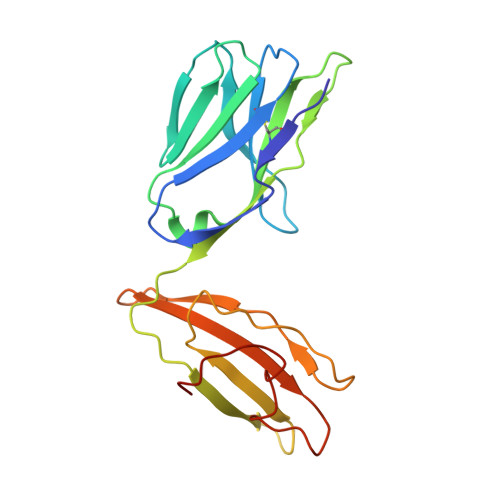
JM22 TCR alpha chainC [auth D]199Homo sapiensMutation(s): 0 
UniProt & NIH Common Fund Data Resources
Find proteins for A0A087WT01 (Homo sapiens)
Explore A0A087WT01 
Go to UniProtKB:  A0A087WT01
PHAROS:  A0A087WT01
GTEx:  ENSG00000211809 
Find proteins for P01848 (Homo sapiens)
Explore P01848 
Go to UniProtKB:  P01848
PHAROS:  P01848
Entity Groups
Sequence Clusters30% Identity50% Identity70% Identity90% Identity95% Identity100% Identity
UniProt GroupsA0A087WT01P01848
Sequence Annotations
Expand
Reference Sequence
Find similar proteins by:|  3D Structure
Entity ID: 4
MoleculeChains  Sequence LengthOrganismDetailsImage
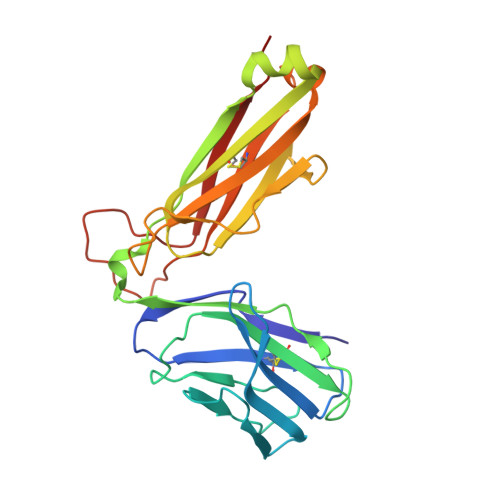
JM22 TCR beta chainD [auth E]241Homo sapiensMutation(s): 0 
UniProt & NIH Common Fund Data Resources
Find proteins for A0A075B6N1 (Homo sapiens)
Explore A0A075B6N1 
Go to UniProtKB:  A0A075B6N1
PHAROS:  A0A075B6N1
GTEx:  ENSG00000211746 
Find proteins for A0A5B9 (Homo sapiens)
Explore A0A5B9 
Go to UniProtKB:  A0A5B9
PHAROS:  A0A5B9
Entity Groups
Sequence Clusters30% Identity50% Identity70% Identity90% Identity95% Identity100% Identity
UniProt GroupsA0A075B6N1A0A5B9
Sequence Annotations
Expand
Reference Sequence
Find similar proteins by:  Sequence   |   3D Structure  
Entity ID: 5
MoleculeChains  Sequence LengthOrganismDetailsImage
M1-G4E, GILEFVFTLE [auth C]9synthetic constructMutation(s): 0 

Experimental Data & Validation

Experimental Data

  • Method: X-RAY DIFFRACTION
  • Resolution: 2.95 Å
  • R-Value Free:  0.279 (Depositor), 0.277 (DCC) 
  • R-Value Work:  0.236 (Depositor), 0.239 (DCC) 
  • R-Value Observed: 0.238 (Depositor) 
Space Group: C 1 2 1
Unit Cell:
Length ( Å )Angle ( ˚ )
a = 233.657α = 90
b = 49.033β = 115.95
c = 113.04γ = 90
Software Package:
Software NamePurpose
SCALAdata scaling
PHASERphasing
PHENIXrefinement
PDB_EXTRACTdata extraction
XDSdata reduction

Structure Validation

View Full Validation Report


Entry History 

Deposition Data

Revision History  (Full details and data files)

  • Version 1.0: 2016-03-23
    Type: Initial release
  • Version 1.1: 2016-03-30
    Changes: Database references
  • Version 1.2: 2016-04-13
    Changes: Database references
  • Version 1.3: 2016-05-04
    Changes: Database references
  • Version 1.4: 2023-09-27
    Changes: Data collection, Database references, Derived calculations, Refinement description
  • Version 1.5: 2024-11-20
    Changes: Structure summary