5FDR | pdb_00005fdr

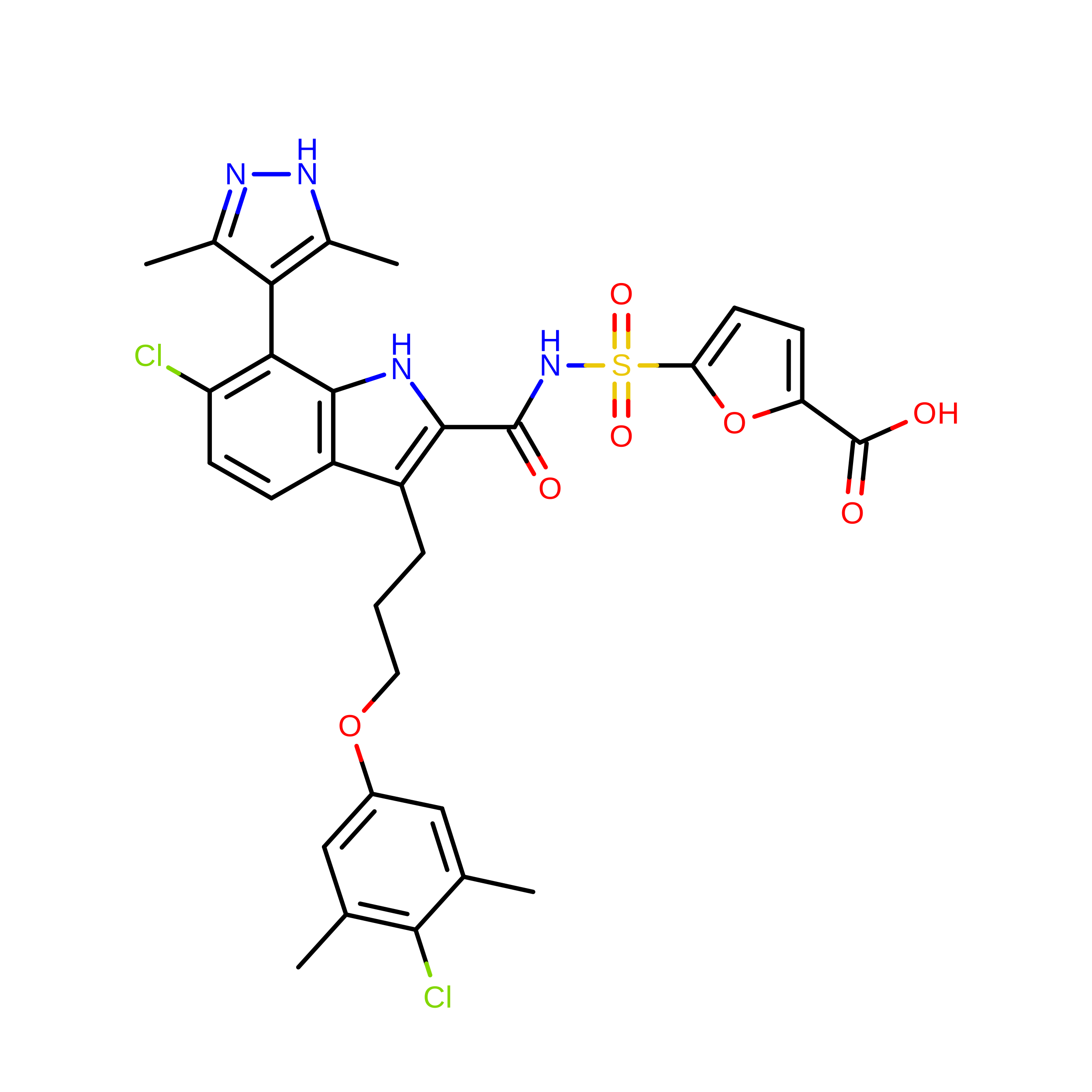
Mcl-1 complexed with small molecule inhibitor


Experimental Data Snapshot

  • Method: X-RAY DIFFRACTION
  • Resolution: 2.60 Å
  • R-Value Free: 
    0.283 (Depositor), 0.281 (DCC) 
  • R-Value Work: 
    0.224 (Depositor), 0.237 (DCC) 
  • R-Value Observed: 
    0.227 (Depositor) 

Starting Model: experimental
View more details

wwPDB Validation 3D Report Full Report

Validation slider image for 5FDR

Ligand Structure Quality Assessment 


This is version 1.4 of the entry. See complete history

Literature

Discovery of 2-Indole-acylsulfonamide Myeloid Cell Leukemia 1 (Mcl-1) Inhibitors Using Fragment-Based Methods.

Pelz, N.F.Bian, Z.Zhao, B.Shaw, S.Tarr, J.C.Belmar, J.Gregg, C.Camper, D.V.Goodwin, C.M.Arnold, A.L.Sensintaffar, J.L.Friberg, A.Rossanese, O.W.Lee, T.Olejniczak, E.T.Fesik, S.W.

(2016) J Med Chem 59: 2054-2066

  • DOI: https://doi.org/10.1021/acs.jmedchem.5b01660
  • Primary Citation Related Structures: 
    5FC4, 5FDO, 5FDR

  • PubMed Abstract: 

    Myeloid cell leukemia-1 (Mcl-1) is a member of the Bcl-2 family of proteins responsible for the regulation of programmed cell death. Amplification of Mcl-1 is a common genetic aberration in human cancer whose overexpression contributes to the evasion of apoptosis and is one of the major resistance mechanisms for many chemotherapies. Mcl-1 mediates its effects primarily through interactions with pro-apoptotic BH3 containing proteins that achieve high affinity for the target by utilizing four hydrophobic pockets in its binding groove. Here we describe the discovery of Mcl-1 inhibitors using fragment-based methods and structure-based design. These novel inhibitors exhibit low nanomolar binding affinities to Mcl-1 and >500-fold selectivity over Bcl-xL. X-ray structures of lead Mcl-1 inhibitors when complexed to Mcl-1 provided detailed information on how these small-molecules bind to the target and were used extensively to guide compound optimization.


  • Organizational Affiliation
    • Department of Biochemistry, Vanderbilt University School of Medicine , 2215 Garland Avenue, 607 Light Hall, Nashville, Tennessee 37232-0146, United States.

Macromolecule Content 

  • Total Structure Weight: 74.5 kDa 
  • Atom Count: 4,937 
  • Modeled Residue Count: 595 
  • Deposited Residue Count: 632 
  • Unique protein chains: 1

Macromolecules

Find similar proteins by:|  3D Structure
Entity ID: 1
MoleculeChains  Sequence LengthOrganismDetailsImage
Induced myeloid leukemia cell differentiation protein Mcl-1
A, B, C, D
158Homo sapiensMutation(s): 0 
Gene Names: MCL1BCL2L3
UniProt & NIH Common Fund Data Resources
Find proteins for Q07820 (Homo sapiens)
Explore Q07820 
Go to UniProtKB:  Q07820
PHAROS:  Q07820
GTEx:  ENSG00000143384 
Entity Groups
Sequence Clusters30% Identity50% Identity70% Identity90% Identity95% Identity100% Identity
UniProt GroupQ07820
Sequence Annotations
Expand
Reference Sequence

Experimental Data & Validation

Experimental Data

  • Method: X-RAY DIFFRACTION
  • Resolution: 2.60 Å
  • R-Value Free:  0.283 (Depositor), 0.281 (DCC) 
  • R-Value Work:  0.224 (Depositor), 0.237 (DCC) 
  • R-Value Observed: 0.227 (Depositor) 
Space Group: P 1 21 1
Unit Cell:
Length ( Å )Angle ( ˚ )
a = 35.04α = 90
b = 115.005β = 91.17
c = 95.327γ = 90
Software Package:
Software NamePurpose
PHENIXrefinement
HKL-2000data reduction
HKL-2000data scaling
PHASERphasing

Structure Validation

View Full Validation Report


Ligand Structure Quality Assessment 


Entry History 

& Funding Information

Deposition Data

  • Released Date: 2016-03-02 
  • Deposition Author(s): Zhao, B.

Funding OrganizationLocationGrant Number
National Institutes of Health/National Cancer Institute (NIH/NCI)United States--

Revision History  (Full details and data files)

  • Version 1.0: 2016-03-02
    Type: Initial release
  • Version 1.1: 2016-03-23
    Changes: Database references
  • Version 1.2: 2017-09-20
    Changes: Author supporting evidence, Database references, Derived calculations
  • Version 1.3: 2019-12-04
    Changes: Author supporting evidence
  • Version 1.4: 2023-09-27
    Changes: Data collection, Database references, Refinement description