Download Mendeley
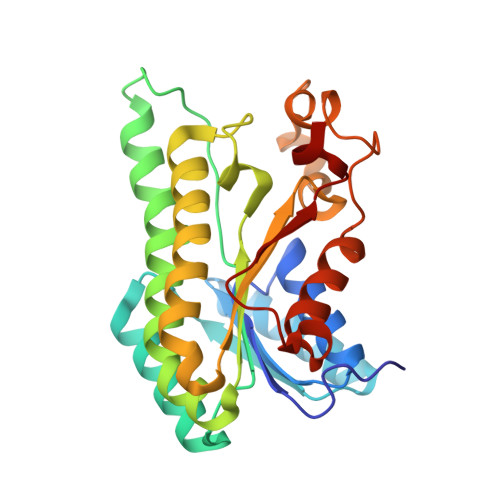
Crystal structure of a short-chain dehydrogenase from Brucella ovis with apo and coenzyme NAD + -bound protomer chains.
Zupko, S.P., Konstanty, A.T., Mayclin, S.J., Choi, R., Serbzhinskiy, D., Robles, E., Moses, V., Barrett, L.K., Van Voorhis, W.C., Edwards, T.E., Myler, P.J., Torelli, A.T., French, J.B., Hicks, K.A.(2025) Acta Crystallogr F Struct Biol Commun
- PubMed: 41216818 Search on PubMed
- DOI: https://doi.org/10.1107/S2053230X25009227
- Primary Citation Related Structures:
5ER6, 5HA5 - PubMed Abstract:
Short-chain dehydrogenases (SDRs) are a family of NAD(P)-dependent enzymes involved in redox reactions, specifically carbonyl-alcohol reductions. Here, we report the apo and NAD + -bound structures of an SDR from the pathogenic organism Brucella ovis. B. ovis primarily affects sheep and other livestock, resulting in reduced fertility. Based on sequence and structural alignment, the B. ovis SDR (BoSDR) is a classical SDR. Classical SDRs have a canonical YxxxK active-site sequence in which the catalytic general base is a tyrosine residue located at position 163. In addition, the putative active site also contains a serine residue (Ser150) and lysine residue (Lys167) that are hypothesized to be involved in catalysis. BoSDR is a biological and crystallographic tetramer. In the coenzyme-bound structure, two different orientations of the NAD + coenzyme are fortuitously observed, which provides insights into the conformational changes that accompany coenzyme binding. The apo and NAD + -bound structures provide valuable information about the unique structural features of enzymes in the SDR superfamily.
- Department of Chemistry, State University of New York at Cortland, Cortland, NY 13045, USA.
Organizational Affiliation: