5EH6 | pdb_00005eh6

Crystal Structure of the Glycophorin A Transmembrane Monomer in Lipidic Cubic Phase


Experimental Data Snapshot

  • Method: X-RAY DIFFRACTION
  • Resolution: 1.92 Å
  • R-Value Free: 
    0.238 (Depositor), 0.239 (DCC) 
  • R-Value Work: 
    0.224 (Depositor), 0.228 (DCC) 
  • R-Value Observed: 
    0.225 (Depositor) 

Starting Model: experimental
View more details

wwPDB Validation 3D Report Full Report

Validation slider image for 5EH6

This is version 1.5 of the entry. See complete history

Literature

Crystal Structure of the Glycophorin A Transmembrane Dimer in Lipidic Cubic Phase.

Trenker, R.Call, M.E.Call, M.J.

(2015) J Am Chem Soc 137: 15676-15679

  • DOI: https://doi.org/10.1021/jacs.5b11354
  • Primary Citation Related Structures: 
    5EH4, 5EH6

  • PubMed Abstract: 

    The mechanisms of assembly and function for many important type I/II (single-pass) transmembrane (TM) receptors are proposed to involve the formation and/or alteration of specific interfaces among their membrane-embedded α-helical TM domains. The application of lipidic cubic phase (LCP) bilayer media for crystallization of single-α-helical TM complexes has the potential to provide valuable structural and mechanistic insights into many such systems. However, the fidelity of the interfaces observed in crowded crystalline arrays has been difficult to establish from the very limited number of such structures determined using X-ray diffraction data. Here we examine this issue using the glycophorin A (GpA) model system, whose homodimeric TM helix interface has been characterized by solution and solid-state NMR and biochemical techniques but never crystallographically. We report that a GpA-TM peptide readily crystallized in a monoolein cubic phase bilayer, yielding a dimeric α-helical structure that is in excellent agreement with previously reported NMR measurements made in several different types of host media. These results provide compelling support for the wider application of LCP techniques to enable X-ray crystallographic analysis of single-pass TM interactions.


  • Organizational Affiliation
    • Structural Biology Division, The Walter and Eliza Hall Institute of Medical Research , Parkville, Victoria 3052, Australia.

Macromolecule Content 

  • Total Structure Weight: 3.29 kDa 
  • Atom Count: 197 
  • Modeled Residue Count: 28 
  • Deposited Residue Count: 30 
  • Unique protein chains: 1

Macromolecules

Find similar proteins by:|  3D Structure
Entity ID: 1
MoleculeChains  Sequence LengthOrganismDetailsImage
Glycophorin-A30Homo sapiensMutation(s): 1 
Gene Names: GYPAGPA
Membrane Entity: Yes 
UniProt & NIH Common Fund Data Resources
Find proteins for P02724 (Homo sapiens)
Explore P02724 
Go to UniProtKB:  P02724
PHAROS:  P02724
GTEx:  ENSG00000170180 
Entity Groups
Sequence Clusters30% Identity50% Identity70% Identity90% Identity95% Identity100% Identity
UniProt GroupP02724
Sequence Annotations
Expand
Reference Sequence

Small Molecules

Modified Residues  1 Unique
IDChains TypeFormula2D DiagramParent
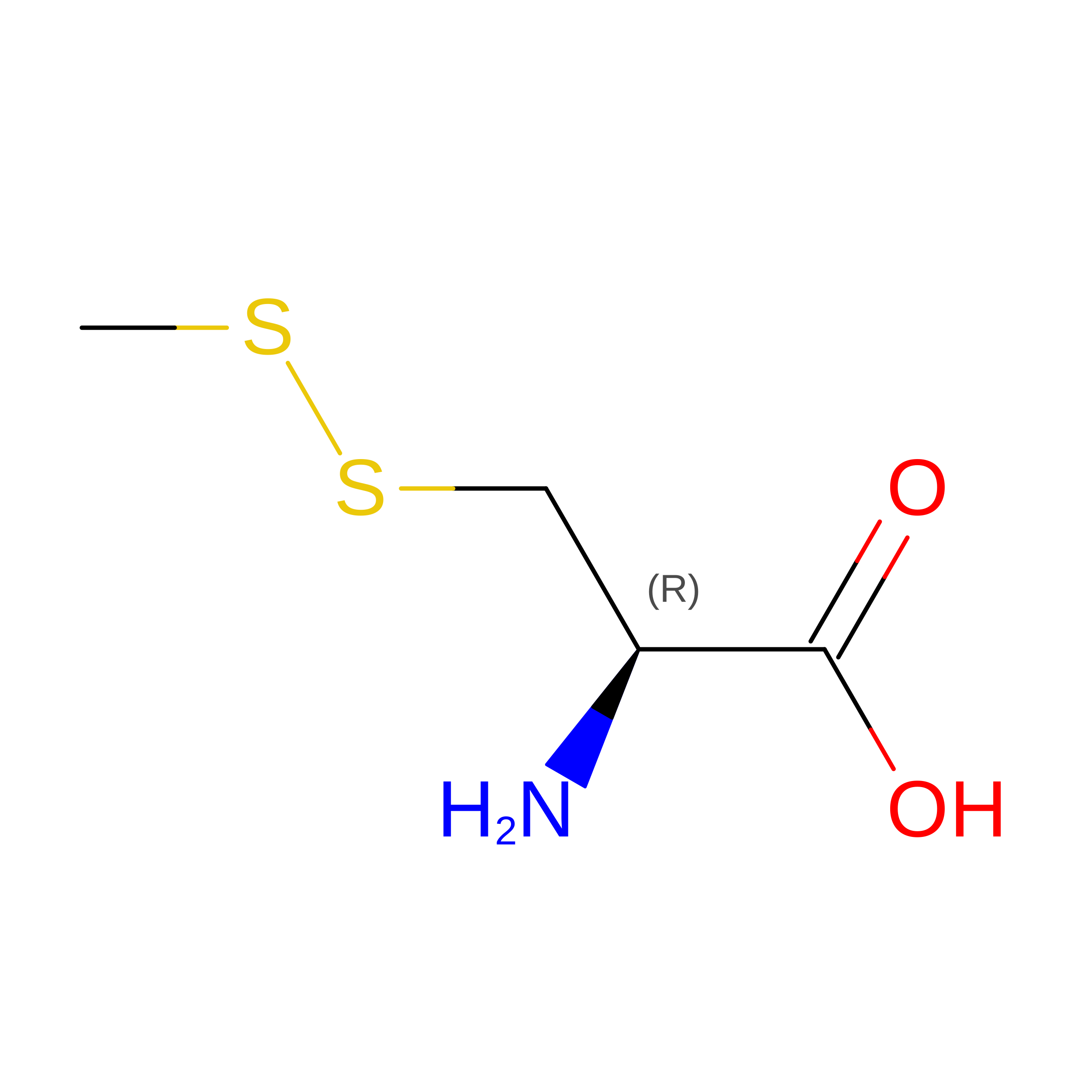
SCH
Query on SCH
A
L-PEPTIDE LINKINGC4 H9 N O2 S2CYS

Experimental Data & Validation

Experimental Data

  • Method: X-RAY DIFFRACTION
  • Resolution: 1.92 Å
  • R-Value Free:  0.238 (Depositor), 0.239 (DCC) 
  • R-Value Work:  0.224 (Depositor), 0.228 (DCC) 
  • R-Value Observed: 0.225 (Depositor) 
Space Group: H 3 2
Unit Cell:
Length ( Å )Angle ( ˚ )
a = 31.312α = 90
b = 31.312β = 90
c = 136.287γ = 120
Software Package:
Software NamePurpose
PHENIXrefinement
HKL-2000data reduction
HKL-2000data scaling
PHENIXphasing

Structure Validation

View Full Validation Report


Entry History 

& Funding Information

Deposition Data


Funding OrganizationLocationGrant Number
National Health and Medical Research Council (NHMRC, Australia)AustraliaGNT1030902
Australian Research Council (ARC)AustraliaFT120100145
Australian Research Council (ARC)AustraliaDP11010436

Revision History  (Full details and data files)

  • Version 1.0: 2015-12-23
    Type: Initial release
  • Version 1.1: 2016-01-06
    Changes: Database references
  • Version 1.2: 2017-09-20
    Changes: Author supporting evidence, Data collection, Derived calculations
  • Version 1.3: 2018-01-17
    Changes: Author supporting evidence
  • Version 1.4: 2020-01-01
    Changes: Author supporting evidence
  • Version 1.5: 2023-09-27
    Changes: Data collection, Database references, Refinement description