4TW0 | pdb_00004tw0

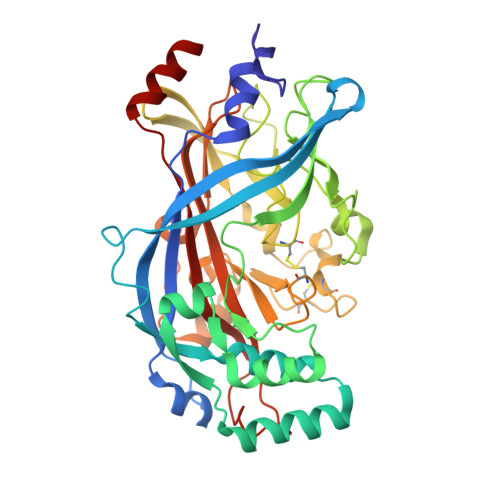
Crystal Structure of SCARB2 in Acidic Condition (pH4.8)


Experimental Data Snapshot

  • Method: X-RAY DIFFRACTION
  • Resolution: 3.65 Å
  • R-Value Free: 
    0.303 (Depositor), 0.302 (DCC) 
  • R-Value Work: 
    0.249 (Depositor), 0.253 (DCC) 
  • R-Value Observed: 
    0.252 (Depositor) 

Starting Model: experimental
View more details

wwPDB Validation 3D Report Full Report

Validation slider image for 4TW0

Ligand Structure Quality Assessment 


This is version 3.1 of the entry. See complete history

Literature

Molecular mechanism of SCARB2-mediated attachment and uncoating of EV71

Dang, M.Wang, X.Wang, Q.Wang, Y.Lin, J.Sun, Y.Li, X.Zhang, L.Lou, Z.Wang, J.Rao, Z.

(2014) Protein Cell 5: 692-703

  • DOI: https://doi.org/10.1007/s13238-014-0087-3
  • Primary Citation Related Structures: 
    4TVZ, 4TW0, 4TW2

  • PubMed Abstract: 

    Unlike the well-established picture for the entry of enveloped viruses, the mechanism of cellular entry of non-enveloped eukaryotic viruses remains largely mysterious. Picornaviruses are representative models for such viruses, and initiate this entry process by their functional receptors. Here we present the structural and functional studies of SCARB2, a functional receptor of the important human enterovirus 71 (EV71). SCARB2 is responsible for attachment as well as uncoating of EV71. Differences in the structures of SCARB2 under neutral and acidic conditions reveal that SCARB2 undergoes a pivotal pH-dependent conformational change which opens a lipid-transfer tunnel to mediate the expulsion of a hydrophobic pocket factor from the virion, a pre-requisite for uncoating. We have also identified the key residues essential for attachment to SCARB2, identifying the canyon region of EV71 as mediating the receptor interaction. Together these results provide a clear understanding of cellular attachment and initiation of uncoating for enteroviruses.


  • Organizational Affiliation
    • National Laboratory of Macromolecules, Institute of Biophysics, Chinese Academy of Science, Beijing, 100101, China.

Macromolecule Content 

  • Total Structure Weight: 194.73 kDa 
  • Atom Count: 13,135 
  • Modeled Residue Count: 1,571 
  • Deposited Residue Count: 1,572 
  • Unique protein chains: 1

Macromolecules

Find similar proteins by:|  3D Structure
Entity ID: 1
MoleculeChains  Sequence LengthOrganismDetailsImage
Scavenger receptor class B member 2
A, B, C, D
393Homo sapiensMutation(s): 0 
Gene Names: SCARB2CD36L2LIMP2LIMPII
UniProt & NIH Common Fund Data Resources
Find proteins for Q14108 (Homo sapiens)
Explore Q14108 
Go to UniProtKB:  Q14108
PHAROS:  Q14108
GTEx:  ENSG00000138760 
Entity Groups
Sequence Clusters30% Identity50% Identity70% Identity90% Identity95% Identity100% Identity
UniProt GroupQ14108
Glycosylation
Glycosylation Sites: 7Go to GlyGen: Q14108-1
Sequence Annotations
Expand
Reference Sequence

Oligosaccharides

Help  
Entity ID: 2
MoleculeChains Length2D Diagram GlycosylationD Interactions
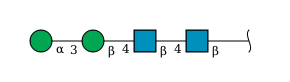
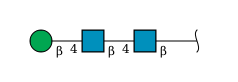
alpha-D-mannopyranose-(1-3)-beta-D-mannopyranose-(1-4)-2-acetamido-2-deoxy-beta-D-glucopyranose-(1-4)-2-acetamido-2-deoxy-beta-D-glucopyranose
E, J, O, T
4N-Glycosylation
Glycosylation Resources
GlyTouCan: G81315DD
GlyCosmos: G81315DD
GlyGen: G81315DD
Entity ID: 3
MoleculeChains Length2D Diagram GlycosylationD Interactions
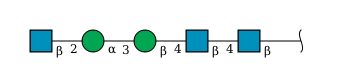
2-acetamido-2-deoxy-beta-D-glucopyranose-(1-2)-alpha-D-mannopyranose-(1-3)-beta-D-mannopyranose-(1-4)-2-acetamido-2-deoxy-beta-D-glucopyranose-(1-4)-2-acetamido-2-deoxy-beta-D-glucopyranose
F, K, P, U
5N-Glycosylation
Glycosylation Resources
GlyTouCan: G10133VD
GlyCosmos: G10133VD
GlyGen: G10133VD
Entity ID: 4
MoleculeChains Length2D Diagram GlycosylationD Interactions
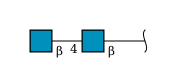
2-acetamido-2-deoxy-beta-D-glucopyranose-(1-4)-2-acetamido-2-deoxy-beta-D-glucopyranose
G, H, L, M, Q
G, H, L, M, Q, R, V, W
2N-Glycosylation
Glycosylation Resources
GlyTouCan: G42666HT
GlyCosmos: G42666HT
GlyGen: G42666HT
Entity ID: 5
MoleculeChains Length2D Diagram GlycosylationD Interactions
beta-D-mannopyranose-(1-4)-2-acetamido-2-deoxy-beta-D-glucopyranose-(1-4)-2-acetamido-2-deoxy-beta-D-glucopyranose
I, N, S, X
3N-Glycosylation
Glycosylation Resources
GlyTouCan: G15407YE
GlyCosmos: G15407YE
GlyGen: G15407YE

Small Molecules

Ligands 1 Unique
IDChains Name / Formula / InChI Key2D Diagram3D Interactions
NAG

Query on NAG


Download:Ideal Coordinates CCD File
AA [auth B]
BA [auth B]
CA [auth C]
DA [auth C]
EA [auth D]
AA [auth B],
BA [auth B],
CA [auth C],
DA [auth C],
EA [auth D],
FA [auth D],
Y [auth A],
Z [auth A]
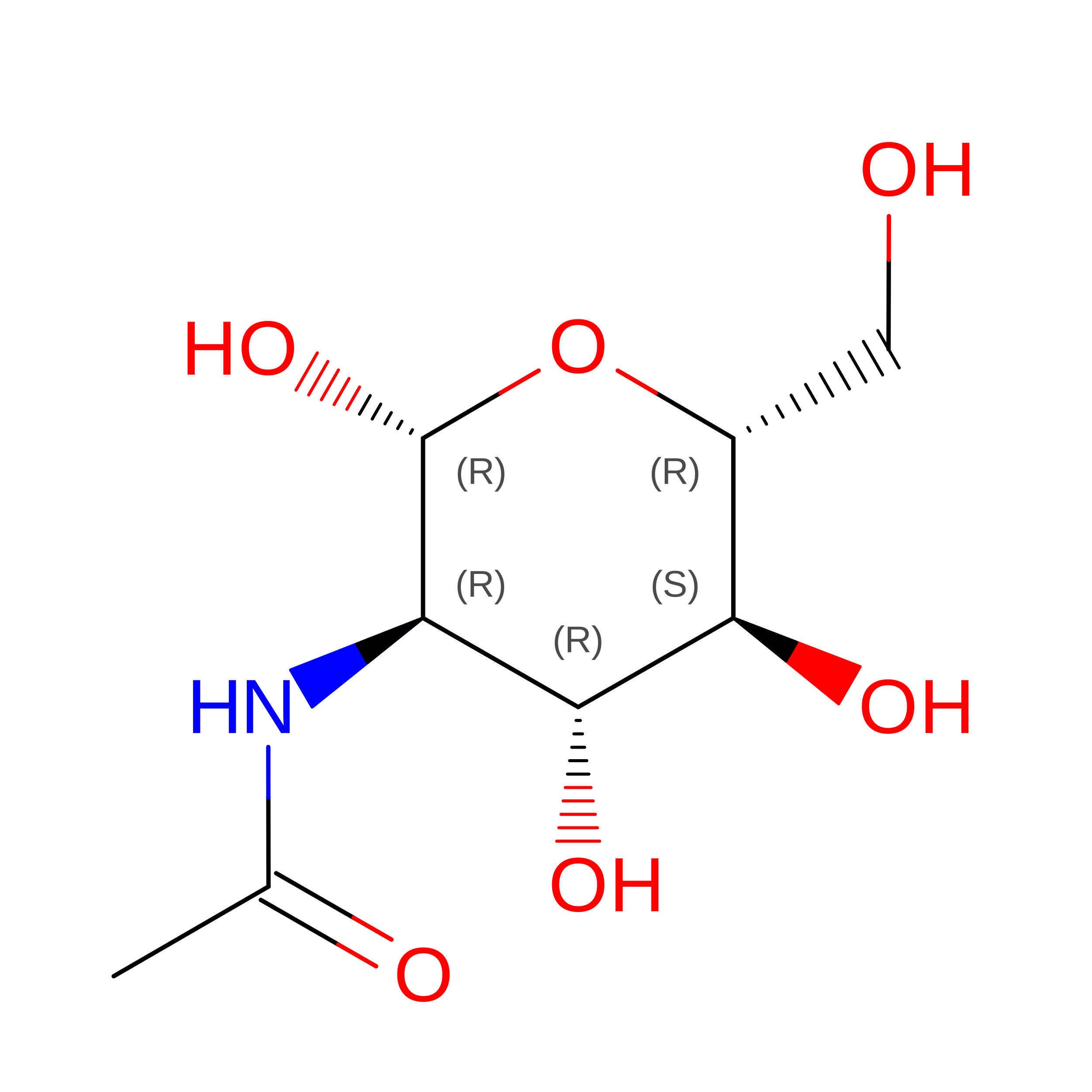
2-acetamido-2-deoxy-beta-D-glucopyranose
C8 H15 N O6
OVRNDRQMDRJTHS-FMDGEEDCSA-N

Experimental Data & Validation

Experimental Data

  • Method: X-RAY DIFFRACTION
  • Resolution: 3.65 Å
  • R-Value Free:  0.303 (Depositor), 0.302 (DCC) 
  • R-Value Work:  0.249 (Depositor), 0.253 (DCC) 
  • R-Value Observed: 0.252 (Depositor) 
Space Group: P 1 21 1
Unit Cell:
Length ( Å )Angle ( ˚ )
a = 103.99α = 90
b = 99.636β = 90.02
c = 125.853γ = 90
Software Package:
Software NamePurpose
PHENIXrefinement
SCALEPACKdata reduction
PHASERphasing
PDB_EXTRACTdata extraction
SCALEPACKdata scaling

Structure Validation

View Full Validation Report


Ligand Structure Quality Assessment 


Entry History 

& Funding Information

Deposition Data


Funding OrganizationLocationGrant Number
Institute of Biophysics, Chinese Academy of ScienceChina2014CB542800

Revision History  (Full details and data files)

  • Version 1.0: 2015-07-08
    Type: Initial release
  • Version 1.1: 2015-07-15
    Changes: Derived calculations
  • Version 1.2: 2020-01-29
    Changes: Data collection, Derived calculations, Refinement description, Source and taxonomy
  • Version 2.0: 2020-07-29
    Type: Remediation
    Reason: Carbohydrate remediation
    Changes: Advisory, Atomic model, Data collection, Derived calculations, Structure summary
  • Version 3.0: 2023-11-08
    Changes: Atomic model, Data collection, Database references, Derived calculations, Refinement description, Structure summary
  • Version 3.1: 2024-11-20
    Changes: Structure summary