4P6J | pdb_00004p6j

Crystal Structure of the Computationally Designed Transmembrane Metallotransporter with 4-bromophenylalanine in Octyl Glucoside

  • Classification: DE NOVO PROTEIN
  • Organism(s): synthetic construct
  • Mutation(s): No 

  • Deposited: 2014-03-25 Released: 2014-12-24 
  • Deposition Author(s): Joh, N.H., Acharya, R., DeGrado, W.F.
  • Funding Organization(s): National Institutes of Health/National Institute Of Allergy and Infectious Diseases (NIH/NIAID), National Institutes of Health/National Institute of General Medical Sciences (NIH/NIGMS)

Experimental Data Snapshot

  • Method: X-RAY DIFFRACTION
  • Resolution: 2.80 Å
  • R-Value Free: 
    0.272 (Depositor), 0.274 (DCC) 
  • R-Value Work: 
    0.248 (Depositor), 0.252 (DCC) 
  • R-Value Observed: 
    0.249 (Depositor) 

wwPDB Validation 3D Report Full Report

Validation slider image for 4P6J

This is version 1.6 of the entry. See complete history

Literature

De novo design of a transmembrane Zn2+-transporting four-helix bundle.

Joh, N.H.Wang, T.Bhate, M.P.Acharya, R.Wu, Y.Grabe, M.Hong, M.Grigoryan, G.DeGrado, W.F.

(2014) Science 346: 1520-1524

  • DOI: https://doi.org/10.1126/science.1261172
  • Primary Citation Related Structures: 
    2MUZ, 4P6J, 4P6K, 4P6L

  • PubMed Abstract: 

    The design of functional membrane proteins from first principles represents a grand challenge in chemistry and structural biology. Here, we report the design of a membrane-spanning, four-helical bundle that transports first-row transition metal ions Zn(2+) and Co(2+), but not Ca(2+), across membranes. The conduction path was designed to contain two di-metal binding sites that bind with negative cooperativity. X-ray crystallography and solid-state and solution nuclear magnetic resonance indicate that the overall helical bundle is formed from two tightly interacting pairs of helices, which form individual domains that interact weakly along a more dynamic interface. Vesicle flux experiments show that as Zn(2+) ions diffuse down their concentration gradients, protons are antiported. These experiments illustrate the feasibility of designing membrane proteins with predefined structural and dynamic properties.


  • Organizational Affiliation
    • Department of Pharmaceutical Chemistry, Cardiovascular Research Institute, University of California, San Francisco, San Francisco, CA 94158, USA.

Macromolecule Content 

  • Total Structure Weight: 6.13 kDa 
  • Atom Count: 427 
  • Modeled Residue Count: 52 
  • Deposited Residue Count: 52 
  • Unique protein chains: 1

Macromolecules

Find similar proteins by:|  3D Structure
Entity ID: 1
MoleculeChains  Sequence LengthOrganismDetailsImage
Computationally Designed Transporter of Zn(II) and Proton
A, B
26synthetic constructMutation(s): 0 

Small Molecules

Ligands 1 Unique
IDChains Name / Formula / InChI Key2D Diagram3D Interactions
SO4

Query on SO4


Download:Ideal Coordinates CCD File
C [auth B]SULFATE ION
O4 S
QAOWNCQODCNURD-UHFFFAOYSA-L
Modified Residues  1 Unique
IDChains TypeFormula2D DiagramParent
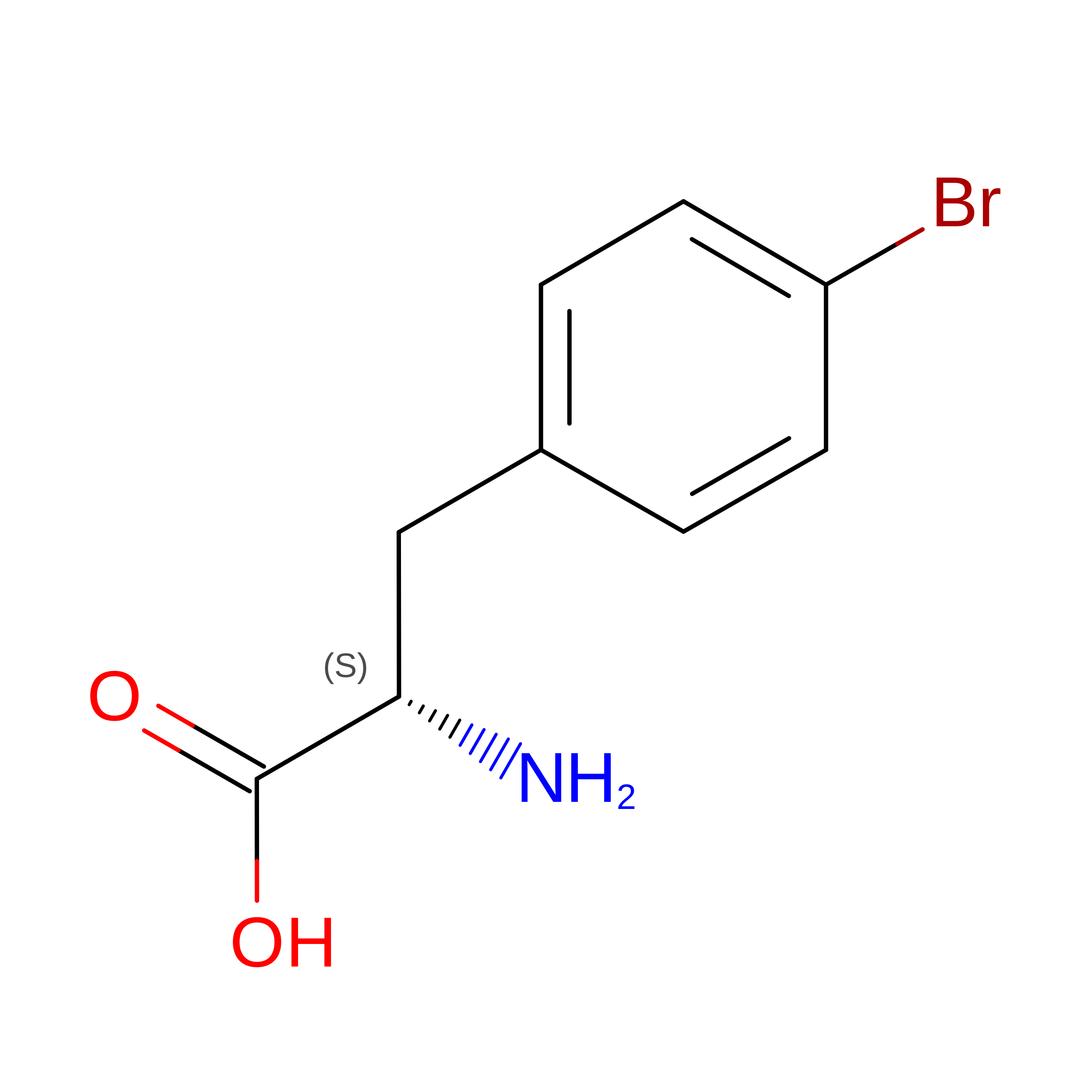
4BF
Query on 4BF
A, B
L-PEPTIDE LINKINGC9 H10 Br N O2TYR

Experimental Data & Validation

Experimental Data

  • Method: X-RAY DIFFRACTION
  • Resolution: 2.80 Å
  • R-Value Free:  0.272 (Depositor), 0.274 (DCC) 
  • R-Value Work:  0.248 (Depositor), 0.252 (DCC) 
  • R-Value Observed: 0.249 (Depositor) 
Space Group: P 43 21 2
Unit Cell:
Length ( Å )Angle ( ˚ )
a = 41.45α = 90
b = 41.45β = 90
c = 63.99γ = 90
Software Package:
Software NamePurpose
PHENIXrefinement

Structure Validation

View Full Validation Report


Entry History 

& Funding Information

Deposition Data


Funding OrganizationLocationGrant Number
National Institutes of Health/National Institute Of Allergy and Infectious Diseases (NIH/NIAID)United States7U01AI074571
National Institutes of Health/National Institute of General Medical Sciences (NIH/NIGMS)United States3F32GM096727

Revision History  (Full details and data files)

  • Version 1.0: 2014-12-24
    Type: Initial release
  • Version 1.1: 2014-12-31
    Changes: Database references
  • Version 1.2: 2015-01-14
    Changes: Database references
  • Version 1.3: 2017-09-20
    Changes: Author supporting evidence, Database references, Derived calculations, Source and taxonomy
  • Version 1.4: 2017-11-01
    Changes: Author supporting evidence
  • Version 1.5: 2019-12-11
    Changes: Author supporting evidence
  • Version 1.6: 2023-12-27
    Changes: Data collection, Database references