4ZBL | pdb_00004zbl

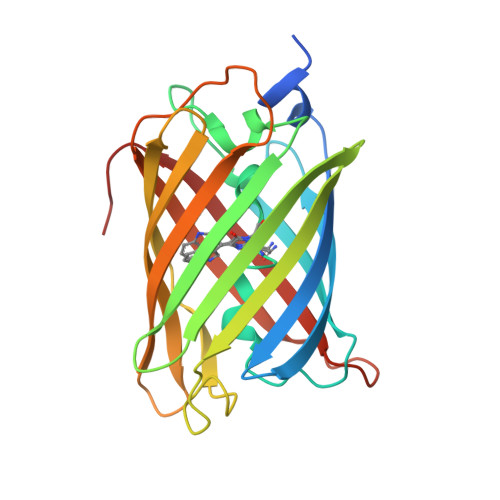
Phototoxic fluorescent protein mKillerOrange


Experimental Data Snapshot

  • Method: X-RAY DIFFRACTION
  • Resolution: 1.57 Å
  • R-Value Free: 
    0.175 (Depositor), 0.181 (DCC) 
  • R-Value Work: 
    0.144 (Depositor), 0.156 (DCC) 
  • R-Value Observed: 
    0.146 (Depositor) 

Starting Model: experimental
View more details

wwPDB Validation 3D Report Full Report

Validation slider image for 4ZBL

This is version 5.0 of the entry. See complete history

Literature

Crystal Structure of Phototoxic Orange Fluorescent Proteins with a Tryptophan-Based Chromophore.

Pletneva, N.V.Pletnev, V.Z.Sarkisyan, K.S.Gorbachev, D.A.Egorov, E.S.Mishin, A.S.Lukyanov, K.A.Dauter, Z.Pletnev, S.

(2015) PLoS One 10: e0145740-e0145740

  • DOI: https://doi.org/10.1371/journal.pone.0145740
  • Primary Citation Related Structures: 
    4ZBL, 4ZFS

  • PubMed Abstract: 

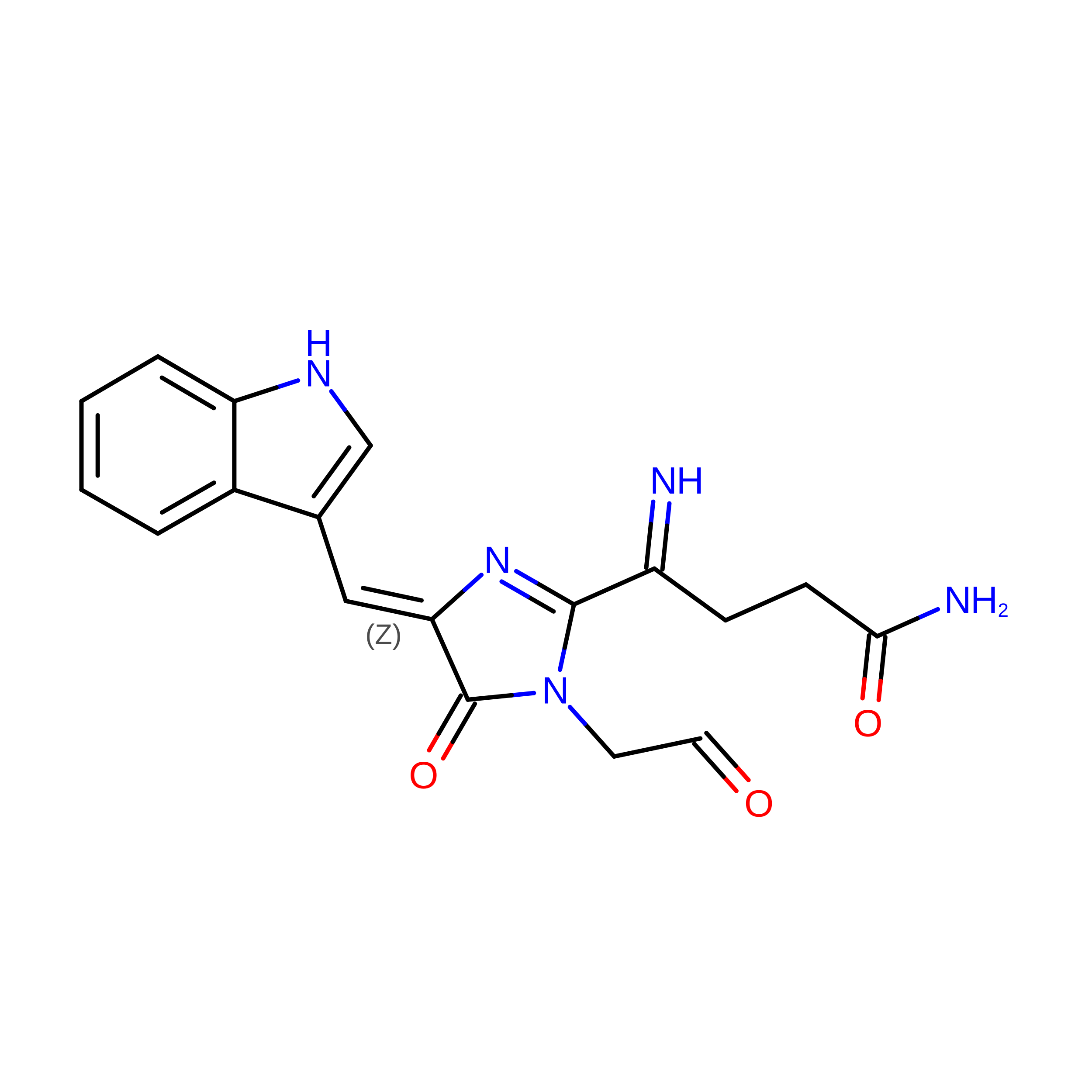
    Phototoxic fluorescent proteins represent a sparse group of genetically encoded photosensitizers that could be used for precise light-induced inactivation of target proteins, DNA damage, and cell killing. Only two such GFP-based fluorescent proteins (FPs), KillerRed and its monomeric variant SuperNova, were described up to date. Here, we present a crystallographic study of their two orange successors, dimeric KillerOrange and monomeric mKillerOrange, at 1.81 and 1.57 Å resolution, respectively. They are the first orange-emitting protein photosensitizers with a tryptophan-based chromophore (Gln65-Trp66-Gly67). Same as their red progenitors, both orange photosensitizers have a water-filled channel connecting the chromophore to the β-barrel exterior and enabling transport of ROS. In both proteins, Trp66 of the chromophore adopts an unusual trans-cis conformation stabilized by H-bond with the nearby Gln159. This trans-cis conformation along with the water channel was shown to be a key structural feature providing bright orange emission and phototoxicity of both examined orange photosensitizers.


  • Organizational Affiliation
    • Shemyakin-Ovchinnikov Institute of Bioorganic Chemistry, Russian Academy of Sciences, Moscow, Russian Federation.

Macromolecule Content 

  • Total Structure Weight: 27.46 kDa 
  • Atom Count: 2,091 
  • Modeled Residue Count: 226 
  • Deposited Residue Count: 240 
  • Unique protein chains: 1

Macromolecules

Find similar proteins by:|  3D Structure
Entity ID: 1
MoleculeChains  Sequence LengthOrganismDetailsImage
KillerOrange240HydrozoaMutation(s): 1 
UniProt
Find proteins for Q2TCH5 (Anthomedusae sp. DC-2005)
Explore Q2TCH5 
Go to UniProtKB:  Q2TCH5
Entity Groups
Sequence Clusters30% Identity50% Identity70% Identity90% Identity95% Identity100% Identity
UniProt GroupQ2TCH5
Sequence Annotations
Expand
Reference Sequence

Experimental Data & Validation

Experimental Data

  • Method: X-RAY DIFFRACTION
  • Resolution: 1.57 Å
  • R-Value Free:  0.175 (Depositor), 0.181 (DCC) 
  • R-Value Work:  0.144 (Depositor), 0.156 (DCC) 
  • R-Value Observed: 0.146 (Depositor) 
Space Group: P 31
Unit Cell:
Length ( Å )Angle ( ˚ )
a = 64.16α = 90
b = 64.16β = 90
c = 47.35γ = 120
Software Package:
Software NamePurpose
SCALEPACKdata scaling
REFMACrefinement
PDB_EXTRACTdata extraction
HKL-2000data scaling
MOLREPphasing
HKL-2000data scaling

Structure Validation

View Full Validation Report


Entry History 

& Funding Information

Deposition Data


Funding OrganizationLocationGrant Number
Russian Science FoundationRussian Federation14-14-00281

Revision History  (Full details and data files)

  • Version 1.0: 2015-12-23
    Type: Initial release
  • Version 1.1: 2016-01-13
    Changes: Database references
  • Version 1.2: 2017-11-29
    Changes: Database references
  • Version 1.3: 2018-08-29
    Changes: Data collection, Database references
  • Version 2.0: 2023-11-15
    Changes: Atomic model, Data collection, Database references, Derived calculations
  • Version 2.1: 2024-01-10
    Changes: Refinement description
  • Version 3.0: 2024-05-15
    Changes: Database references, Derived calculations, Polymer sequence, Structure summary
  • Version 4.0: 2024-07-10
    Changes: Data collection, Non-polymer description, Structure summary
  • Version 4.1: 2024-11-06
    Changes: Structure summary
  • Version 5.0: 2026-03-18
    Changes: Polymer sequence