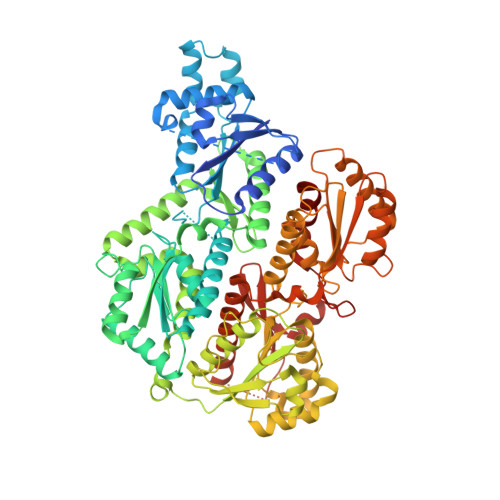
4WL0 | pdb_00004wl0

Ligand-free structure of human platelet phosphofructokinase in an R-state, crystal form I


Experimental Data Snapshot

  • Method: X-RAY DIFFRACTION
  • Resolution: 2.89 Å
  • R-Value Free: 
    0.236 (Depositor), 0.236 (DCC) 
  • R-Value Work: 
    0.211 (Depositor), 0.210 (DCC) 
  • R-Value Observed: 
    0.212 (Depositor) 

Starting Model: experimental
View more details

wwPDB Validation 3D Report Full Report

Validation slider image for 4WL0

This is version 1.3 of the entry. See complete history

Literature

Crystal structure of human platelet phosphofructokinase-1 locked in an activated conformation.

Kloos, M.Bruser, A.Kirchberger, J.Schoneberg, T.Strater, N.

(2015) Biochem J 469: 421-432

  • DOI: https://doi.org/10.1042/BJ20150251
  • Primary Citation Related Structures: 
    4RH3, 4U1R, 4WL0, 4XZ2

  • PubMed Abstract: 

    Phosphofructokinase-1 (Pfk) acts as the main control point of flux through glycolysis. It is involved in complex allosteric regulation and Pfk mutations have been linked to cancer development. Whereas the 3D structure and structural basis of allosteric regulation of prokaryotic Pfk has been studied in great detail, our knowledge about the molecular basis of the allosteric behaviour of the more complex mammalian Pfk is still very limited. To characterize the structural basis of allosteric regulation, the subunit interfaces and the functional consequences of modifications in Tarui's disease and cancer, we analysed the physiological homotetramer of human platelet Pfk at up to 2.67 Å resolution in two crystal forms. The crystallized enzyme is permanently activated by a deletion of the 22 C-terminal residues. Complex structures with ADP and fructose-6-phosphate (F6P) and with ATP suggest a role of three aspartates in the deprotonation of the OH-nucleophile of F6P and in the co-ordination of the catalytic magnesium ion. Changes at the dimer interface, including an asymmetry observed in both crystal forms, are the primary mechanism of allosteric regulation of Pfk by influencing the F6P-binding site. Whereas the nature of this conformational switch appears to be largely conserved in bacterial, yeast and mammalian Pfk, initiation of these changes differs significantly in eukaryotic Pfk.


  • Organizational Affiliation
    • Institute of Bioanalytical Chemistry, Center for Biotechnology and Biomedicine, University of Leipzig, Deutscher Platz 5, 04103 Leipzig, Germany.

Macromolecule Content 

  • Total Structure Weight: 333.4 kDa 
  • Atom Count: 22,052 
  • Modeled Residue Count: 2,878 
  • Deposited Residue Count: 3,044 
  • Unique protein chains: 1

Macromolecules

Find similar proteins by:|  3D Structure
Entity ID: 1
MoleculeChains  Sequence LengthOrganismDetailsImage
ATP-dependent 6-phosphofructokinase, platelet type
A, B, C, D
761Homo sapiensMutation(s): 0 
Gene Names: PFKPPFKF
EC: 2.7.1.11
UniProt & NIH Common Fund Data Resources
Find proteins for Q01813 (Homo sapiens)
Explore Q01813 
Go to UniProtKB:  Q01813
PHAROS:  Q01813
GTEx:  ENSG00000067057 
Entity Groups
Sequence Clusters30% Identity50% Identity70% Identity90% Identity95% Identity100% Identity
UniProt GroupQ01813
Sequence Annotations
Expand
Reference Sequence

Experimental Data & Validation

Experimental Data

  • Method: X-RAY DIFFRACTION
  • Resolution: 2.89 Å
  • R-Value Free:  0.236 (Depositor), 0.236 (DCC) 
  • R-Value Work:  0.211 (Depositor), 0.210 (DCC) 
  • R-Value Observed: 0.212 (Depositor) 
Space Group: P 1 21 1
Unit Cell:
Length ( Å )Angle ( ˚ )
a = 79.343α = 90
b = 178.062β = 104.45
c = 133.117γ = 90
Software Package:
Software NamePurpose
XDSdata reduction
XSCALEdata scaling
PHASERphasing
Cootmodel building
PHENIXrefinement
PDB_EXTRACTdata extraction
XSCALEdata reduction

Structure Validation

View Full Validation Report


Entry History 

& Funding Information

Deposition Data


Funding OrganizationLocationGrant Number
German Research FoundationGermanyB8

Revision History  (Full details and data files)

  • Version 1.0: 2015-06-03
    Type: Initial release
  • Version 1.1: 2015-07-01
    Changes: Database references
  • Version 1.2: 2018-08-01
    Changes: Author supporting evidence, Data collection, Database references
  • Version 1.3: 2024-05-01
    Changes: Data collection, Database references, Refinement description