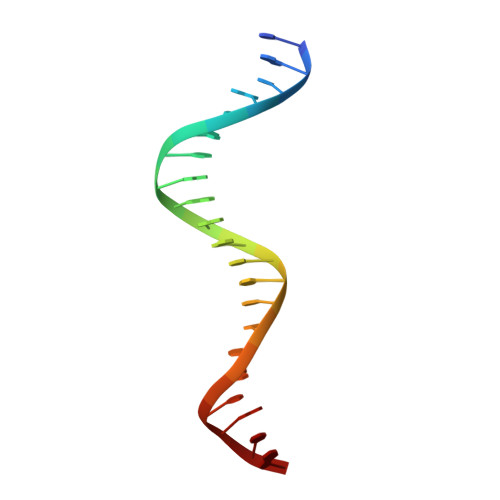
4R22 | pdb_00004r22

TnrA-DNA complex


Experimental Data Snapshot

  • Method: X-RAY DIFFRACTION
  • Resolution: 2.60 Å
  • R-Value Free: 
    0.279 (Depositor), 0.279 (DCC) 
  • R-Value Work: 
    0.261 (Depositor), 0.261 (DCC) 
  • R-Value Observed: 
    0.261 (Depositor) 

wwPDB Validation 3D Report Full Report

Validation slider image for 4R22

This is version 1.1 of the entry. See complete history

Literature

Structures of regulatory machinery reveal novel molecular mechanisms controlling B. subtilis nitrogen homeostasis.

Schumacher, M.A.Chinnam, N.B.Cuthbert, B.Tonthat, N.K.Whitfill, T.

(2015) Genes Dev 29: 451-464

  • DOI: https://doi.org/10.1101/gad.254714.114
  • Primary Citation Related Structures: 
    4R22, 4R24, 4R25, 4R4E, 4RX6, 4S0R

  • PubMed Abstract: 

    All cells must sense and adapt to changing nutrient availability. However, detailed molecular mechanisms coordinating such regulatory pathways remain poorly understood. In Bacillus subtilis, nitrogen homeostasis is controlled by a unique circuitry composed of the regulator TnrA, which is deactivated by feedback-inhibited glutamine synthetase (GS) during nitrogen excess and stabilized by GlnK upon nitrogen depletion, and the repressor GlnR. Here we describe a complete molecular dissection of this network. TnrA and GlnR, the global nitrogen homeostatic transcription regulators, are revealed as founders of a new structural family of dimeric DNA-binding proteins with C-terminal, flexible, effector-binding sensors that modulate their dimerization. Remarkably, the TnrA sensor domains insert into GS intersubunit catalytic pores, destabilizing the TnrA dimer and causing an unprecedented GS dodecamer-to-tetradecamer conversion, which concomitantly deactivates GS. In contrast, each subunit of the GlnK trimer "templates" active TnrA dimers. Unlike TnrA, GlnR sensors mediate an autoinhibitory dimer-destabilizing interaction alleviated by GS, which acts as a GlnR chaperone. Thus, these studies unveil heretofore unseen mechanisms by which inducible sensor domains drive metabolic reprograming in the model Gram-positive bacterium B. subtilis.


  • Organizational Affiliation
    • Department of Biochemistry, Duke University Medical Center, Durham, North Carolina 27710, USA maria.schumacher@duke.edu.

Macromolecule Content 

  • Total Structure Weight: 16.2 kDa 
  • Atom Count: 1,110 
  • Modeled Residue Count: 103 
  • Deposited Residue Count: 103 
  • Unique protein chains: 1
  • Unique nucleic acid chains: 1

Macromolecules


Find similar proteins by:|  3D Structure
Entity ID: 1
MoleculeChains  Sequence LengthOrganismDetailsImage
HTH-type transcriptional regulator TnrAA [auth B]82Priestia megaterium WSH-002Mutation(s): 0 
Gene Names: tnrABMWSH_3277
UniProt
Find proteins for G2RUZ1 (Priestia megaterium (strain WSH-002))
Explore G2RUZ1 
Go to UniProtKB:  G2RUZ1
Entity Groups
Sequence Clusters30% Identity50% Identity70% Identity90% Identity95% Identity100% Identity
UniProt GroupG2RUZ1
Sequence Annotations
Expand
Reference Sequence
Find similar nucleic acids by:  Sequence
Entity ID: 2
MoleculeChains LengthOrganismImage
DNA (5'-D(*CP*GP*TP*GP*TP*AP*AP*GP*GP*AP*AP*TP*TP*CP*TP*GP*AP*CP*AP*CP*G)-3')B [auth G]21synthetic construct
Sequence Annotations
Expand
Reference Sequence

Experimental Data & Validation

Experimental Data

  • Method: X-RAY DIFFRACTION
  • Resolution: 2.60 Å
  • R-Value Free:  0.279 (Depositor), 0.279 (DCC) 
  • R-Value Work:  0.261 (Depositor), 0.261 (DCC) 
  • R-Value Observed: 0.261 (Depositor) 
Space Group: P 21 21 2
Unit Cell:
Length ( Å )Angle ( ˚ )
a = 66.44α = 90
b = 46.39β = 90
c = 42.46γ = 90
Software Package:
Software NamePurpose
MOSFLMdata reduction
PHASERphasing
CNSrefinement
PDB_EXTRACTdata extraction
ADSCdata collection
SCALAdata scaling

Structure Validation

View Full Validation Report


Entry History 

Deposition Data

Revision History  (Full details and data files)

  • Version 1.0: 2015-03-04
    Type: Initial release
  • Version 1.1: 2024-02-28
    Changes: Data collection, Database references