4QNH | pdb_00004qnh

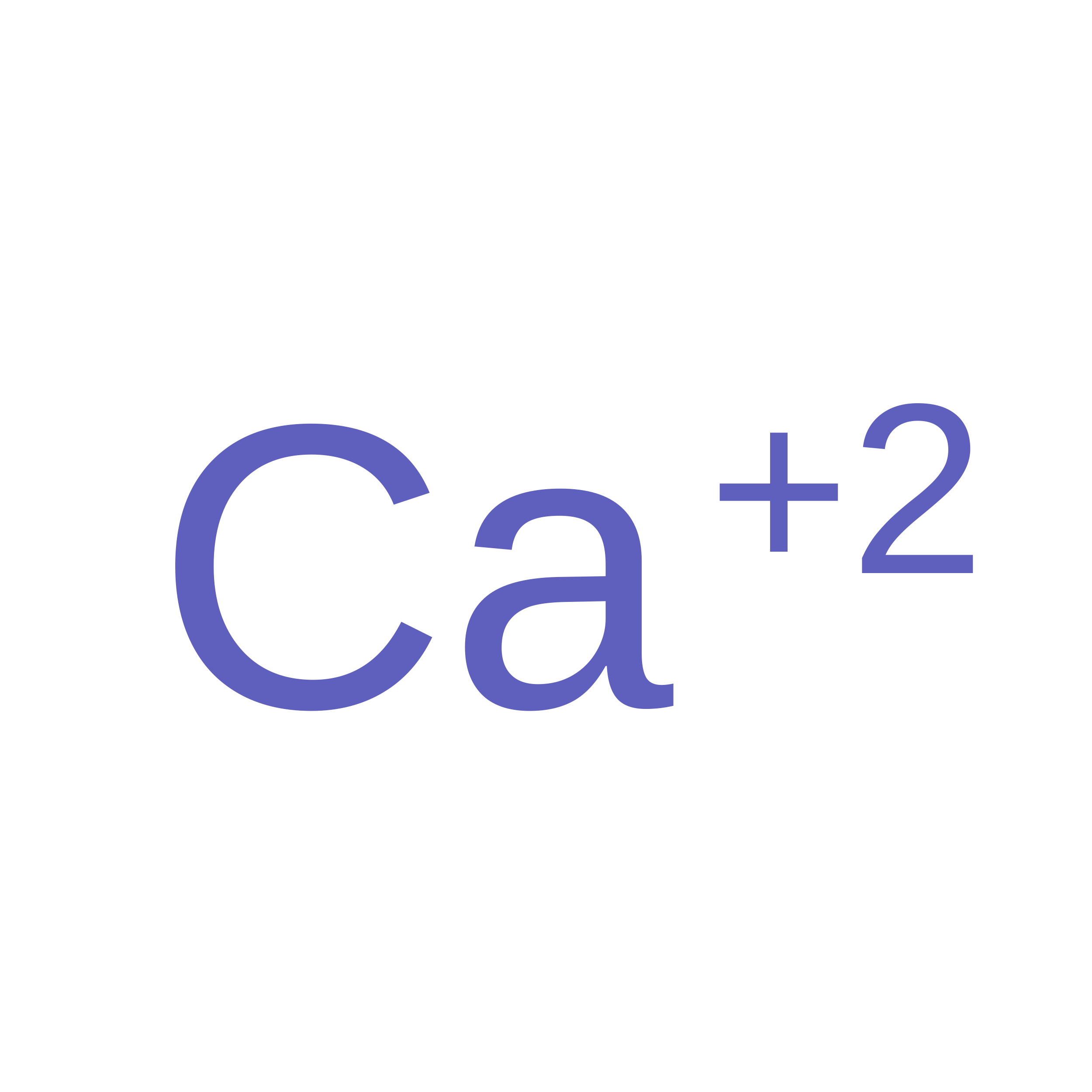
Calcium-calmodulin (T79D) complexed with the calmodulin binding domain from a small conductance potassium channel SK2-a


Experimental Data Snapshot

  • Method: X-RAY DIFFRACTION
  • Resolution: 2.02 Å
  • R-Value Free: 
    0.234 (Depositor), 0.236 (DCC) 
  • R-Value Work: 
    0.182 (Depositor), 0.184 (DCC) 
  • R-Value Observed: 
    0.184 (Depositor) 

wwPDB Validation 3D Report Full Report

Validation slider image for 4QNH

This is version 1.2 of the entry. See complete history

Literature

Selective phosphorylation modulates the PIP2 sensitivity of the CaM-SK channel complex.

Zhang, M.Meng, X.Y.Cui, M.Pascal, J.M.Logothetis, D.E.Zhang, J.F.

(2014) Nat Chem Biol 10: 753-759

  • DOI: https://doi.org/10.1038/nchembio.1592
  • Primary Citation Related Structures: 
    4QNH

  • PubMed Abstract: 

    Phosphatidylinositol bisphosphate (PIP2) regulates the activities of many membrane proteins, including ion channels, through direct interactions. However, the affinity of PIP2 is so high for some channel proteins that its physiological role as a modulator has been questioned. Here we show that PIP2 is a key cofactor for activation of small conductance Ca2+-activated potassium channels (SKs) by Ca(2+)-bound calmodulin (CaM). Removal of the endogenous PIP2 inhibits SKs. The PIP2-binding site resides at the interface of CaM and the SK C terminus. We further demonstrate that the affinity of PIP2 for its target proteins can be regulated by cellular signaling. Phosphorylation of CaM T79, located adjacent to the PIP2-binding site, by casein kinase 2 reduces the affinity of PIP2 for the CaM-SK channel complex by altering the dynamic interactions among amino acid residues surrounding the PIP2-binding site. This effect of CaM phosphorylation promotes greater channel inhibition by G protein-mediated hydrolysis of PIP2.


  • Organizational Affiliation
    • 1] Department of Molecular Physiology and Biophysics, Thomas Jefferson University, Philadelphia, Pennsylvania, USA. [2] Department of Physiology and Biophysics, Virginia Commonwealth University School of Medicine, Richmond, Virginia, USA.

Macromolecule Content 

  • Total Structure Weight: 29.29 kDa 
  • Atom Count: 2,083 
  • Modeled Residue Count: 233 
  • Deposited Residue Count: 251 
  • Unique protein chains: 2

Macromolecules

Find similar proteins by:|  3D Structure
Entity ID: 1
MoleculeChains  Sequence LengthOrganismDetailsImage
Small conductance calcium-activated potassium channel protein 2A [auth B]102Rattus norvegicusMutation(s): 0 
Gene Names: Kcnn2
UniProt
Find proteins for P70604 (Rattus norvegicus)
Explore P70604 
Go to UniProtKB:  P70604
Entity Groups
Sequence Clusters30% Identity50% Identity70% Identity90% Identity95% Identity100% Identity
UniProt GroupP70604
Sequence Annotations
Expand
Reference Sequence
Find similar proteins by:|  3D Structure
Entity ID: 2
MoleculeChains  Sequence LengthOrganismDetailsImage
CalmodulinB [auth R]149Rattus norvegicusMutation(s): 1 
Gene Names: Calm1CalmCamCam1Calm2Cam2CambCalm3Cam3Camc
UniProt
Find proteins for P0DP29 (Rattus norvegicus)
Explore P0DP29 
Go to UniProtKB:  P0DP29
Entity Groups
Sequence Clusters30% Identity50% Identity70% Identity90% Identity95% Identity100% Identity
UniProt GroupP0DP29
Sequence Annotations
Expand
Reference Sequence

Experimental Data & Validation

Experimental Data

  • Method: X-RAY DIFFRACTION
  • Resolution: 2.02 Å
  • R-Value Free:  0.234 (Depositor), 0.236 (DCC) 
  • R-Value Work:  0.182 (Depositor), 0.184 (DCC) 
  • R-Value Observed: 0.184 (Depositor) 
Space Group: C 1 2 1
Unit Cell:
Length ( Å )Angle ( ˚ )
a = 77.16α = 90
b = 65.96β = 93.56
c = 64.68γ = 90
Software Package:
Software NamePurpose
ADSCdata collection
PHENIXmodel building
PHENIXrefinement
MOSFLMdata reduction
SCALAdata scaling
PHENIXphasing

Structure Validation

View Full Validation Report


Entry History 

Deposition Data

Revision History  (Full details and data files)

  • Version 1.0: 2014-08-06
    Type: Initial release
  • Version 1.1: 2014-09-03
    Changes: Database references
  • Version 1.2: 2024-02-28
    Changes: Data collection, Database references, Derived calculations