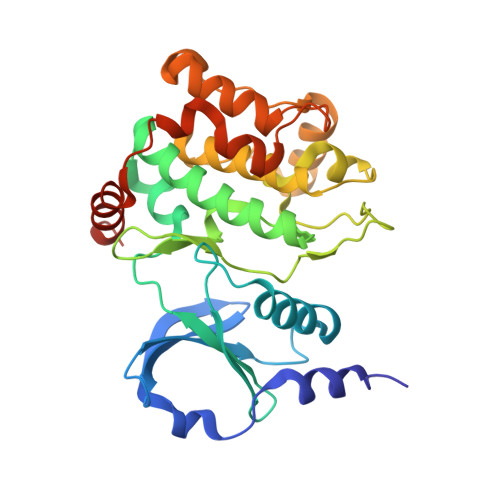
4O0R | pdb_00004o0r

Back pocket flexibility provides group-II PAK selectivity for type 1 kinase inhibitors


Experimental Data Snapshot

  • Method: X-RAY DIFFRACTION
  • Resolution: 2.40 Å
  • R-Value Free: 
    0.242 (Depositor), 0.244 (DCC) 
  • R-Value Work: 
    0.206 (Depositor), 0.208 (DCC) 
  • R-Value Observed: 
    0.208 (Depositor) 

wwPDB Validation 3D Report Full Report

Validation slider image for 4O0R

Ligand Structure Quality Assessment 


This is version 2.1 of the entry. See complete history

Literature

Back Pocket Flexibility Provides Group II p21-Activated Kinase (PAK) Selectivity for Type I 1/2 Kinase Inhibitors.

Staben, S.T.Feng, J.A.Lyle, K.Belvin, M.Boggs, J.Burch, J.D.Chua, C.C.Cui, H.Dipasquale, A.G.Friedman, L.S.Heise, C.Koeppen, H.Kotey, A.Mintzer, R.Oh, A.Roberts, D.A.Rouge, L.Rudolph, J.Tam, C.Wang, W.Xiao, Y.Young, A.Zhang, Y.Hoeflich, K.P.

(2014) J Med Chem 57: 1033-1045

  • DOI: https://doi.org/10.1021/jm401768t
  • Primary Citation Related Structures: 
    4O0R, 4O0T, 4O0V, 4O0X, 4O0Y

  • PubMed Abstract: 

    Structure-based methods were used to design a potent and highly selective group II p21-activated kinase (PAK) inhibitor with a novel binding mode, compound 17. Hydrophobic interactions within a lipophilic pocket past the methionine gatekeeper of group II PAKs approached by these type I 1/2 binders were found to be important for improving potency. A structure-based hypothesis and strategy for achieving selectivity over group I PAKs, and the broad kinome, based on unique flexibility of this lipophilic pocket, is presented. A concentration-dependent decrease in tumor cell migration and invasion in two triple-negative breast cancer cell lines was observed with compound 17.


  • Organizational Affiliation
    • Department of Discovery Chemistry, ‡Department of Translational Oncology, △Department of Pathology, §Department of Drug Metabolism and Pharmacokinetics, ∥Department of Biochemical and Cellular Pharmacology, and ⊥Department of Structural Biology, Genentech, Inc. , 1 DNA Way, South San Francisco, California 94080, United States.

Macromolecule Content 

  • Total Structure Weight: 67.58 kDa 
  • Atom Count: 4,523 
  • Modeled Residue Count: 575 
  • Deposited Residue Count: 600 
  • Unique protein chains: 1

Macromolecules

Find similar proteins by:|  3D Structure
Entity ID: 1
MoleculeChains  Sequence LengthOrganismDetailsImage
Serine/threonine-protein kinase PAK 1
A, B
300Homo sapiensMutation(s): 0 
Gene Names: PAK1
EC: 2.7.11.1
UniProt & NIH Common Fund Data Resources
Find proteins for Q13153 (Homo sapiens)
Explore Q13153 
Go to UniProtKB:  Q13153
PHAROS:  Q13153
GTEx:  ENSG00000149269 
Entity Groups
Sequence Clusters30% Identity50% Identity70% Identity90% Identity95% Identity100% Identity
UniProt GroupQ13153
Sequence Annotations
Expand
Reference Sequence

Small Molecules

Ligands 1 Unique
IDChains Name / Formula / InChI Key2D Diagram3D Interactions
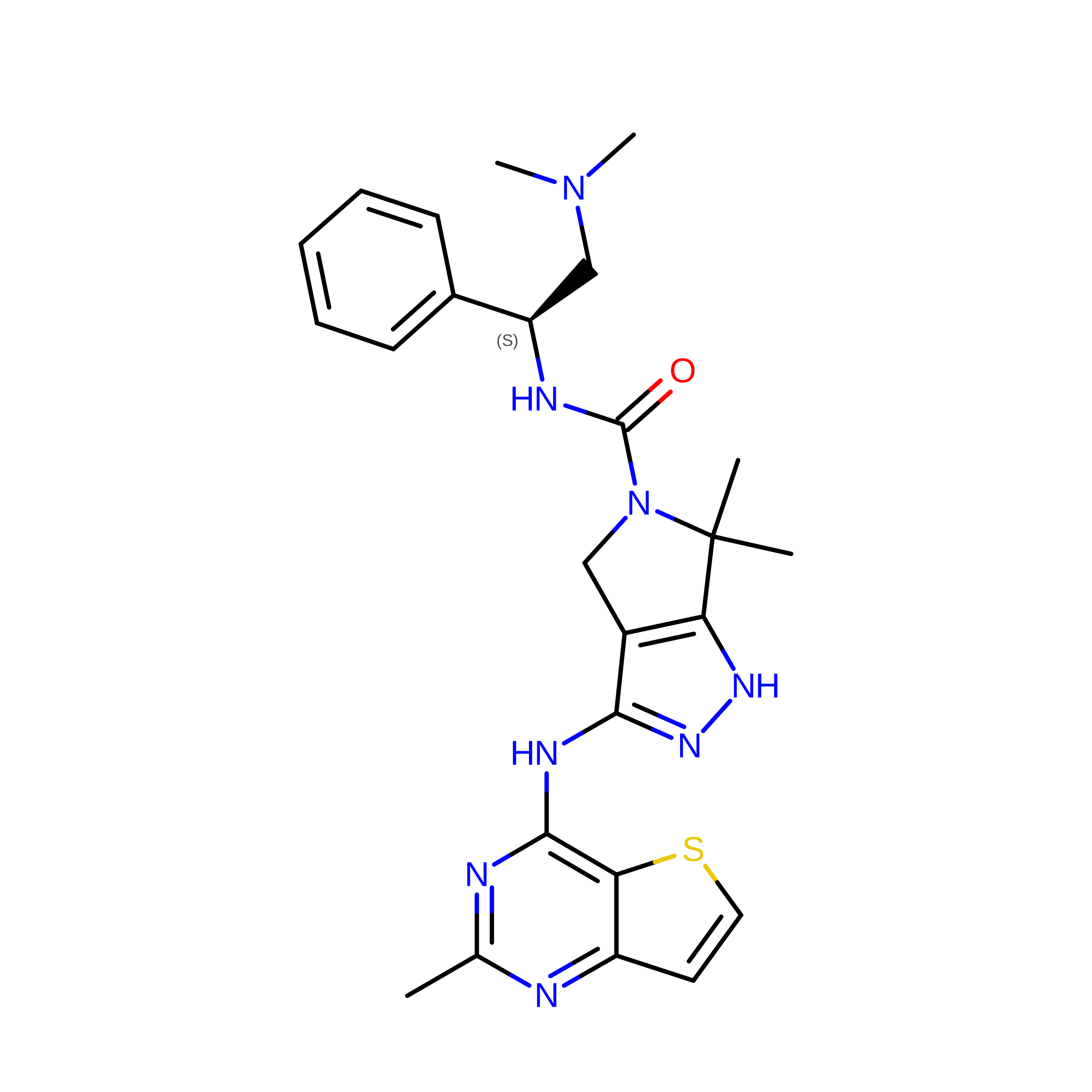
7KC

Query on 7KC


Download:Ideal Coordinates CCD File
C [auth A]PF-3758309
C25 H30 N8 O S
AYCPARAPKDAOEN-LJQANCHMSA-N
Binding Affinity Annotations 
IDSourceBinding Affinity
7KC BindingDB:  4O0R Ki: min: 14, max: 39 (nM) from 2 assay(s)
IC50: min: 14, max: 190 (nM) from 3 assay(s)

Experimental Data & Validation

Experimental Data

  • Method: X-RAY DIFFRACTION
  • Resolution: 2.40 Å
  • R-Value Free:  0.242 (Depositor), 0.244 (DCC) 
  • R-Value Work:  0.206 (Depositor), 0.208 (DCC) 
  • R-Value Observed: 0.208 (Depositor) 
Space Group: P 1 21 1
Unit Cell:
Length ( Å )Angle ( ˚ )
a = 63.323α = 90
b = 80.774β = 106.25
c = 66.013γ = 90
Software Package:
Software NamePurpose
Blu-Icedata collection
PHASERphasing
PHENIXrefinement
HKL-2000data reduction
SCALEPACKdata scaling

Structure Validation

View Full Validation Report


Ligand Structure Quality Assessment 


Entry History 

Deposition Data

Revision History  (Full details and data files)

  • Version 1.0: 2014-02-12
    Type: Initial release
  • Version 1.1: 2014-02-26
    Changes: Database references
  • Version 2.0: 2019-01-30
    Changes: Atomic model, Data collection, Derived calculations, Non-polymer description, Structure summary
  • Version 2.1: 2024-11-20
    Changes: Data collection, Database references, Structure summary