Download Mendeley
(19)F nuclear magnetic resonance and crystallographic studies of 5-fluorotryptophan-labeled anthrax protective antigen and effects of the receptor on stability.
Chadegani, F., Lovell, S., Mullangi, V., Miyagi, M., Battaile, K.P., Bann, J.G.(2014) Biochemistry 53: 690-701
- PubMed: 24387629 Search on PubMedSearch on PubMed Central
- DOI: https://doi.org/10.1021/bi401405s
- Primary Citation Related Structures:
4NAM - PubMed Abstract:
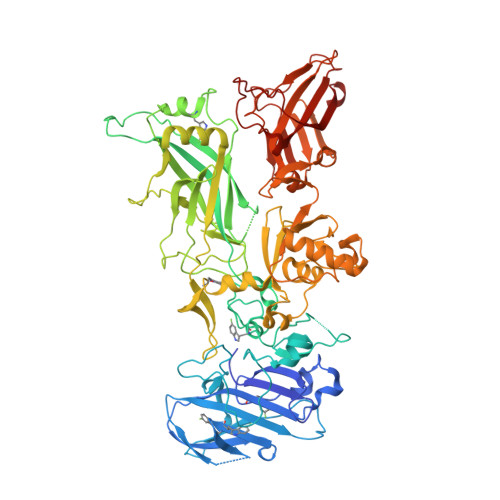
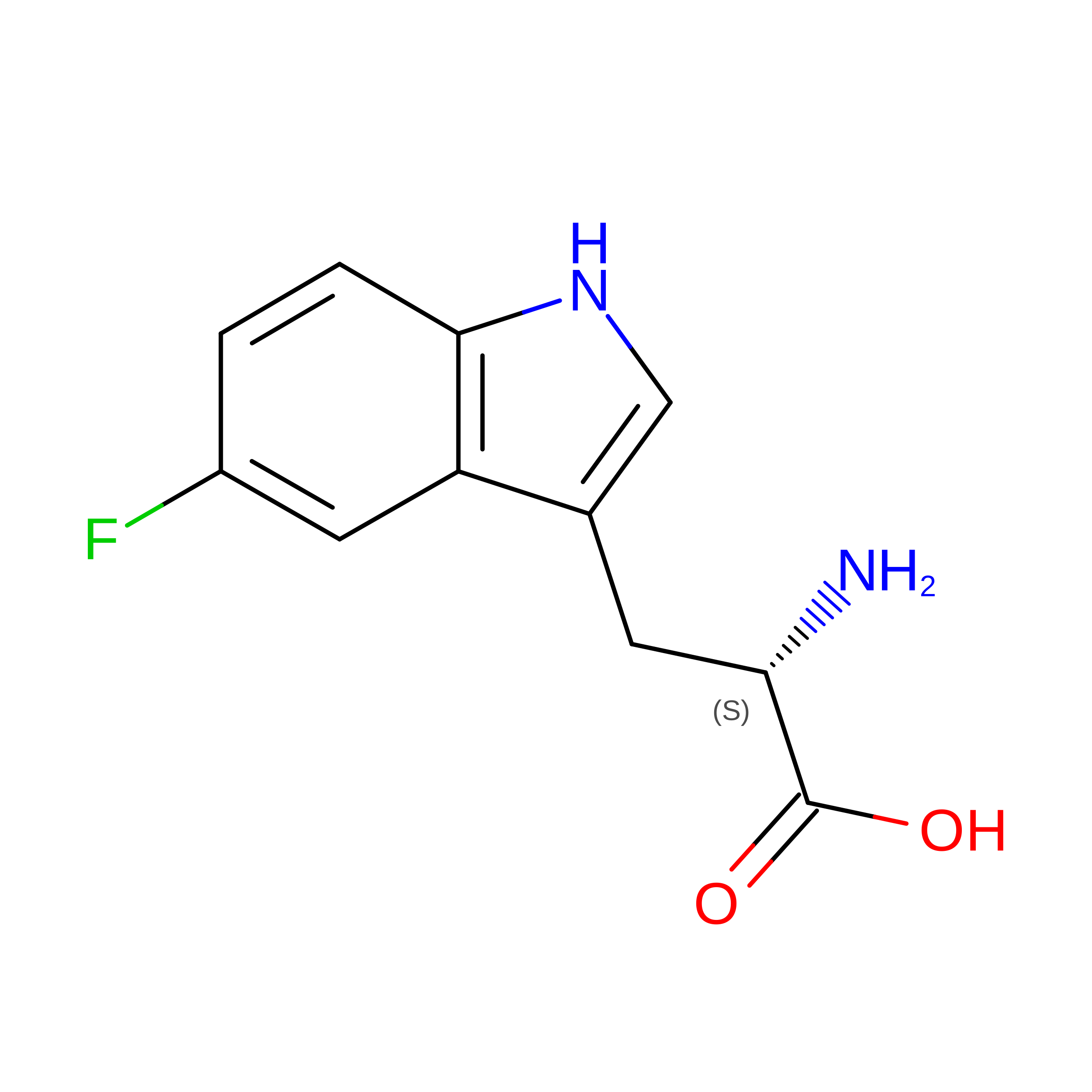
The anthrax protective antigen (PA) is an 83 kDa protein that is one of three protein components of the anthrax toxin, an AB toxin secreted by Bacillus anthracis. PA is capable of undergoing several structural changes, including oligomerization to either a heptameric or octameric structure called the prepore, and at acidic pH a major conformational change to form a membrane-spanning pore. To follow these structural changes at a residue-specific level, we have conducted initial studies in which we have biosynthetically incorporated 5-fluorotryptophan (5-FTrp) into PA, and we have studied the influence of 5-FTrp labeling on the structural stability of PA and on binding to the host receptor capillary morphogenesis protein 2 (CMG2) using (19)F nuclear magnetic resonance (NMR). There are seven tryptophans in PA, but of the four domains in PA, only two contain tryptophans: domain 1 (Trp65, -90, -136, -206, and -226) and domain 2 (Trp346 and -477). Trp346 is of particular interest because of its proximity to the CMG2 binding interface, and because it forms part of the membrane-spanning pore. We show that the (19)F resonance of Trp346 is sensitive to changes in pH, consistent with crystallographic studies, and that receptor binding significantly stabilizes Trp346 to both pH and temperature. In addition, we provide evidence that suggests that resonances from tryptophans distant from the binding interface are also stabilized by the receptor. Our studies highlight the positive impact of receptor binding on protein stability and the use of (19)F NMR in gaining insight into structural changes in a high-molecular weight protein.
- Department of Chemistry, Wichita State University , Wichita, Kansas 67260, United States.
Organizational Affiliation: