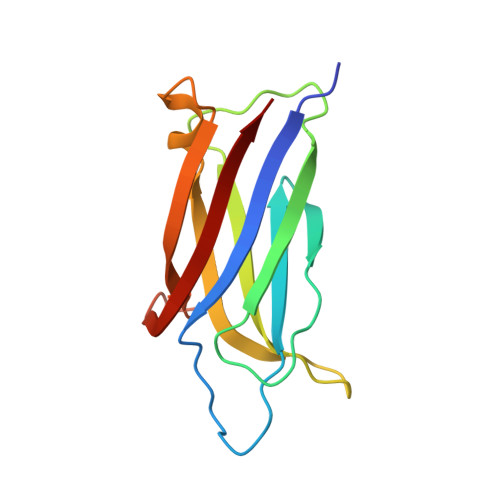
4IQH | pdb_00004iqh

Crystal Structure Analysis of Dysferlin C2A variant 1 (C2Av1)


Experimental Data Snapshot

  • Method: X-RAY DIFFRACTION
  • Resolution: 1.76 Å
  • R-Value Free: 
    0.215 (Depositor), 0.234 (DCC) 
  • R-Value Work: 
    0.192 (Depositor) 
  • R-Value Observed: 
    0.195 (Depositor) 

Starting Model: experimental
View more details

wwPDB Validation 3D Report Full Report

Validation slider image for 4IQH

This is version 1.3 of the entry. See complete history

Literature

Alternate Splicing of Dysferlin C2A Confers Ca(2+)-Dependent and Ca(2+)-Independent Binding for Membrane Repair.

Fuson, K.Rice, A.Mahling, R.Snow, A.Nayak, K.Shanbhogue, P.Meyer, A.G.Redpath, G.M.Hinderliter, A.Cooper, S.T.Sutton, R.B.

(2014) Structure 22: 104-115

  • DOI: https://doi.org/10.1016/j.str.2013.10.001
  • Primary Citation Related Structures: 
    4IHB, 4IQH

  • PubMed Abstract: 

    Dysferlin plays a critical role in the Ca²⁺-dependent repair of microlesions that occur in the muscle sarcolemma. Of the seven C2 domains in dysferlin, only C2A is reported to bind both Ca²⁺ and phospholipid, thus acting as a key sensor in membrane repair. Dysferlin C2A exists as two isoforms, the "canonical" C2A and C2A variant 1 (C2Av1). Interestingly, these isoforms have markedly different responses to Ca²⁺ and phospholipid. Structural and thermodynamic analyses are consistent with the canonical C2A domain as a Ca²⁺-dependent, phospholipid-binding domain, whereas C2Av1 would likely be Ca²⁺-independent under physiological conditions. Additionally, both isoforms display remarkably low free energies of stability, indicative of a highly flexible structure. The inverted ligand preference and flexibility for both C2A isoforms suggest the capability for both constitutive and Ca²⁺-regulated effector interactions, an activity that would be essential in its role as a mediator of membrane repair.


  • Organizational Affiliation
    • Department of Cell Physiology and Molecular Biophysics, Texas Tech University Health Sciences Center, Lubbock, TX 79430, USA; Center for Membrane Protein Research, Texas Tech University Health Sciences Center, Lubbock, TX 79430, USA.

Macromolecule Content 

  • Total Structure Weight: 42.99 kDa 
  • Atom Count: 3,634 
  • Modeled Residue Count: 383 
  • Deposited Residue Count: 390 
  • Unique protein chains: 1

Macromolecules

Find similar proteins by:|  3D Structure
Entity ID: 1
MoleculeChains  Sequence LengthOrganismDetailsImage
Dysferlin
A, B, C
130Homo sapiensMutation(s): 0 
Gene Names: DYSFDysferlinFER1L1
UniProt & NIH Common Fund Data Resources
Find proteins for O75923 (Homo sapiens)
Explore O75923 
Go to UniProtKB:  O75923
PHAROS:  O75923
GTEx:  ENSG00000135636 
Entity Groups
Sequence Clusters30% Identity50% Identity70% Identity90% Identity95% Identity100% Identity
UniProt GroupO75923
Sequence Annotations
Expand
Reference Sequence

Experimental Data & Validation

Experimental Data

  • Method: X-RAY DIFFRACTION
  • Resolution: 1.76 Å
  • R-Value Free:  0.215 (Depositor), 0.234 (DCC) 
  • R-Value Work:  0.192 (Depositor) 
  • R-Value Observed: 0.195 (Depositor) 
Space Group: P 31 2 1
Unit Cell:
Length ( Å )Angle ( ˚ )
a = 71.16α = 90
b = 71.16β = 90
c = 137.45γ = 120
Software Package:
Software NamePurpose
HKL-3000data collection
PHASERphasing
PHENIXrefinement
HKL-3000data reduction
SCALEPACKdata scaling

Structure Validation

View Full Validation Report


Entry History 

Deposition Data

Revision History  (Full details and data files)

  • Version 1.0: 2013-12-18
    Type: Initial release
  • Version 1.1: 2014-01-29
    Changes: Database references
  • Version 1.2: 2018-04-25
    Changes: Data collection
  • Version 1.3: 2023-09-20
    Changes: Data collection, Database references, Refinement description