4IKM | pdb_00004ikm

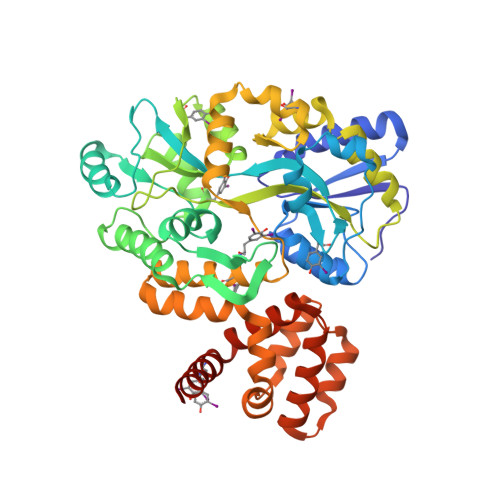
X-ray structure of CARD8 CARD domain


Experimental Data Snapshot

  • Method: X-RAY DIFFRACTION
  • Resolution: 2.46 Å
  • R-Value Free: 
    0.253 (Depositor), 0.254 (DCC) 
  • R-Value Work: 
    0.201 (Depositor), 0.206 (DCC) 
  • R-Value Observed: 
    0.203 (Depositor) 

Starting Model: experimental
View more details

wwPDB Validation 3D Report Full Report

Validation slider image for 4IKM

This is version 2.2 of the entry. See complete history

Literature

The structure of the CARD8 caspase-recruitment domain suggests its association with the FIIND domain and procaspases through adjacent surfaces.

Jin, T.Huang, M.Smith, P.Jiang, J.Xiao, T.S.

(2013) Acta Crystallogr Sect F Struct Biol Cryst Commun 69: 482-487

  • DOI: https://doi.org/10.1107/S1744309113010075
  • Primary Citation Related Structures: 
    4IKM

  • PubMed Abstract: 

    CARD8 plays crucial roles in regulating apoptotic and inflammatory signaling pathways through the association of its caspase-recruitment domain (CARD) with those of procaspase-9 and procaspase-1. The CARD8 CARD has also been predicted to form an intramolecular complex with its FIIND domain. Here, the first crystal structure of the CARD8 CARD is reported; it adopts a six-helix bundle fold with a unique conformation of the α6 helix that is described here for the first time. The surface of the CARD8 CARD displays a prominent acidic patch at its α2, α3 and α5 helices that may interact with the procaspase-9 CARD, whereas an adjacent charged surface at its α3 and α4 helices may associate with the CARD8 FIIND domain without interfering with the CARD-CARD interaction. This suggests that the function of CARD8 may be regulated by both intramolecular and intermolecular interactions involving electrostatic attractions.


  • Organizational Affiliation
    • Structural Immunobiology Unit, Laboratory of Immunology, National Institute of Allergy and Infectious Diseases, National Institutes of Health, Bethesda, MD 20892-0430, USA.

Macromolecule Content 

  • Total Structure Weight: 54.09 kDa 
  • Atom Count: 3,703 
  • Modeled Residue Count: 463 
  • Deposited Residue Count: 469 
  • Unique protein chains: 1

Macromolecules

Find similar proteins by:|  3D Structure
Entity ID: 1
MoleculeChains  Sequence LengthOrganismDetailsImage
Maltose-binding periplasmic protein, Caspase recruitment domain-containing protein 8469Escherichia coli K-12Homo sapiens
This entity is chimeric
Mutation(s): 0 
Gene Names: b4034CARD8TUCANCARDINALJW3994malEKIAA0955NDPP1
EC: 3.4
UniProt & NIH Common Fund Data Resources
Find proteins for P0AEX9 (Escherichia coli (strain K12))
Explore P0AEX9 
Go to UniProtKB:  P0AEX9
Find proteins for Q9Y2G2 (Homo sapiens)
Explore Q9Y2G2 
Go to UniProtKB:  Q9Y2G2
PHAROS:  Q9Y2G2
GTEx:  ENSG00000105483 
Entity Groups
Sequence Clusters30% Identity50% Identity70% Identity90% Identity95% Identity100% Identity
UniProt GroupsQ9Y2G2P0AEX9
Sequence Annotations
Expand
Reference Sequence

Oligosaccharides

Help  
Entity ID: 2
MoleculeChains Length2D Diagram GlycosylationD Interactions
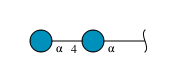
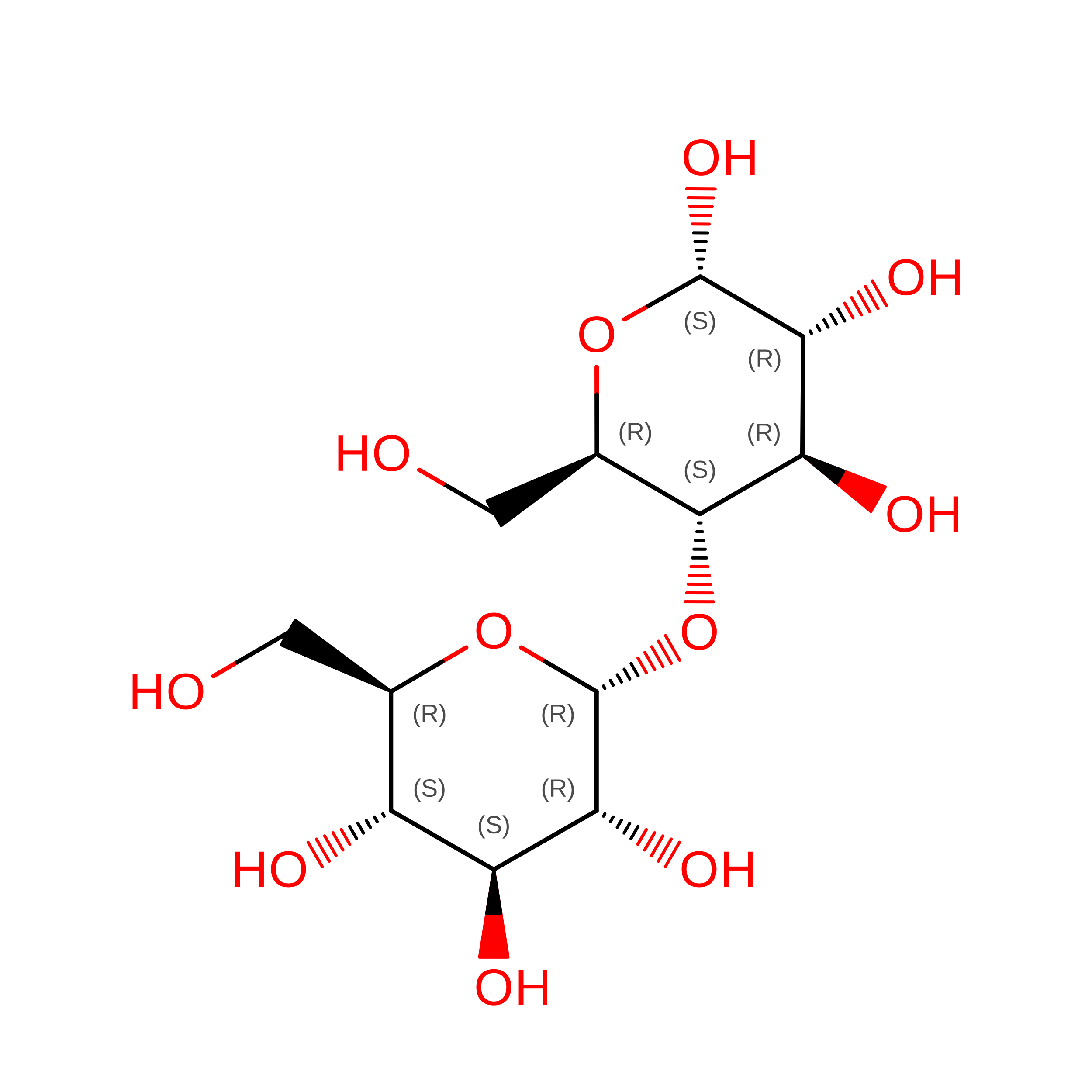
alpha-D-glucopyranose-(1-4)-alpha-D-glucopyranose
B
2N/A
Glycosylation Resources
GlyTouCan: G07411ON
GlyCosmos: G07411ON

Biologically Interesting Molecules (External Reference) 

1 Unique

Experimental Data & Validation

Experimental Data

  • Method: X-RAY DIFFRACTION
  • Resolution: 2.46 Å
  • R-Value Free:  0.253 (Depositor), 0.254 (DCC) 
  • R-Value Work:  0.201 (Depositor), 0.206 (DCC) 
  • R-Value Observed: 0.203 (Depositor) 
Space Group: P 65 2 2
Unit Cell:
Length ( Å )Angle ( ˚ )
a = 94.877α = 90
b = 94.877β = 90
c = 219.39γ = 120
Software Package:
Software NamePurpose
Blu-Icedata collection
PHASERphasing
PHENIXrefinement
HKL-2000data reduction
SCALEPACKdata scaling

Structure Validation

View Full Validation Report


Entry History 

Deposition Data

Revision History  (Full details and data files)

  • Version 1.0: 2013-05-08
    Type: Initial release
  • Version 1.1: 2013-06-05
    Changes: Database references
  • Version 1.2: 2017-08-02
    Changes: Advisory, Refinement description, Source and taxonomy
  • Version 1.3: 2017-11-15
    Changes: Refinement description
  • Version 2.0: 2020-07-29
    Type: Remediation
    Reason: Carbohydrate remediation
    Changes: Atomic model, Data collection, Database references, Derived calculations, Non-polymer description, Structure summary
  • Version 2.1: 2023-09-20
    Changes: Advisory, Data collection, Database references, Refinement description, Structure summary
  • Version 2.2: 2024-10-30
    Changes: Structure summary