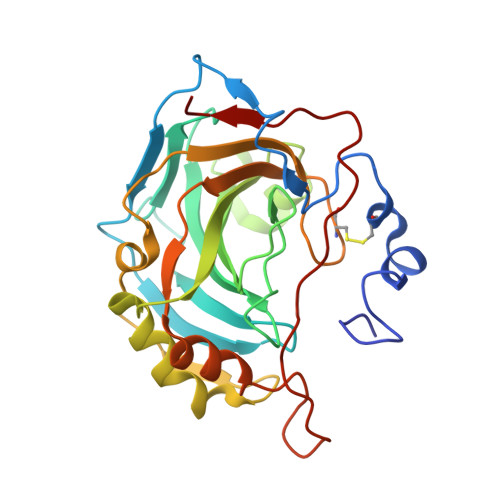
4HBA | pdb_00004hba

Structural and Catalytic Characterization of a Thermal and Acid Stable Variant of Human Carbonic Anhydrase II Containing an Engineered Disulfide Bond


Experimental Data Snapshot

  • Method: X-RAY DIFFRACTION
  • Resolution: 1.76 Å
  • R-Value Free: 
    0.189 (Depositor), 0.195 (DCC) 
  • R-Value Work: 
    0.150 (Depositor), 0.153 (DCC) 
  • R-Value Observed: 
    0.152 (Depositor) 

wwPDB Validation 3D Report Full Report

Validation slider image for 4HBA

This is version 1.3 of the entry. See complete history

Literature

Structural and catalytic characterization of a thermally stable and acid-stable variant of human carbonic anhydrase II containing an engineered disulfide bond.

Boone, C.D.Habibzadegan, A.Tu, C.Silverman, D.N.McKenna, R.

(2013) Acta Crystallogr D Biol Crystallogr 69: 1414-1422

  • DOI: https://doi.org/10.1107/S0907444913008743
  • Primary Citation Related Structures: 
    4HBA

  • PubMed Abstract: 

    The carbonic anhydrases (CAs) are a family of mostly zinc metalloenzymes that catalyze the reversible hydration of CO2 to bicarbonate and a proton. Recently, there has been industrial interest in utilizing CAs as biocatalysts for carbon sequestration and biofuel production. The conditions used in these processes, however, result in high temperatures and acidic pH. This unfavorable environment results in rapid destabilization and loss of catalytic activity in CAs, ultimately resulting in cost-inefficient high-maintenance operation of the system. In order to negate these detrimental industrial conditions, cysteines at residues 23 (Ala23Cys) and 203 (Leu203Cys) were engineered into a wild-type variant of human CA II (HCAII) containing the mutation Cys206Ser. The X-ray crystallographic structure of the disulfide-containing HCAII (dsHCAII) was solved to 1.77 Å resolution and revealed that successful oxidation of the cysteine bond was achieved while also retaining desirable active-site geometry. Kinetic studies utilizing the measurement of (18)O-labeled CO2 by mass spectrometry revealed that dsHCAII retained high catalytic efficiency, and differential scanning calorimetry showed acid stability and thermal stability that was enhanced by up to 14 K compared with native HCAII. Together, these studies have shown that dsHCAII has properties that could be used in an industrial setting to help to lower costs and improve the overall reaction efficiency.


  • Organizational Affiliation
    • Department of Biochemistry and Molecular Biology, University of Florida, PO Box 100245, Gainesville, FL 32610, USA.

Macromolecule Content 

  • Total Structure Weight: 29.54 kDa 
  • Atom Count: 2,328 
  • Modeled Residue Count: 257 
  • Deposited Residue Count: 260 
  • Unique protein chains: 1

Macromolecules

Find similar proteins by:|  3D Structure
Entity ID: 1
MoleculeChains  Sequence LengthOrganismDetailsImage
Carbonic anhydrase 2260Homo sapiensMutation(s): 3 
Gene Names: CA2
EC: 4.2.1.1 (PDB Primary Data), 4.2.1.69 (UniProt)
UniProt & NIH Common Fund Data Resources
Find proteins for P00918 (Homo sapiens)
Explore P00918 
Go to UniProtKB:  P00918
PHAROS:  P00918
GTEx:  ENSG00000104267 
Entity Groups
Sequence Clusters30% Identity50% Identity70% Identity90% Identity95% Identity100% Identity
UniProt GroupP00918
Sequence Annotations
Expand
Reference Sequence

Experimental Data & Validation

Experimental Data

  • Method: X-RAY DIFFRACTION
  • Resolution: 1.76 Å
  • R-Value Free:  0.189 (Depositor), 0.195 (DCC) 
  • R-Value Work:  0.150 (Depositor), 0.153 (DCC) 
  • R-Value Observed: 0.152 (Depositor) 
Space Group: P 1 21 1
Unit Cell:
Length ( Å )Angle ( ˚ )
a = 42.284α = 90
b = 41.156β = 104.17
c = 71.61γ = 90
Software Package:
Software NamePurpose
DENZOdata reduction
SCALEPACKdata scaling
PHENIXrefinement
PDB_EXTRACTdata extraction
CrystalCleardata collection
PHENIXphasing

Structure Validation

View Full Validation Report


Entry History 

Deposition Data

Revision History  (Full details and data files)

  • Version 1.0: 2013-07-31
    Type: Initial release
  • Version 1.1: 2014-01-15
    Changes: Database references
  • Version 1.2: 2017-11-15
    Changes: Refinement description
  • Version 1.3: 2024-11-06
    Changes: Data collection, Database references, Derived calculations, Structure summary