4H58 | pdb_00004h58

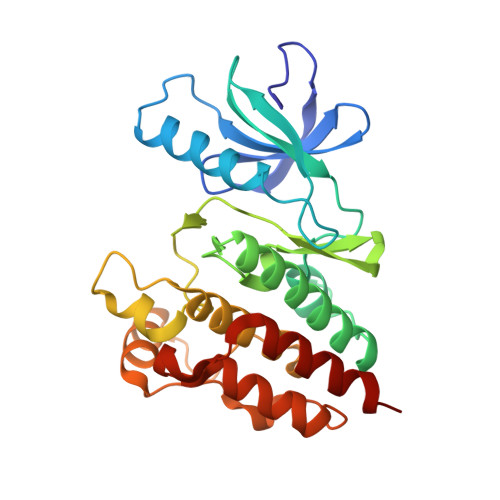
BRAF in complex with compound 3


Experimental Data Snapshot

  • Method: X-RAY DIFFRACTION
  • Resolution: 3.10 Å
  • R-Value Free: 
    0.272 (Depositor), 0.272 (DCC) 
  • R-Value Work: 
    0.222 (Depositor), 0.225 (DCC) 
  • R-Value Observed: 
    0.224 (Depositor) 

Starting Model: experimental
View more details

wwPDB Validation 3D Report Full Report

Validation slider image for 4H58

Ligand Structure Quality Assessment 


This is version 1.3 of the entry. See complete history

Literature

Discovery and Optimization of a Novel Series of Potent Mutant B-Raf(V600E) Selective Kinase Inhibitors.

Vasbinder, M.M.Aquila, B.Augustin, M.Chen, H.Cheung, T.Cook, D.Drew, L.Fauber, B.P.Glossop, S.Grondine, M.Hennessy, E.Johannes, J.Lee, S.Lyne, P.Mortl, M.Omer, C.Palakurthi, S.Pontz, T.Read, J.Sha, L.Shen, M.Steinbacher, S.Wang, H.Wu, A.Ye, M.

(2013) J Med Chem 56: 1996-2015

  • DOI: https://doi.org/10.1021/jm301658d
  • Primary Citation Related Structures: 
    4BB4, 4H58

  • PubMed Abstract: 

    B-Raf represents an attractive target for anticancer therapy and the development of small molecule B-Raf inhibitors has delivered new therapies for metastatic melanoma patients. We have discovered a novel class of small molecules that inhibit mutant B-Raf(V600E) kinase activity both in vitro and in vivo. Investigations into the structure-activity relationships of the series are presented along with efforts to improve upon the cellular potency, solubility, and pharmacokinetic profile. Compounds selectively inhibited B-Raf(V600E) in vitro and showed preferential antiproliferative activity in mutant B-Raf(V600E) cell lines and exhibited selectivity in a kinase panel against other kinases. Examples from this series inhibit growth of a B-Raf(V600E) A375 xenograft in vivo at a well-tolerated dose. In addition, aminoquinazolines described herein were shown to display pERK elevation in nonmutant B-Raf cell lines in vitro.


  • Organizational Affiliation
    • Oncology iMED, AstraZeneca R&D Boston, 35 Gatehouse Drive, Waltham, Massachusetts 02451, United States. melissa.vasbinder@astrazeneca.com

Macromolecule Content 

  • Total Structure Weight: 94.47 kDa 
  • Atom Count: 6,432 
  • Modeled Residue Count: 797 
  • Deposited Residue Count: 825 
  • Unique protein chains: 1

Macromolecules

Find similar proteins by:|  3D Structure
Entity ID: 1
MoleculeChains  Sequence LengthOrganismDetailsImage
Serine/threonine-protein kinase B-raf
A, B, C
275Homo sapiensMutation(s): 0 
Gene Names: BRAFBRAF1RAFB1
EC: 2.7.11.1
UniProt & NIH Common Fund Data Resources
Find proteins for P15056 (Homo sapiens)
Explore P15056 
Go to UniProtKB:  P15056
PHAROS:  P15056
GTEx:  ENSG00000157764 
Entity Groups
Sequence Clusters30% Identity50% Identity70% Identity90% Identity95% Identity100% Identity
UniProt GroupP15056
Sequence Annotations
Expand
Reference Sequence

Small Molecules

Ligands 2 Unique
IDChains Name / Formula / InChI Key2D Diagram3D Interactions
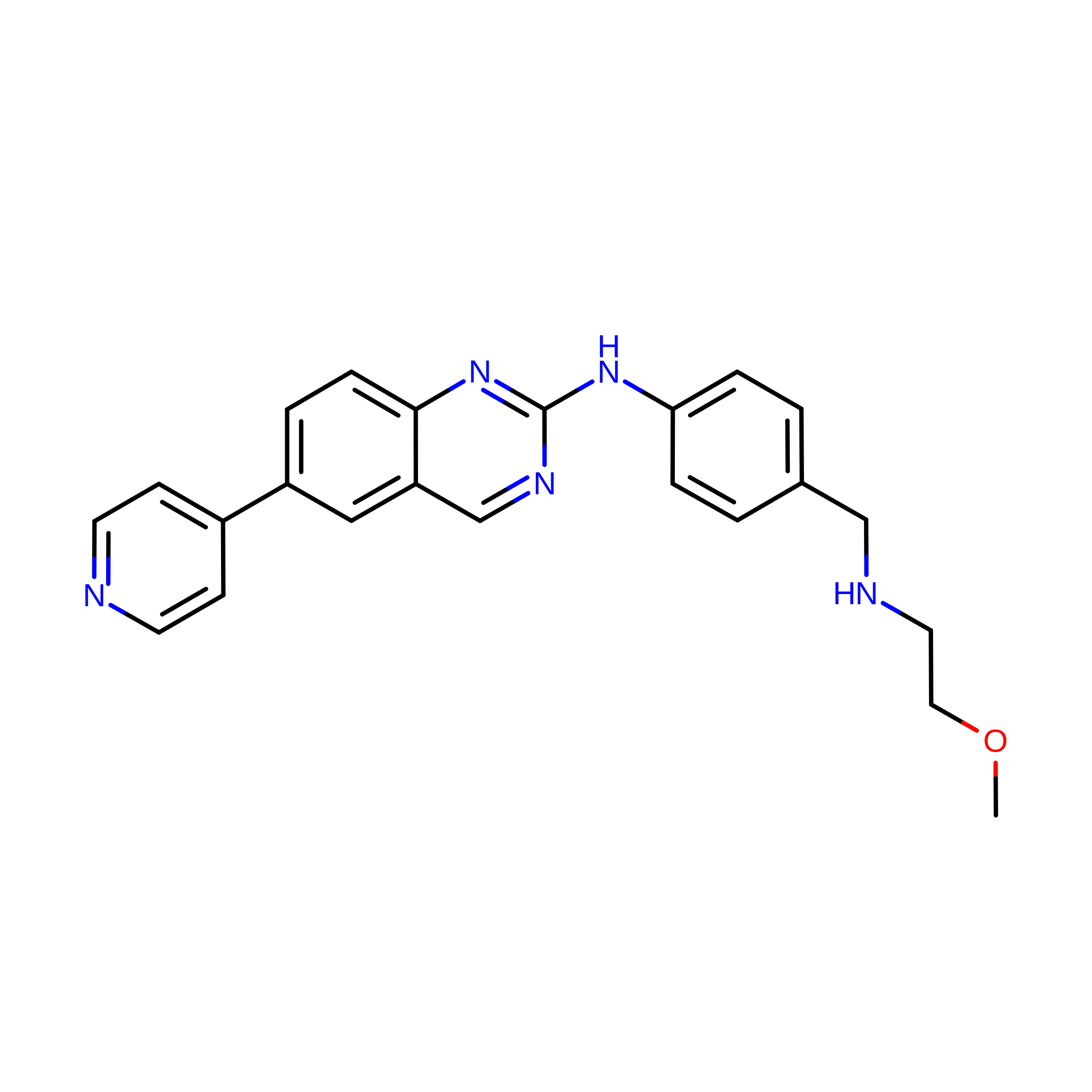
10Z

Query on 10Z


Download:Ideal Coordinates CCD File
D [auth A]N-(4-{[(2-methoxyethyl)amino]methyl}phenyl)-6-(pyridin-4-yl)quinazolin-2-amine
C23 H23 N5 O
UKKAXPVDQSQDFB-UHFFFAOYSA-N
CL

Query on CL


Download:Ideal Coordinates CCD File
E [auth C]CHLORIDE ION
Cl
VEXZGXHMUGYJMC-UHFFFAOYSA-M

Experimental Data & Validation

Experimental Data

  • Method: X-RAY DIFFRACTION
  • Resolution: 3.10 Å
  • R-Value Free:  0.272 (Depositor), 0.272 (DCC) 
  • R-Value Work:  0.222 (Depositor), 0.225 (DCC) 
  • R-Value Observed: 0.224 (Depositor) 
Space Group: I 41 2 2
Unit Cell:
Length ( Å )Angle ( ˚ )
a = 204.74α = 90
b = 204.74β = 90
c = 152.95γ = 90
Software Package:
Software NamePurpose
MOLREPphasing
REFMACrefinement
XDSdata reduction
XSCALEdata scaling

Structure Validation

View Full Validation Report


Ligand Structure Quality Assessment 


Entry History 

Revision History  (Full details and data files)

  • Version 1.0: 2013-02-27
    Type: Initial release
  • Version 1.1: 2013-03-27
    Changes: Database references
  • Version 1.2: 2017-11-15
    Changes: Refinement description
  • Version 1.3: 2023-09-20
    Changes: Data collection, Database references, Derived calculations, Refinement description