4GBR | pdb_00004gbr

N-Terminal T4 Lysozyme Fusion Facilitates Crystallization of a G Protein Coupled Receptor


Experimental Data Snapshot

  • Method: X-RAY DIFFRACTION
  • Resolution: 3.99 Å
  • R-Value Free: 
    0.282 (Depositor), 0.321 (DCC) 
  • R-Value Work: 
    0.265 (Depositor), 0.281 (DCC) 
  • R-Value Observed: 
    0.268 (Depositor) 

wwPDB Validation 3D Report Full Report

Validation slider image for 4GBR

Ligand Structure Quality Assessment 


This is version 1.1 of the entry. See complete history

Literature

N-terminal t4 lysozyme fusion facilitates crystallization of a g protein coupled receptor.

Zou, Y.Weis, W.I.Kobilka, B.K.

(2012) PLoS One 7: e46039-e46039

  • DOI: https://doi.org/10.1371/journal.pone.0046039
  • Primary Citation Related Structures: 
    4GBR

  • PubMed Abstract: 

    A highly crystallizable T4 lysozyme (T4L) was fused to the N-terminus of the β(2) adrenergic receptor (β(2)AR), a G-protein coupled receptor (GPCR) for catecholamines. We demonstrate that the N-terminal fused T4L is sufficiently rigid relative to the receptor to facilitate crystallogenesis without thermostabilizing mutations or the use of a stabilizing antibody, G protein, or protein fused to the 3rd intracellular loop. This approach adds to the protein engineering strategies that enable crystallographic studies of GPCRs alone or in complex with a signaling partner.


  • Organizational Affiliation
    • Department of Molecular and Cellular Physiology, Stanford University School of Medicine, Stanford, California, United States of America.

Macromolecule Content 

  • Total Structure Weight: 53.73 kDa 
  • Atom Count: 3,610 
  • Modeled Residue Count: 448 
  • Deposited Residue Count: 472 
  • Unique protein chains: 2

Macromolecules

Find similar proteins by:|  3D Structure
Entity ID: 1
MoleculeChains  Sequence LengthOrganismDetailsImage
Beta-2 adrenergic receptor309Homo sapiensMutation(s): 3 
Gene Names: ADRB2ADRB2RB2AR
Membrane Entity: Yes 
UniProt & NIH Common Fund Data Resources
Find proteins for P07550 (Homo sapiens)
Explore P07550 
Go to UniProtKB:  P07550
PHAROS:  P07550
GTEx:  ENSG00000169252 
Entity Groups
Sequence Clusters30% Identity50% Identity70% Identity90% Identity95% Identity100% Identity
UniProt GroupP07550
Sequence Annotations
Expand
Reference Sequence
Find similar proteins by:|  3D Structure
Entity ID: 2
MoleculeChains  Sequence LengthOrganismDetailsImage
Lysozyme163Tequatrovirus T4Mutation(s): 0 
Gene Names: E
EC: 3.2.1.17
UniProt
Find proteins for P00720 (Enterobacteria phage T4)
Explore P00720 
Go to UniProtKB:  P00720
Entity Groups
Sequence Clusters30% Identity50% Identity70% Identity90% Identity95% Identity100% Identity
UniProt GroupP00720
Sequence Annotations
Expand
Reference Sequence

Small Molecules

Ligands 1 Unique
IDChains Name / Formula / InChI Key2D Diagram3D Interactions
CAU

Query on CAU


Download:Ideal Coordinates CCD File
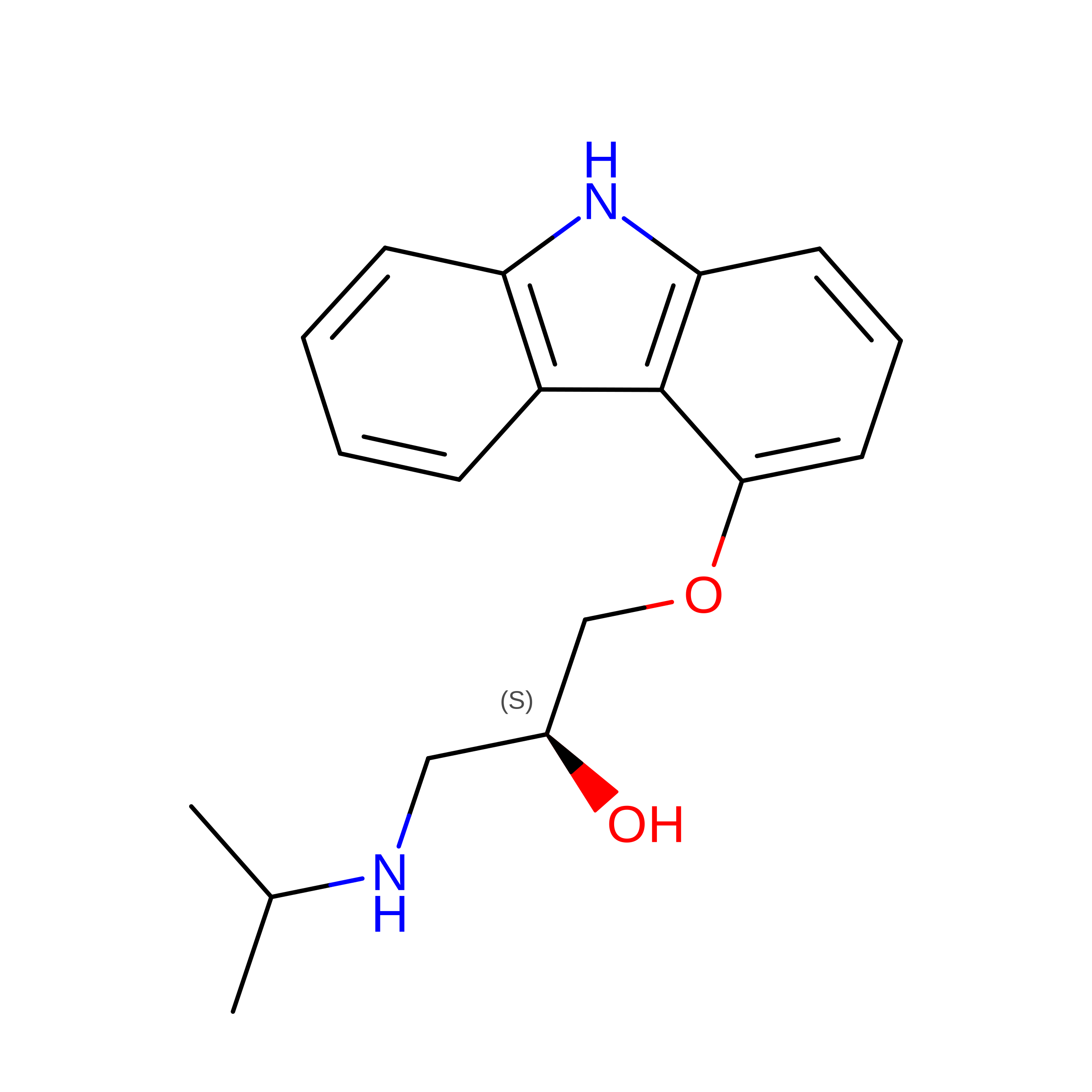
C [auth A](2S)-1-(9H-Carbazol-4-yloxy)-3-(isopropylamino)propan-2-ol
C18 H22 N2 O2
BQXQGZPYHWWCEB-ZDUSSCGKSA-N

Experimental Data & Validation

Experimental Data

  • Method: X-RAY DIFFRACTION
  • Resolution: 3.99 Å
  • R-Value Free:  0.282 (Depositor), 0.321 (DCC) 
  • R-Value Work:  0.265 (Depositor), 0.281 (DCC) 
  • R-Value Observed: 0.268 (Depositor) 
Space Group: P 21 21 21
Unit Cell:
Length ( Å )Angle ( ˚ )
a = 51.382α = 90
b = 71.376β = 90
c = 161.37γ = 90
Software Package:
Software NamePurpose
APEXdata collection
MOLREPphasing
PHENIXrefinement
HKL-2000data reduction
HKL-2000data scaling

Structure Validation

View Full Validation Report


Ligand Structure Quality Assessment 


Entry History 

Deposition Data

Revision History  (Full details and data files)

  • Version 1.0: 2012-10-24
    Type: Initial release
  • Version 1.1: 2024-10-16
    Changes: Data collection, Database references, Derived calculations, Structure summary