4F9G | pdb_00004f9g

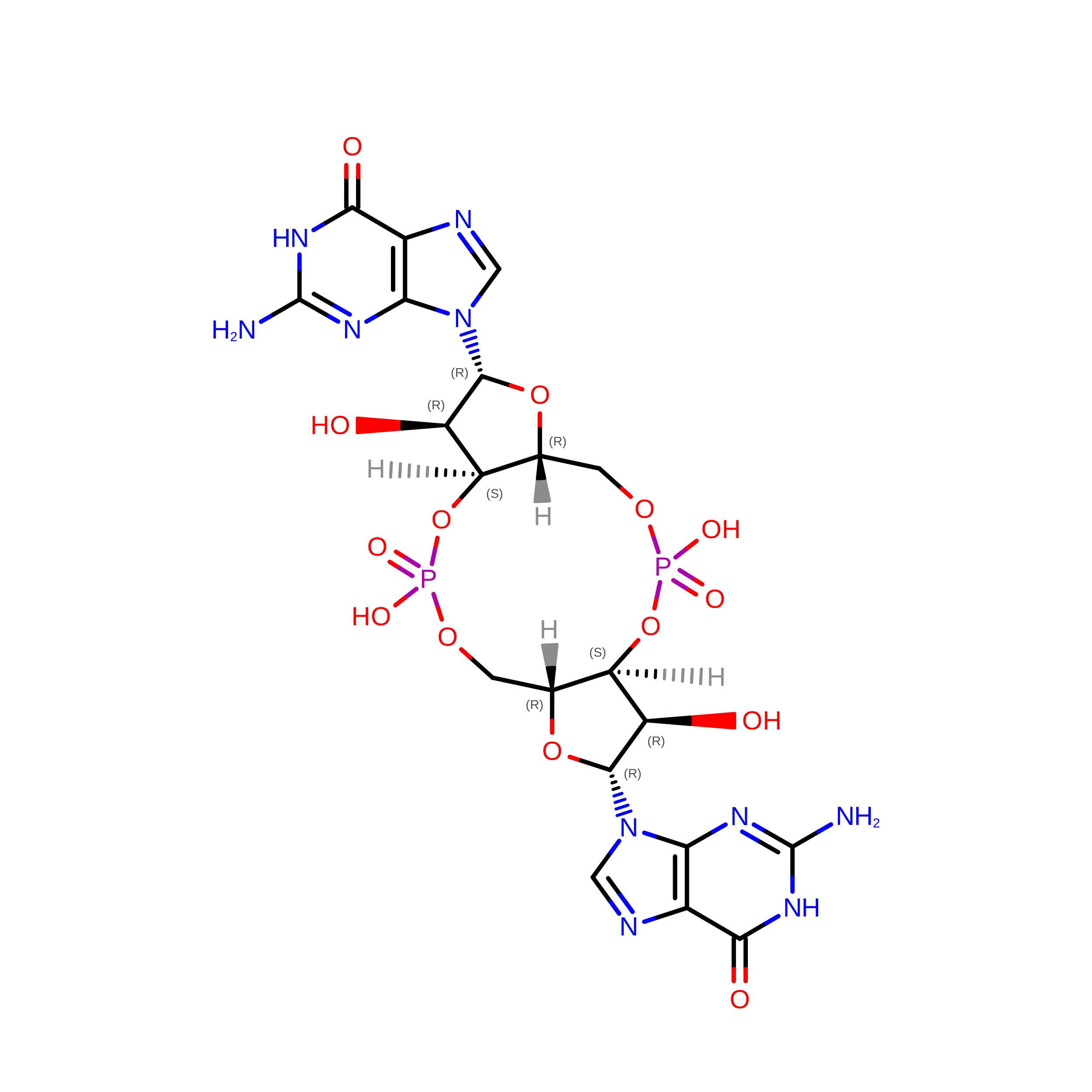
Crystal structure of STING complex with Cyclic di-GMP.


Experimental Data Snapshot

  • Method: X-RAY DIFFRACTION
  • Resolution: 2.95 Å
  • R-Value Free: 
    0.255 (Depositor), 0.270 (DCC) 
  • R-Value Work: 
    0.205 (Depositor), 0.215 (DCC) 
  • R-Value Observed: 
    0.210 (Depositor) 

Starting Model: experimental
View more details

wwPDB Validation 3D Report Full Report

Validation slider image for 4F9G

Ligand Structure Quality Assessment 


This is version 1.2 of the entry. See complete history

Literature

Cyclic di-GMP Sensing via the Innate Immune Signaling Protein STING.

Yin, Q.Tian, Y.Kabaleeswaran, V.Jiang, X.Tu, D.Eck, M.J.Chen, Z.J.Wu, H.

(2012) Mol Cell 46: 735-745

  • DOI: https://doi.org/10.1016/j.molcel.2012.05.029
  • Primary Citation Related Structures: 
    4F9E, 4F9G

  • PubMed Abstract: 

    Detection of foreign materials is the first step of successful immune responses. Stimulator of interferon genes (STING) was shown to directly bind cyclic diguanylate monophosphate (c-di-GMP), a bacterial second messenger, and to elicit strong interferon responses. Here we elucidate the structural features of the cytosolic c-di-GMP binding domain (CBD) of STING and its complex with c-di-GMP. The CBD exhibits an α + β fold and is a dimer in the crystal and in solution. Surprisingly, one c-di-GMP molecule binds to the central crevice of a STING dimer, using a series of stacking and hydrogen bonding interactions. We show that STING is autoinhibited by an intramolecular interaction between the CBD and the C-terminal tail (CTT) and that c-di-GMP releases STING from this autoinhibition by displacing the CTT. The structures provide a remarkable example of pathogen-host interactions in which a unique microbial molecule directly engages the innate immune system.


  • Organizational Affiliation
    • Department of Biochemistry, Weill Cornell Medical College, New York, NY 10065, USA. qiy2001@med.cornell.edu

Macromolecule Content 

  • Total Structure Weight: 60.39 kDa 
  • Atom Count: 2,720 
  • Modeled Residue Count: 339 
  • Deposited Residue Count: 530 
  • Unique protein chains: 1

Macromolecules

Find similar proteins by:|  3D Structure
Entity ID: 1
MoleculeChains  Sequence LengthOrganismDetailsImage
Transmembrane protein 173A,
B [auth C]
265Homo sapiensMutation(s): 0 
Gene Names: TMEM173ERISMITASTING
UniProt & NIH Common Fund Data Resources
Find proteins for Q86WV6 (Homo sapiens)
Explore Q86WV6 
Go to UniProtKB:  Q86WV6
PHAROS:  Q86WV6
GTEx:  ENSG00000184584 
Entity Groups
Sequence Clusters30% Identity50% Identity70% Identity90% Identity95% Identity100% Identity
UniProt GroupQ86WV6
Sequence Annotations
Expand
Reference Sequence

Small Molecules

Ligands 1 Unique
IDChains Name / Formula / InChI Key2D Diagram3D Interactions
C2E

Query on C2E


Download:Ideal Coordinates CCD File
C [auth A]9,9'-[(2R,3R,3aS,5S,7aR,9R,10R,10aS,12S,14aR)-3,5,10,12-tetrahydroxy-5,12-dioxidooctahydro-2H,7H-difuro[3,2-d:3',2'-j][1,3,7,9,2,8]tetraoxadiphosphacyclododecine-2,9-diyl]bis(2-amino-1,9-dihydro-6H-purin-6-one)
C20 H24 N10 O14 P2
PKFDLKSEZWEFGL-MHARETSRSA-N

Experimental Data & Validation

Experimental Data

  • Method: X-RAY DIFFRACTION
  • Resolution: 2.95 Å
  • R-Value Free:  0.255 (Depositor), 0.270 (DCC) 
  • R-Value Work:  0.205 (Depositor), 0.215 (DCC) 
  • R-Value Observed: 0.210 (Depositor) 
Space Group: P 1 21 1
Unit Cell:
Length ( Å )Angle ( ˚ )
a = 60.027α = 90
b = 74.2β = 96.32
c = 60.013γ = 90
Software Package:
Software NamePurpose
DENZOdata reduction
SCALEPACKdata scaling
MOLREPphasing
PHENIXrefinement
PDB_EXTRACTdata extraction
ADSCdata collection

Structure Validation

View Full Validation Report


Ligand Structure Quality Assessment 


Entry History 

Deposition Data

Revision History  (Full details and data files)

  • Version 1.0: 2012-07-25
    Type: Initial release
  • Version 1.1: 2014-01-01
    Changes: Other
  • Version 1.2: 2023-09-13
    Changes: Data collection, Database references, Derived calculations, Refinement description, Structure summary