4EF4 | pdb_00004ef4

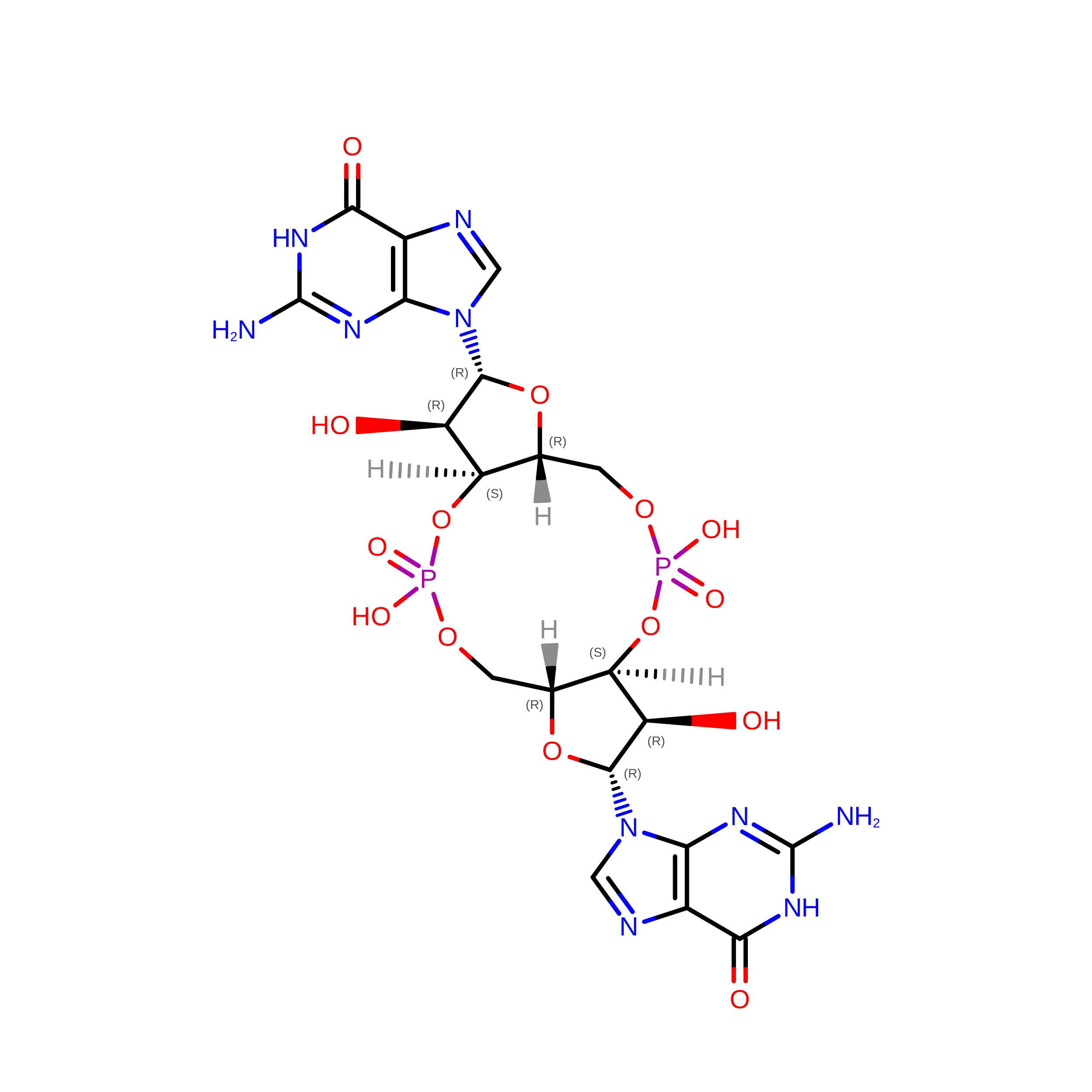
Crystal structure of STING CTD complex with c-di-GMP


Experimental Data Snapshot

  • Method: X-RAY DIFFRACTION
  • Resolution: 2.15 Å
  • R-Value Free: 
    0.257 (Depositor), 0.259 (DCC) 
  • R-Value Work: 
    0.209 (Depositor), 0.215 (DCC) 
  • R-Value Observed: 
    0.211 (Depositor) 

wwPDB Validation 3D Report Full Report

Validation slider image for 4EF4

Ligand Structure Quality Assessment 


This is version 1.4 of the entry. See complete history

Literature

Structural analysis of the STING adaptor protein reveals a hydrophobic dimer interface and mode of cyclic di-GMP binding

Ouyang, S.Song, X.Wang, Y.Ru, H.Shaw, N.Jiang, Y.Niu, F.Zhu, Y.Qiu, W.Parvatiyar, K.Li, Y.Zhang, R.Cheng, G.Liu, Z.J.

(2012) Immunity 36: 1073-1086

  • DOI: https://doi.org/10.1016/j.immuni.2012.03.019
  • Primary Citation Related Structures: 
    4EF4, 4EF5

  • PubMed Abstract: 

    STING is an essential signaling molecule for DNA and cyclic di-GMP (c-di-GMP)-mediated type I interferon (IFN) production via TANK-binding kinase 1 (TBK1) and interferon regulatory factor 3 (IRF3) pathway. It contains an N-terminal transmembrane region and a cytosolic C-terminal domain (CTD). Here, we describe crystal structures of STING CTD alone and complexed with c-di-GMP in a unique binding mode. The strictly conserved aa 153-173 region was shown to be cytosolic and participated in dimerization via hydrophobic interactions. The STING CTD functions as a dimer and the dimerization was independent of posttranslational modifications. Binding of c-di-GMP enhanced interaction of a shorter construct of STING CTD (residues 139-344) with TBK1. This suggests an extra TBK1 binding site, other than serine 358. This study provides a glimpse into the unique architecture of STING and sheds light on the mechanism of c-di-GMP-mediated TBK1 signaling.


  • Organizational Affiliation
    • National Laboratory of Biomacromolecules, Institute of Biophysics, Chinese Academy of Sciences, Beijing, China.

Macromolecule Content 

  • Total Structure Weight: 60.47 kDa 
  • Atom Count: 3,063 
  • Modeled Residue Count: 355 
  • Deposited Residue Count: 530 
  • Unique protein chains: 1

Macromolecules

Find similar proteins by:|  3D Structure
Entity ID: 1
MoleculeChains  Sequence LengthOrganismDetailsImage
Transmembrane protein 173
A, B
265Homo sapiensMutation(s): 0 
Gene Names: STING/MITA/ERIS/MPYS/TMEM173
UniProt & NIH Common Fund Data Resources
Find proteins for Q86WV6 (Homo sapiens)
Explore Q86WV6 
Go to UniProtKB:  Q86WV6
PHAROS:  Q86WV6
GTEx:  ENSG00000184584 
Entity Groups
Sequence Clusters30% Identity50% Identity70% Identity90% Identity95% Identity100% Identity
UniProt GroupQ86WV6
Sequence Annotations
Expand
Reference Sequence

Small Molecules

Ligands 2 Unique
IDChains Name / Formula / InChI Key2D Diagram3D Interactions
C2E

Query on C2E


Download:Ideal Coordinates CCD File
C [auth A]9,9'-[(2R,3R,3aS,5S,7aR,9R,10R,10aS,12S,14aR)-3,5,10,12-tetrahydroxy-5,12-dioxidooctahydro-2H,7H-difuro[3,2-d:3',2'-j][1,3,7,9,2,8]tetraoxadiphosphacyclododecine-2,9-diyl]bis(2-amino-1,9-dihydro-6H-purin-6-one)
C20 H24 N10 O14 P2
PKFDLKSEZWEFGL-MHARETSRSA-N
CA

Query on CA


Download:Ideal Coordinates CCD File
D [auth A],
E [auth B]
CALCIUM ION
Ca
BHPQYMZQTOCNFJ-UHFFFAOYSA-N

Experimental Data & Validation

Experimental Data

  • Method: X-RAY DIFFRACTION
  • Resolution: 2.15 Å
  • R-Value Free:  0.257 (Depositor), 0.259 (DCC) 
  • R-Value Work:  0.209 (Depositor), 0.215 (DCC) 
  • R-Value Observed: 0.211 (Depositor) 
Space Group: P 1 21 1
Unit Cell:
Length ( Å )Angle ( ˚ )
a = 61.375α = 90
b = 72.84β = 97.03
c = 62.44γ = 90
Software Package:
Software NamePurpose
HKL-2000data collection
SHELXSphasing
PHENIXrefinement
HKL-2000data reduction
HKL-2000data scaling

Structure Validation

View Full Validation Report


Ligand Structure Quality Assessment 


Entry History 

Deposition Data

Revision History  (Full details and data files)

  • Version 1.0: 2012-05-16
    Type: Initial release
  • Version 1.1: 2012-05-23
    Changes: Database references
  • Version 1.2: 2012-05-30
    Changes: Database references
  • Version 1.3: 2013-07-03
    Changes: Database references
  • Version 1.4: 2024-03-20
    Changes: Data collection, Database references, Derived calculations, Structure summary