4CIZ | pdb_00004ciz

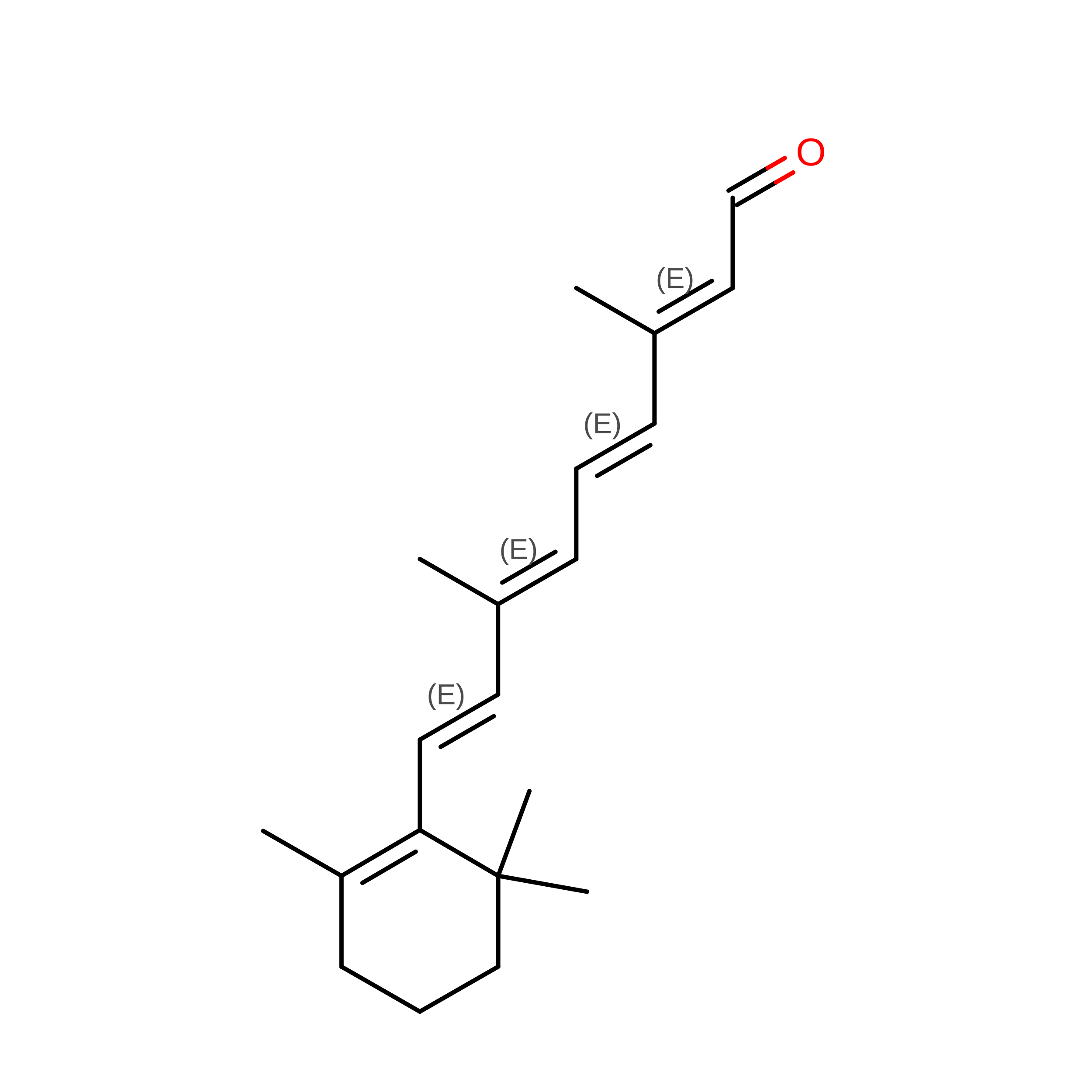
Crystal structure of the complex of the Cellular Retinal Binding Protein with 9-cis-retinal


Experimental Data Snapshot

  • Method: X-RAY DIFFRACTION
  • Resolution: 3.40 Å
  • R-Value Free: 
    0.265 (Depositor), 0.285 (DCC) 
  • R-Value Work: 
    0.234 (Depositor), 0.245 (DCC) 
  • R-Value Observed: 
    0.236 (Depositor) 

Starting Model: experimental
View more details

wwPDB Validation 3D Report Full Report

Validation slider image for 4CIZ

Ligand Structure Quality Assessment 


This is version 1.2 of the entry. See complete history

Literature

Human Cellular Retinaldehyde-Binding Protein Has Secondary Thermal 9-Cis-Retinal Isomerase Activity.

Bolze, C.S.Helbling, R.E.Owen, R.L.Pearson, A.R.Pompidor, G.Dworkowski, F.Fuchs, M.R.Furrer, J.Golczak, M.Palczewski, K.Cascella, M.Stocker, A.

(2014) J Am Chem Soc 136: 137

  • DOI: https://doi.org/10.1021/ja411366w
  • Primary Citation Related Structures: 
    4CIZ, 4CJ6

  • PubMed Abstract: 

    Cellular retinaldehyde-binding protein (CRALBP) chaperones 11-cis-retinal to convert opsin receptor molecules into photosensitive retinoid pigments of the eye. We report a thermal secondary isomerase activity of CRALBP when bound to 9-cis-retinal. UV/vis and (1)H NMR spectroscopy were used to characterize the product as 9,13-dicis-retinal. The X-ray structure of the CRALBP mutant R234W:9-cis-retinal complex at 1.9 Å resolution revealed a niche in the binding pocket for 9-cis-aldehyde different from that reported for 11-cis-retinal. Combined computational, kinetic, and structural data lead us to propose an isomerization mechanism catalyzed by a network of buried waters. Our findings highlight a specific role of water molecules in both CRALBP-assisted specificity toward 9-cis-retinal and its thermal isomerase activity yielding 9,13-dicis-retinal. Kinetic data from two point mutants of CRALBP support an essential role of Glu202 as the initial proton donor in this isomerization reaction.


  • Organizational Affiliation
    • Department of Chemistry and Biochemistry, and ‡Graduate School for Cellular and Biomedical Sciences, University of Bern , Freiestrasse 3, 3012 Bern, Switzerland.

Macromolecule Content 

  • Total Structure Weight: 36.95 kDa 
  • Atom Count: 2,345 
  • Modeled Residue Count: 284 
  • Deposited Residue Count: 317 
  • Unique protein chains: 1

Macromolecules

Find similar proteins by:|  3D Structure
Entity ID: 1
MoleculeChains  Sequence LengthOrganismDetailsImage
RETINALDEHYDE-BINDING PROTEIN 1317Homo sapiensMutation(s): 0 
UniProt & NIH Common Fund Data Resources
Find proteins for P12271 (Homo sapiens)
Explore P12271 
Go to UniProtKB:  P12271
PHAROS:  P12271
GTEx:  ENSG00000140522 
Entity Groups
Sequence Clusters30% Identity50% Identity70% Identity90% Identity95% Identity100% Identity
UniProt GroupP12271
Sequence Annotations
Expand
Reference Sequence

Experimental Data & Validation

Experimental Data

  • Method: X-RAY DIFFRACTION
  • Resolution: 3.40 Å
  • R-Value Free:  0.265 (Depositor), 0.285 (DCC) 
  • R-Value Work:  0.234 (Depositor), 0.245 (DCC) 
  • R-Value Observed: 0.236 (Depositor) 
Space Group: P 65 2 2
Unit Cell:
Length ( Å )Angle ( ˚ )
a = 70.556α = 90
b = 70.556β = 90
c = 299.747γ = 120
Software Package:
Software NamePurpose
PHENIXrefinement
XDSdata reduction
SCALEPACKdata scaling
PHASERphasing

Structure Validation

View Full Validation Report


Ligand Structure Quality Assessment 


Entry History 

Revision History  (Full details and data files)

  • Version 1.0: 2014-01-08
    Type: Initial release
  • Version 1.1: 2014-01-22
    Changes: Database references
  • Version 1.2: 2023-12-20
    Changes: Data collection, Database references, Derived calculations, Other, Refinement description