4A15 | pdb_00004a15

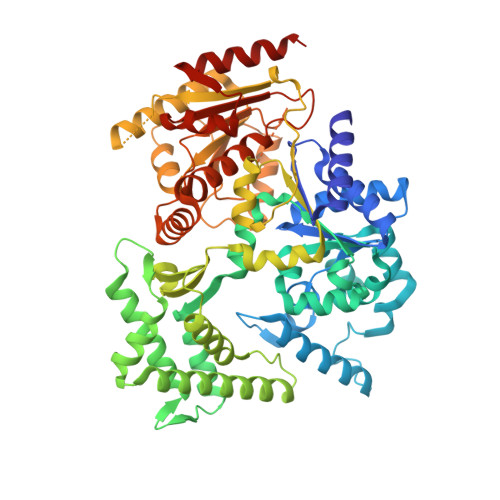
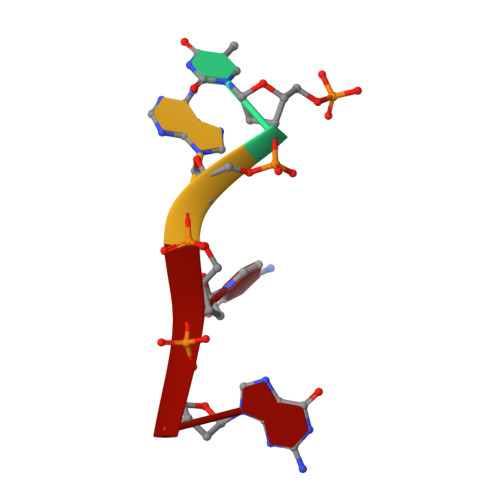
Crystal structure of an XPD DNA complex


Experimental Data Snapshot

  • Method: X-RAY DIFFRACTION
  • Resolution: 2.20 Å
  • R-Value Free: 
    0.250 (Depositor), 0.253 (DCC) 
  • R-Value Work: 
    0.192 (Depositor), 0.195 (DCC) 
  • R-Value Observed: 
    0.195 (Depositor) 

Starting Model: experimental
View more details

wwPDB Validation 3D Report Full Report

Validation slider image for 4A15

This is version 1.1 of the entry. See complete history

Literature

Functional and Structural Studies of the Nucleotide Excision Repair Helicase Xpd Suggest a Polarity for DNA Translocation.

Kuper, J.Wolski, S.C.Michels, G.Kisker, C.

(2011) EMBO J 31: 494

  • DOI: https://doi.org/10.1038/emboj.2011.374
  • Primary Citation Related Structures: 
    4A15

  • PubMed Abstract: 

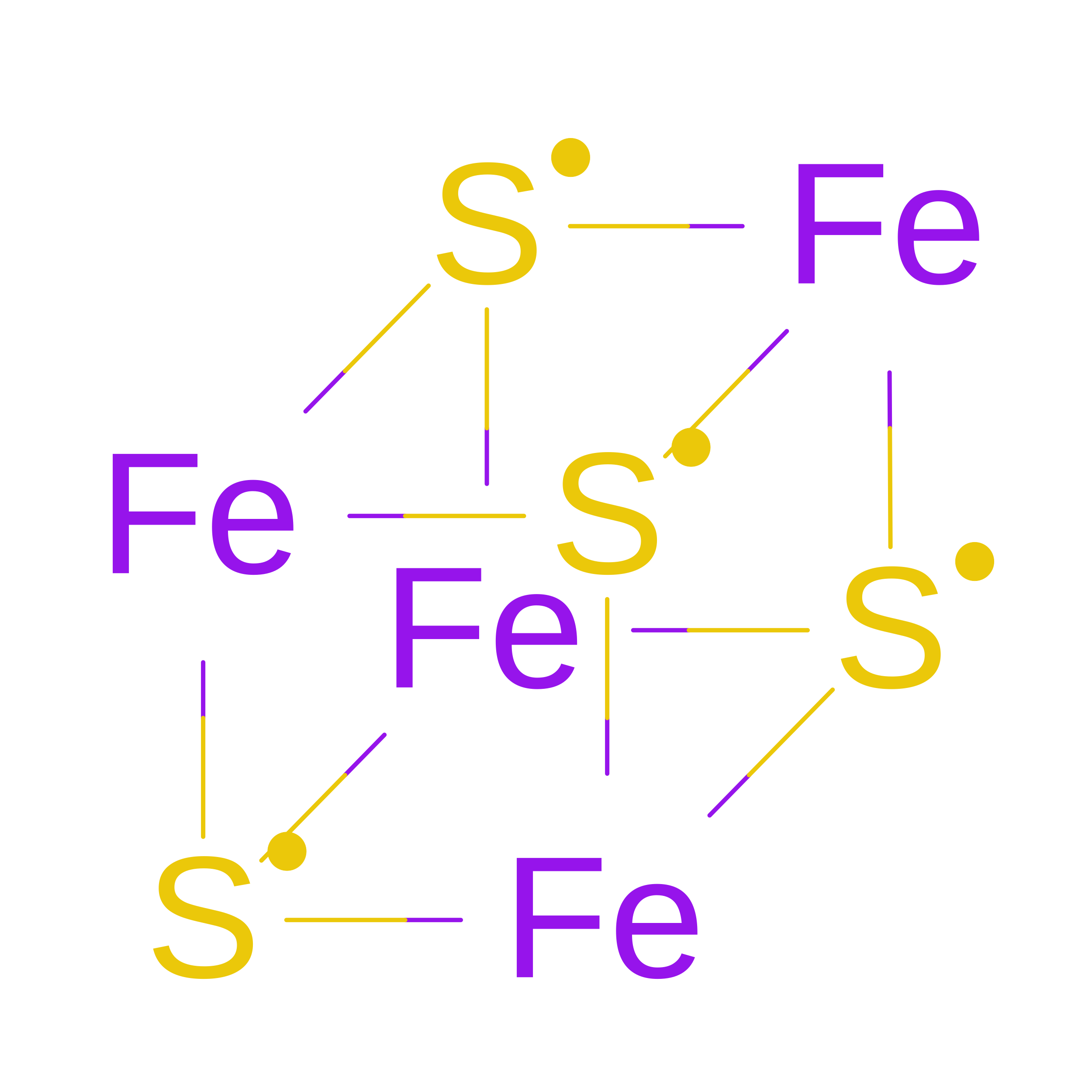
    The XPD protein is a vital subunit of the general transcription factor TFIIH which is not only involved in transcription but is also an essential component of the eukaryotic nucleotide excision DNA repair (NER) pathway. XPD is a superfamily-2 5'-3' helicase containing an iron-sulphur cluster. Its helicase activity is indispensable for NER and it plays a role in the damage verification process. Here, we report the first structure of XPD from Thermoplasma acidophilum (taXPD) in complex with a short DNA fragment, thus revealing the polarity of the translocated strand and providing insights into how the enzyme achieves its 5'-3' directionality. Accompanied by a detailed mutational and biochemical analysis of taXPD, we define the path of the translocated DNA strand through the protein and identify amino acids that are critical for protein function.


  • Organizational Affiliation
    • Rudolf Virchow Center for Experimental Biomedicine, Institute for Structural Biology, University of Würzburg, Würzburg, Germany. jochen.kuper@virchow.uni-wuerzburg.de

Macromolecule Content 

  • Total Structure Weight: 73.35 kDa 
  • Atom Count: 5,067 
  • Modeled Residue Count: 600 
  • Deposited Residue Count: 624 
  • Unique protein chains: 1
  • Unique nucleic acid chains: 1

Macromolecules


Find similar proteins by:|  3D Structure
Entity ID: 1
MoleculeChains  Sequence LengthOrganismDetailsImage
ATP-DEPENDENT DNA HELICASE TA0057620Thermoplasma acidophilumMutation(s): 0 
EC: 3.6.4.12 (PDB Primary Data), 5.6.2.3 (UniProt)
UniProt
Find proteins for Q9HM14 (Thermoplasma acidophilum (strain ATCC 25905 / DSM 1728 / JCM 9062 / NBRC 15155 / AMRC-C165))
Explore Q9HM14 
Go to UniProtKB:  Q9HM14
Entity Groups
Sequence Clusters30% Identity50% Identity70% Identity90% Identity95% Identity100% Identity
UniProt GroupQ9HM14
Sequence Annotations
Expand
Reference Sequence
Find similar nucleic acids by:  Sequence
Entity ID: 2
MoleculeChains LengthOrganismImage
5'-D(*DTP*AP*CP*GP)-3'B [auth E]4N/A
Sequence Annotations
Expand
Reference Sequence

Experimental Data & Validation

Experimental Data

  • Method: X-RAY DIFFRACTION
  • Resolution: 2.20 Å
  • R-Value Free:  0.250 (Depositor), 0.253 (DCC) 
  • R-Value Work:  0.192 (Depositor), 0.195 (DCC) 
  • R-Value Observed: 0.195 (Depositor) 
Space Group: P 65
Unit Cell:
Length ( Å )Angle ( ˚ )
a = 79.06α = 90
b = 79.06β = 90
c = 175.69γ = 120
Software Package:
Software NamePurpose
REFMACrefinement
MOSFLMdata reduction
SCALAdata scaling
PHASERphasing

Structure Validation

View Full Validation Report


Entry History 

Deposition Data

Revision History  (Full details and data files)

  • Version 1.0: 2012-02-01
    Type: Initial release
  • Version 1.1: 2023-12-20
    Changes: Data collection, Database references, Derived calculations, Other, Refinement description