3ZUL | pdb_00003zul

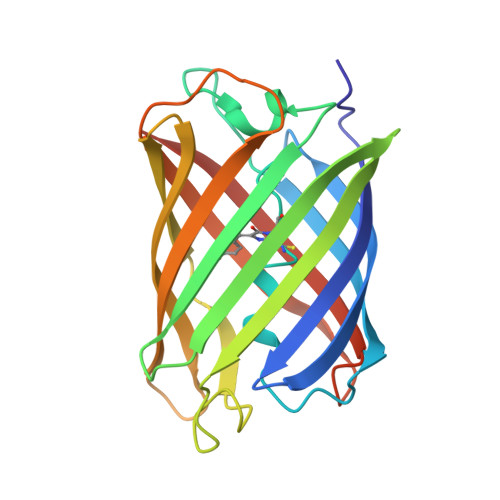
Padron on (fluorescent) Icis intermediate state


Experimental Data Snapshot

  • Method: X-RAY DIFFRACTION
  • Resolution: 2.30 Å
  • R-Value Free: 
    0.256 (Depositor), 0.245 (DCC) 
  • R-Value Work: 
    0.204 (Depositor), 0.195 (DCC) 
  • R-Value Observed: 
    0.206 (Depositor) 

Starting Model: experimental
View more details

wwPDB Validation 3D Report Full Report

Validation slider image for 3ZUL

This is version 2.2 of the entry. See complete history

Literature

Low-Temperature Chromophore Isomerization Reveals the Photoswitching Mechanism of the Fluorescent Protein Padron.

Regis Faro, A.Carpentier, P.Jonasson, G.Pompidor, G.Arcizet, D.Demachy, I.Bourgeois, D.

(2011) J Am Chem Soc 133: 16362

  • DOI: https://doi.org/10.1021/ja207001y
  • Primary Citation Related Structures: 
    3ZUF, 3ZUJ, 3ZUL

  • PubMed Abstract: 

    Photoactivatable fluorescent proteins are essential players in nanoscopy approaches based on the super-localization of single molecules. The subclass of reversibly photoswitchable fluorescent proteins typically activate through isomerization of the chromophore coupled with a change in its protonation state. However, the interplay between these two events, the details of photoswitching pathways, and the role of protein dynamics remain incompletely understood. Here, by using a combination of structural and spectroscopic approaches, we discovered two fluorescent intermediate states along the on-switching pathway of the fluorescent protein Padron. The first intermediate can be populated at temperatures as low as 100 K and results from a remarkable trans-cis isomerization of the anionic chromophore taking place within a protein matrix essentially deprived of conformational flexibility. This intermediate evolves in the dark at cryotemperatures to a second structurally similar but spectroscopically distinct anionic intermediate. The final fluorescent state, which consists of a mixture of anionic and neutral chromophores in the cis configuration, is only reached above the glass transition temperature, suggesting that chromophore protonation involves solvent interactions mediated by pronounced dynamical breathing of the protein scaffold. The possibility of efficiently and reversibly photoactivating Padron at cryotemperatures will facilitate the development of advanced super-resolution imaging modalities such as cryonanoscopy.


  • Organizational Affiliation
    • Pixel Team, IBS, Institut de Biologie Structurale Jean-Pierre Ebel, CEA, CNRS, Université Joseph Fourier, 41 rue Jules Horowitz, F-38027 Grenoble, France.

Macromolecule Content 

  • Total Structure Weight: 152.06 kDa 
  • Atom Count: 11,166 
  • Modeled Residue Count: 1,286 
  • Deposited Residue Count: 1,326 
  • Unique protein chains: 1

Macromolecules

Find similar proteins by:|  3D Structure
Entity ID: 1
MoleculeChains  Sequence LengthOrganismDetailsImage
FLUORESCENT PROTEIN DRONPA
A, B, C, D, E
A, B, C, D, E, F
221Echinophyllia sp. SC22Mutation(s): 1 
UniProt
Find proteins for Q5TLG6 (Echinophyllia sp. SC22)
Explore Q5TLG6 
Go to UniProtKB:  Q5TLG6
Entity Groups
Sequence Clusters30% Identity50% Identity70% Identity90% Identity95% Identity100% Identity
UniProt GroupQ5TLG6
Sequence Annotations
Expand
Reference Sequence

Small Molecules

Modified Residues  1 Unique
IDChains TypeFormula2D DiagramParent
GYC
Query on GYC
A, B, C, D, E
A, B, C, D, E, F
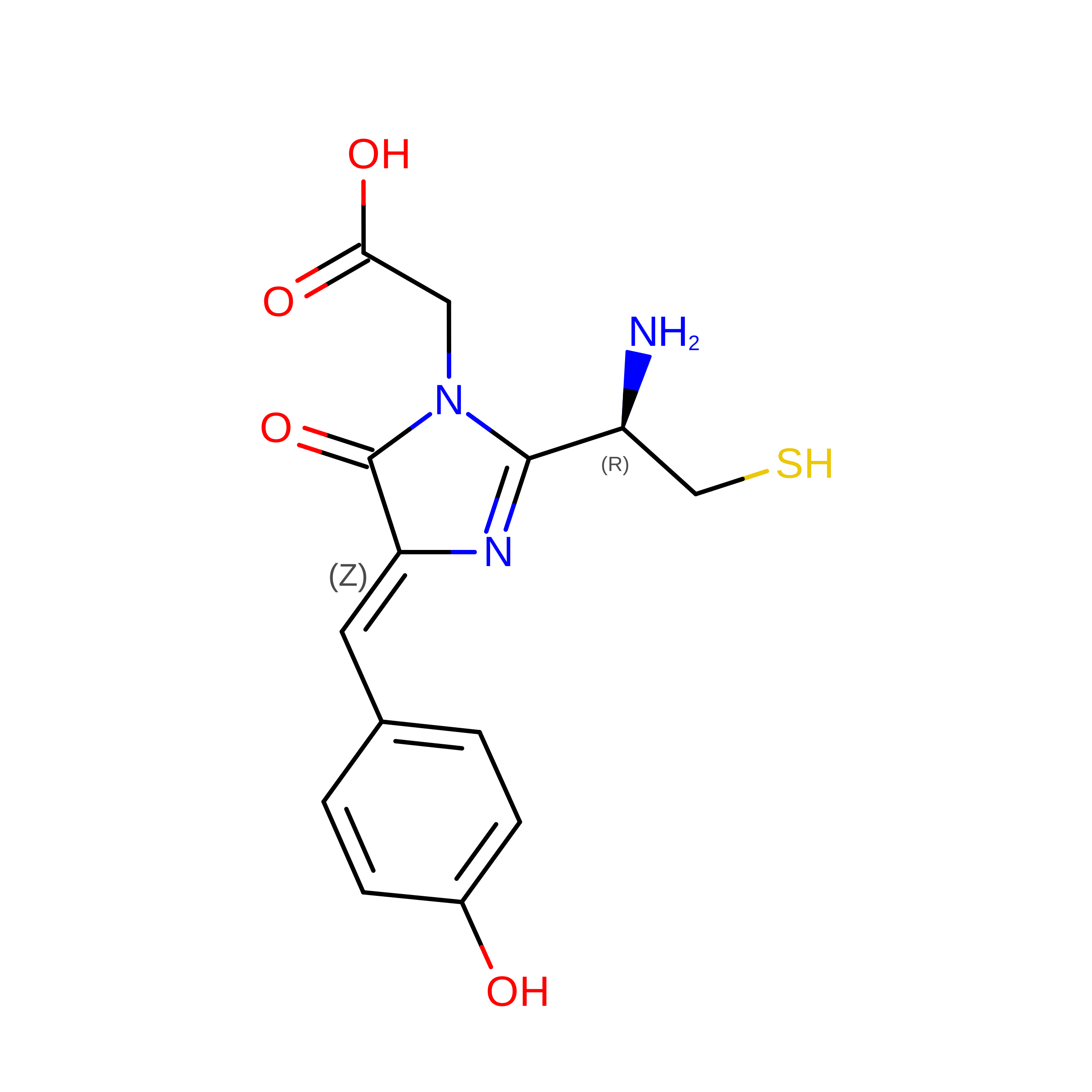
L-PEPTIDE LINKINGC14 H15 N3 O4 SCYS, TYR, GLY

Experimental Data & Validation

Experimental Data

  • Method: X-RAY DIFFRACTION
  • Resolution: 2.30 Å
  • R-Value Free:  0.256 (Depositor), 0.245 (DCC) 
  • R-Value Work:  0.204 (Depositor), 0.195 (DCC) 
  • R-Value Observed: 0.206 (Depositor) 
Space Group: P 21 21 2
Unit Cell:
Length ( Å )Angle ( ˚ )
a = 108.97α = 90
b = 181.38β = 90
c = 72.82γ = 90
Software Package:
Software NamePurpose
PHENIXrefinement
XDSdata reduction
XSCALEdata scaling
PHASERphasing

Structure Validation

View Full Validation Report


Entry History 

Deposition Data

Revision History  (Full details and data files)

  • Version 1.0: 2011-11-09
    Type: Initial release
  • Version 1.1: 2019-10-23
    Changes: Advisory, Data collection, Database references, Derived calculations, Other
  • Version 2.0: 2023-11-15
    Changes: Advisory, Atomic model, Data collection, Database references, Derived calculations
  • Version 2.1: 2023-12-20
    Changes: Refinement description
  • Version 2.2: 2024-10-23
    Changes: Structure summary