3ZP4 | pdb_00003zp4

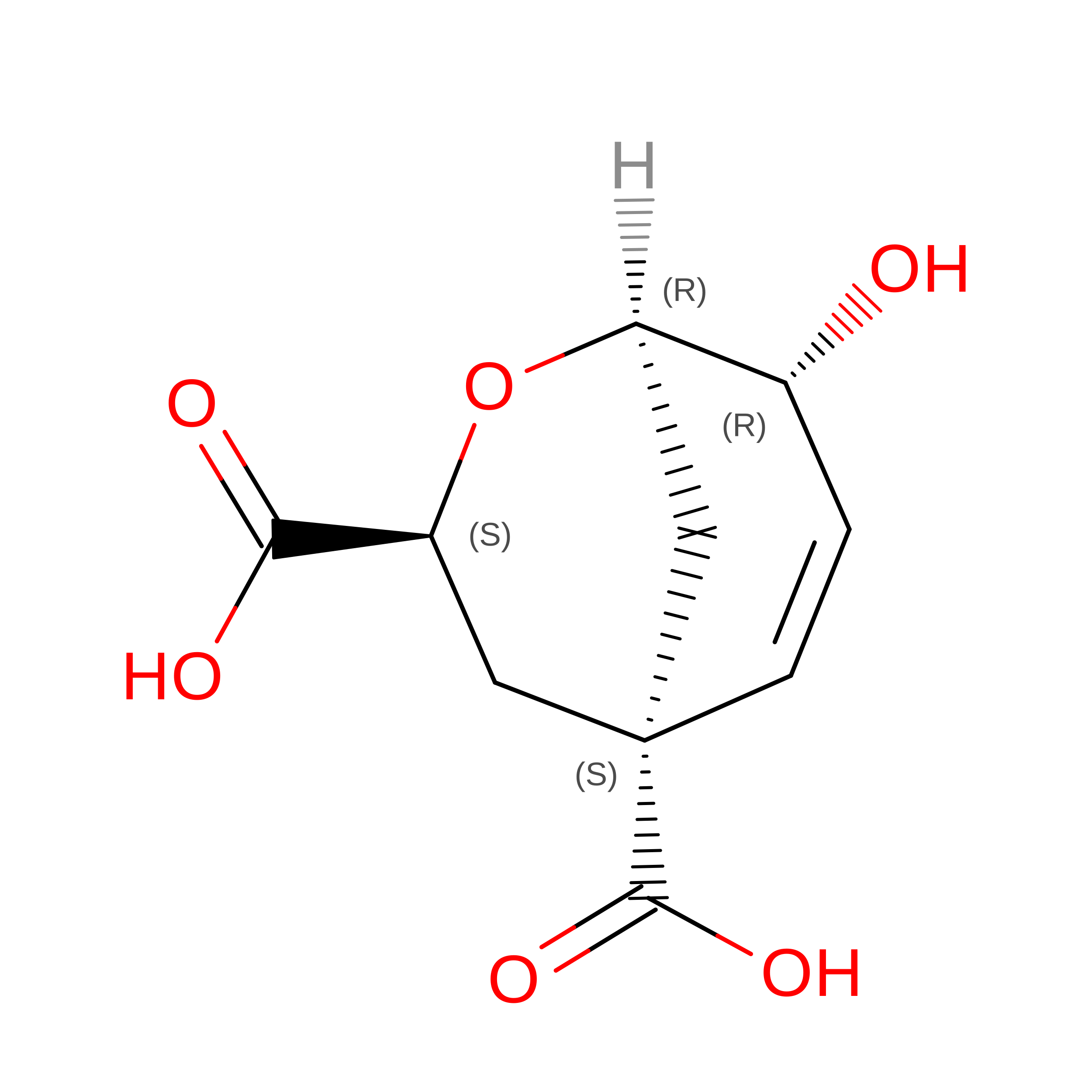
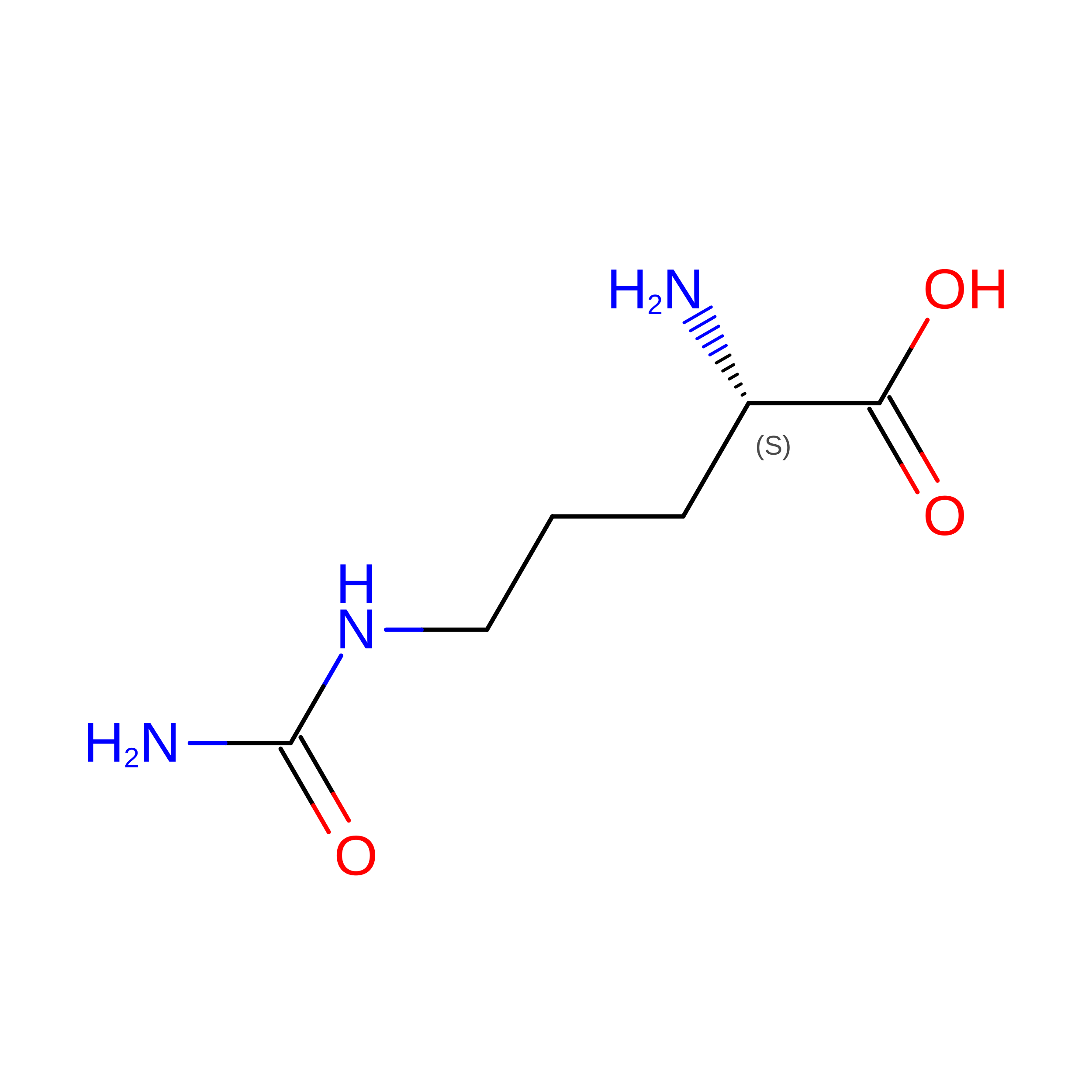
Arg90Cit chorismate mutase of Bacillus subtilis in complex with a transition state analog


Experimental Data Snapshot

  • Method: X-RAY DIFFRACTION
  • Resolution: 1.80 Å
  • R-Value Free: 
    0.231 (Depositor), 0.229 (DCC) 
  • R-Value Work: 
    0.179 (Depositor), 0.176 (DCC) 
  • R-Value Observed: 
    0.181 (Depositor) 

Starting Model: experimental
View more details

wwPDB Validation 3D Report Full Report

Validation slider image for 3ZP4

Ligand Structure Quality Assessment 


This is version 2.2 of the entry. See complete history

Literature

Electrostatic Transition State Stabilization Rather Than Reactant Destabilization Provides the Chemical Basis for Efficient Chorismate Mutase Catalysis.

Burschowsky, D.Van Eerde, A.Okvist, M.Kienhofer, A.Kast, P.Hilvert, D.Krengel, U.

(2014) Proc Natl Acad Sci U S A 111: 17516

  • DOI: https://doi.org/10.1073/pnas.1408512111
  • Primary Citation Related Structures: 
    3ZO8, 3ZOP, 3ZP4, 3ZP7

  • PubMed Abstract: 

    For more than half a century, transition state theory has provided a useful framework for understanding the origins of enzyme catalysis. As proposed by Pauling, enzymes accelerate chemical reactions by binding transition states tighter than substrates, thereby lowering the activation energy compared with that of the corresponding uncatalyzed process. This paradigm has been challenged for chorismate mutase (CM), a well-characterized metabolic enzyme that catalyzes the rearrangement of chorismate to prephenate. Calculations have predicted the decisive factor in CM catalysis to be ground state destabilization rather than transition state stabilization. Using X-ray crystallography, we show, in contrast, that a sluggish variant of Bacillus subtilis CM, in which a cationic active-site arginine was replaced by a neutral citrulline, is a poor catalyst even though it effectively preorganizes chorismate for the reaction. A series of high-resolution molecular snapshots of the reaction coordinate, including the apo enzyme, and complexes with substrate, transition state analog and product, demonstrate that an active site, which is only complementary in shape to a reactive substrate conformer, is insufficient for effective catalysis. Instead, as with other enzymes, electrostatic stabilization of the CM transition state appears to be crucial for achieving high reaction rates.


  • Organizational Affiliation
    • Department of Chemistry, University of Oslo, NO-0315 Oslo, Norway; and.

Macromolecule Content 

  • Total Structure Weight: 88.04 kDa 
  • Atom Count: 6,024 
  • Modeled Residue Count: 702 
  • Deposited Residue Count: 762 
  • Unique protein chains: 1

Macromolecules

Find similar proteins by:|  3D Structure
Entity ID: 1
MoleculeChains  Sequence LengthOrganismDetailsImage
CHORISMATE MUTASE AROH
A, B, C, D, E
A, B, C, D, E, F
127Bacillus subtilisMutation(s): 2 
EC: 5.4.99.5
UniProt
Find proteins for P19080 (Bacillus subtilis (strain 168))
Explore P19080 
Go to UniProtKB:  P19080
Entity Groups
Sequence Clusters30% Identity50% Identity70% Identity90% Identity95% Identity100% Identity
UniProt GroupP19080
Sequence Annotations
Expand
Reference Sequence

Experimental Data & Validation

Experimental Data

  • Method: X-RAY DIFFRACTION
  • Resolution: 1.80 Å
  • R-Value Free:  0.231 (Depositor), 0.229 (DCC) 
  • R-Value Work:  0.179 (Depositor), 0.176 (DCC) 
  • R-Value Observed: 0.181 (Depositor) 
Space Group: P 1
Unit Cell:
Length ( Å )Angle ( ˚ )
a = 50.208α = 97.36
b = 50.842β = 93.18
c = 69.821γ = 100.99
Software Package:
Software NamePurpose
PHENIXrefinement
XDSdata reduction
XDSdata scaling
PHASERphasing

Structure Validation

View Full Validation Report


Ligand Structure Quality Assessment 


Entry History 

Deposition Data

Revision History  (Full details and data files)

  • Version 1.0: 2014-04-16
    Type: Initial release
  • Version 1.1: 2014-11-26
    Changes: Database references
  • Version 1.2: 2014-12-03
    Changes: Database references
  • Version 1.3: 2014-12-10
    Changes: Database references
  • Version 1.4: 2014-12-24
    Changes: Database references
  • Version 2.0: 2023-11-15
    Changes: Atomic model, Data collection, Database references, Derived calculations, Other
  • Version 2.1: 2023-12-20
    Changes: Refinement description
  • Version 2.2: 2024-11-13
    Changes: Structure summary