3T3D | pdb_00003t3d

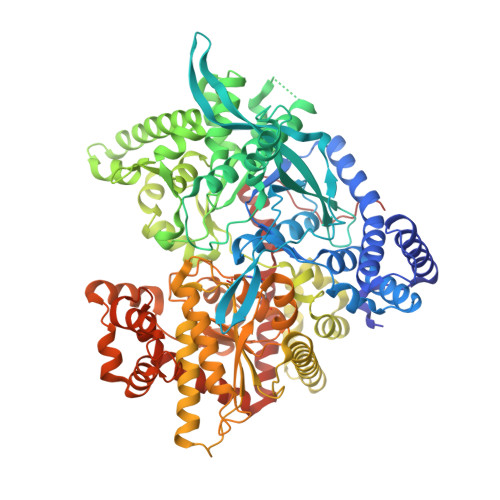
Glycogen phosphorylase b in complex with GlcU


Experimental Data Snapshot

  • Method: X-RAY DIFFRACTION
  • Resolution: 2.50 Å
  • R-Value Free: 
    0.223 (Depositor), 0.218 (DCC) 
  • R-Value Work: 
    0.156 (Depositor), 0.154 (DCC) 
  • R-Value Observed: 
    0.160 (Depositor) 

Starting Model: experimental
View more details

wwPDB Validation 3D Report Full Report

Validation slider image for 3T3D

Ligand Structure Quality Assessment 


This is version 2.2 of the entry. See complete history

Literature

The sigma-Hole Phenomenon of Halogen Atoms Forms the Structural Basis of the Strong Inhibitory Potency of C5 Halogen Substituted Glucopyranosyl Nucleosides towards Glycogen Phosphorylase  b

Kantsadi, A.L.Hayes, J.M.Manta, S.Skamnaki, V.T.Kiritsis, C.Psarra, A.M.Koutsogiannis, Z.Dimopoulou, A.Theofanous, S.Nikoleousakos, N.Zoumpoulakis, P.Kontou, M.Papadopoulos, G.Zographos, S.E.Komiotis, D.Leonidas, D.D.

(2012) ChemMedChem 7: 722-732

  • DOI: https://doi.org/10.1002/cmdc.201100533
  • Primary Citation Related Structures: 
    3T3D, 3T3E, 3T3G, 3T3H, 3T3I

  • PubMed Abstract: 

    C5 halogen substituted glucopyranosyl nucleosides (1-(β-D-glucopyranosyl)-5-X-uracil; X=Cl, Br, I) have been discovered as some of the most potent active site inhibitors of glycogen phosphorylase (GP), with respective K(i) values of 1.02, 3.27, and 1.94 μM. The ability of the halogen atom to form intermolecular electrostatic interactions through the σ-hole phenomenon rather than through steric effects alone forms the structural basis of their improved inhibitory potential relative to the unsubstituted 1-(β-D-glucopyranosyl)uracil (K(i) =12.39 μM), as revealed by X-ray crystallography and modeling calculations exploiting quantum mechanics methods. Good agreement was obtained between kinetics results and relative binding affinities calculated by QM/MM-PBSA methodology for various substitutions at C5. Ex vivo experiments demonstrated that the most potent derivative (X=Cl) toward purified GP has no cytotoxicity and moderate inhibitory potency at the cellular level. In accordance, ADMET property predictions were performed, and suggest decreased polar surface areas as a potential means of improving activity in the cell.


  • Organizational Affiliation
    • Department of Biochemistry and Biotechnology, University of Thessaly, 26 Ploutonos Str., 41221 Larissa, Greece.

Macromolecule Content 

  • Total Structure Weight: 97.79 kDa 
  • Atom Count: 6,830 
  • Modeled Residue Count: 810 
  • Deposited Residue Count: 842 
  • Unique protein chains: 1

Macromolecules

Find similar proteins by:|  3D Structure
Entity ID: 1
MoleculeChains  Sequence LengthOrganismDetailsImage
Glycogen phosphorylase, muscle form842Oryctolagus cuniculusMutation(s): 0 
EC: 2.4.1.1
UniProt
Find proteins for P00489 (Oryctolagus cuniculus)
Explore P00489 
Go to UniProtKB:  P00489
Entity Groups
Sequence Clusters30% Identity50% Identity70% Identity90% Identity95% Identity100% Identity
UniProt GroupP00489
Sequence Annotations
Expand
Reference Sequence

Small Molecules

Ligands 1 Unique
IDChains Name / Formula / InChI Key2D Diagram3D Interactions
CJB

Query on CJB


Download:Ideal Coordinates CCD File
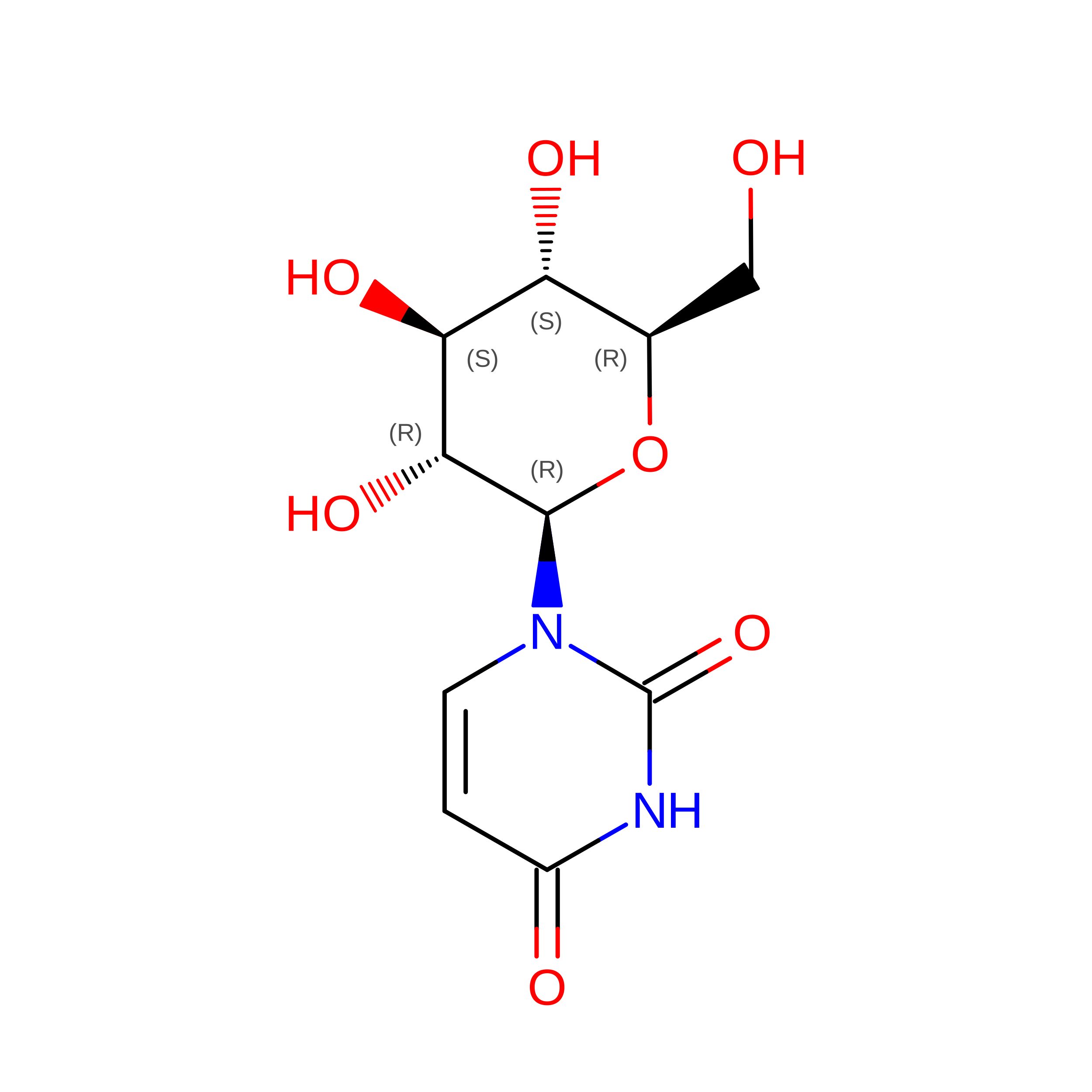
B [auth A]1-beta-D-glucopyranosylpyrimidine-2,4(1H,3H)-dione
C10 H14 N2 O7
PBGBADORVLQASN-DDIGBBAMSA-N
Modified Residues  1 Unique
IDChains TypeFormula2D DiagramParent
LLP
Query on LLP
A
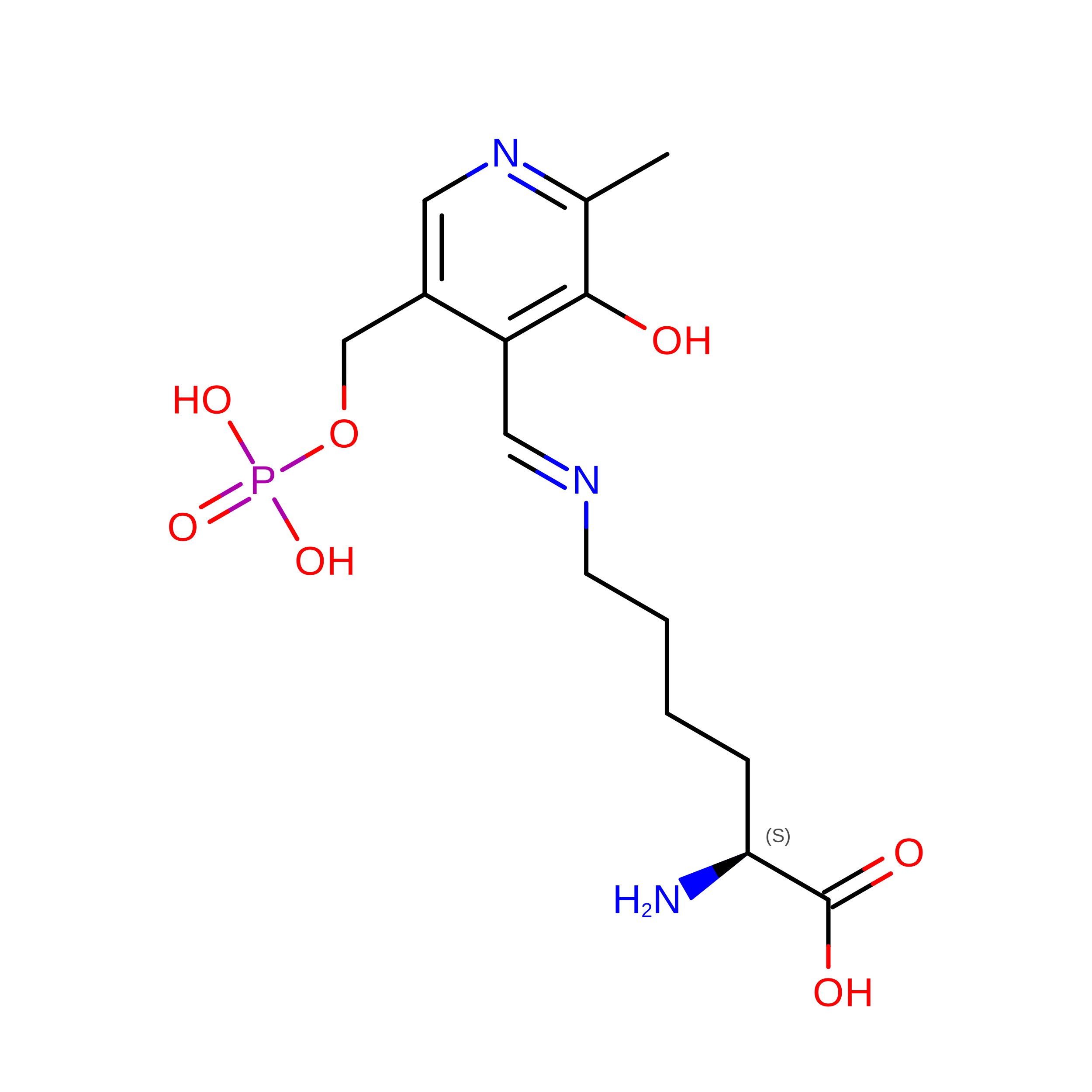
L-PEPTIDE LINKINGC14 H22 N3 O7 PLYS
Binding Affinity Annotations 
IDSourceBinding Affinity
CJB BindingDB:  3T3D Ki: 6100 (nM) from 1 assay(s)

Experimental Data & Validation

Experimental Data

  • Method: X-RAY DIFFRACTION
  • Resolution: 2.50 Å
  • R-Value Free:  0.223 (Depositor), 0.218 (DCC) 
  • R-Value Work:  0.156 (Depositor), 0.154 (DCC) 
  • R-Value Observed: 0.160 (Depositor) 
Space Group: P 43 21 2
Unit Cell:
Length ( Å )Angle ( ˚ )
a = 128.636α = 90
b = 128.636β = 90
c = 116.283γ = 90
Software Package:
Software NamePurpose
CrysalisProdata collection
REFMACrefinement
MOSFLMdata reduction
SCALAdata scaling
REFMACphasing

Structure Validation

View Full Validation Report


Ligand Structure Quality Assessment 


Entry History 

Deposition Data

Revision History  (Full details and data files)

  • Version 1.0: 2012-02-15
    Type: Initial release
  • Version 1.1: 2013-06-26
    Changes: Database references
  • Version 1.2: 2017-11-08
    Changes: Refinement description
  • Version 2.0: 2020-07-29
    Type: Remediation
    Reason: Carbohydrate remediation
    Changes: Atomic model, Data collection, Derived calculations
  • Version 2.1: 2023-09-13
    Changes: Data collection, Database references, Refinement description, Structure summary
  • Version 2.2: 2023-12-06
    Changes: Data collection