3OSR | pdb_00003osr

Maltose-bound maltose sensor engineered by insertion of circularly permuted green fluorescent protein into E. coli maltose binding protein at position 311


Experimental Data Snapshot

  • Method: X-RAY DIFFRACTION
  • Resolution: 2.00 Å
  • R-Value Free: 
    0.226 (Depositor), 0.233 (DCC) 
  • R-Value Work: 
    0.183 (Depositor), 0.193 (DCC) 
  • R-Value Observed: 
    0.185 (Depositor) 

Starting Models: experimental
View more details

wwPDB Validation 3D Report Full Report

Validation slider image for 3OSR

This is version 4.0 of the entry. See complete history

Literature

A genetically encoded, high-signal-to-noise maltose sensor.

Marvin, J.S.Schreiter, E.R.Echevarria, I.M.Looger, L.L.

(2011) Proteins 79: 3025-3036

  • DOI: https://doi.org/10.1002/prot.23118
  • Primary Citation Related Structures: 
    3OSQ, 3OSR

  • PubMed Abstract: 

    We describe the generation of a family of high-signal-to-noise single-wavelength genetically encoded indicators for maltose. This was achieved by insertion of circularly permuted fluorescent proteins into a bacterial periplasmic binding protein (PBP), Escherichia coli maltodextrin-binding protein, resulting in a four-color family of maltose indicators. The sensors were iteratively optimized to have sufficient brightness and maltose-dependent fluorescence increases for imaging, under both one- and two-photon illumination. We demonstrate that maltose affinity of the sensors can be tuned in a fashion largely independent of the fluorescent readout mechanism. Using literature mutations, the binding specificity could be altered to moderate sucrose preference, but with a significant loss of affinity. We use the soluble sensors in individual E. coli bacteria to observe rapid maltose transport across the plasma membrane, and membrane fusion versions of the sensors on mammalian cells to visualize the addition of maltose to extracellular media. The PBP superfamily includes scaffolds specific for a number of analytes whose visualization would be critical to the reverse engineering of complex systems such as neural networks, biosynthetic pathways, and signal transduction cascades. We expect the methodology outlined here to be useful in the development of indicators for many such analytes.


  • Organizational Affiliation
    • Janelia Farm Research Campus, Howard Hughes Medical Institute, Ashburn, Virginia 20147, USA. marvinj@janelia.hhmi.org

Macromolecule Content 

  • Total Structure Weight: 146.07 kDa 
  • Atom Count: 10,100 
  • Modeled Residue Count: 1,205 
  • Deposited Residue Count: 1,306 
  • Unique protein chains: 1

Macromolecules

Find similar proteins by:|  3D Structure
Entity ID: 1
MoleculeChains  Sequence LengthOrganismDetailsImage
Maltose-binding periplasmic protein,Green fluorescent protein
A, B
653Escherichia coli O157:H7Aequorea victoriaMutation(s): 1 
Gene Names: malEZ5632ECs5017GFP
UniProt
Find proteins for P0AEX9 (Escherichia coli (strain K12))
Explore P0AEX9 
Go to UniProtKB:  P0AEX9
Entity Groups
Sequence Clusters30% Identity50% Identity70% Identity90% Identity95% Identity100% Identity
UniProt GroupP0AEX9
Sequence Annotations
Expand
Reference Sequence

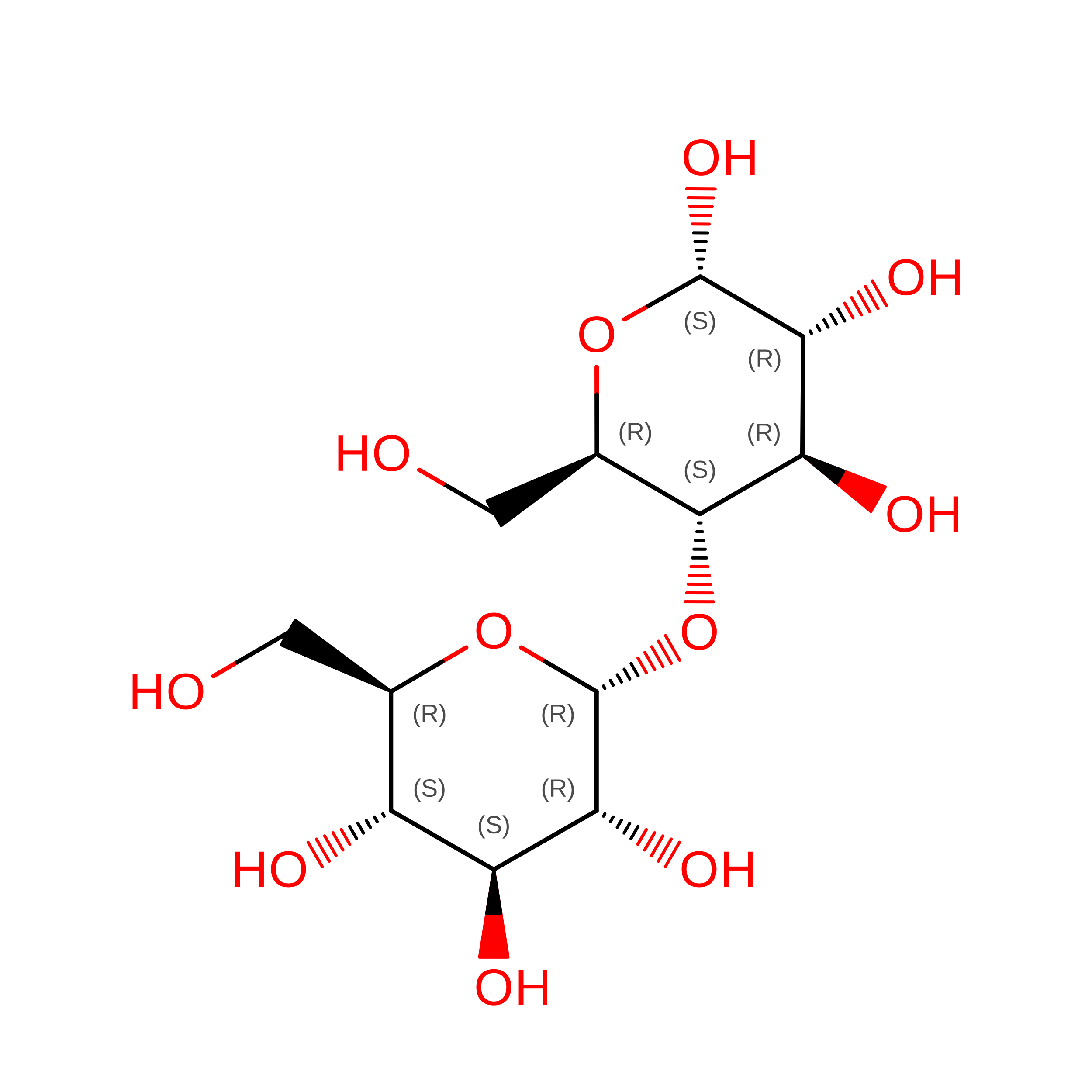
Oligosaccharides

Help  
Entity ID: 2
MoleculeChains Length2D Diagram GlycosylationD Interactions
alpha-D-glucopyranose-(1-4)-alpha-D-glucopyranose
C, D
2N/A
Glycosylation Resources
GlyTouCan: G07411ON
GlyCosmos: G07411ON

Small Molecules

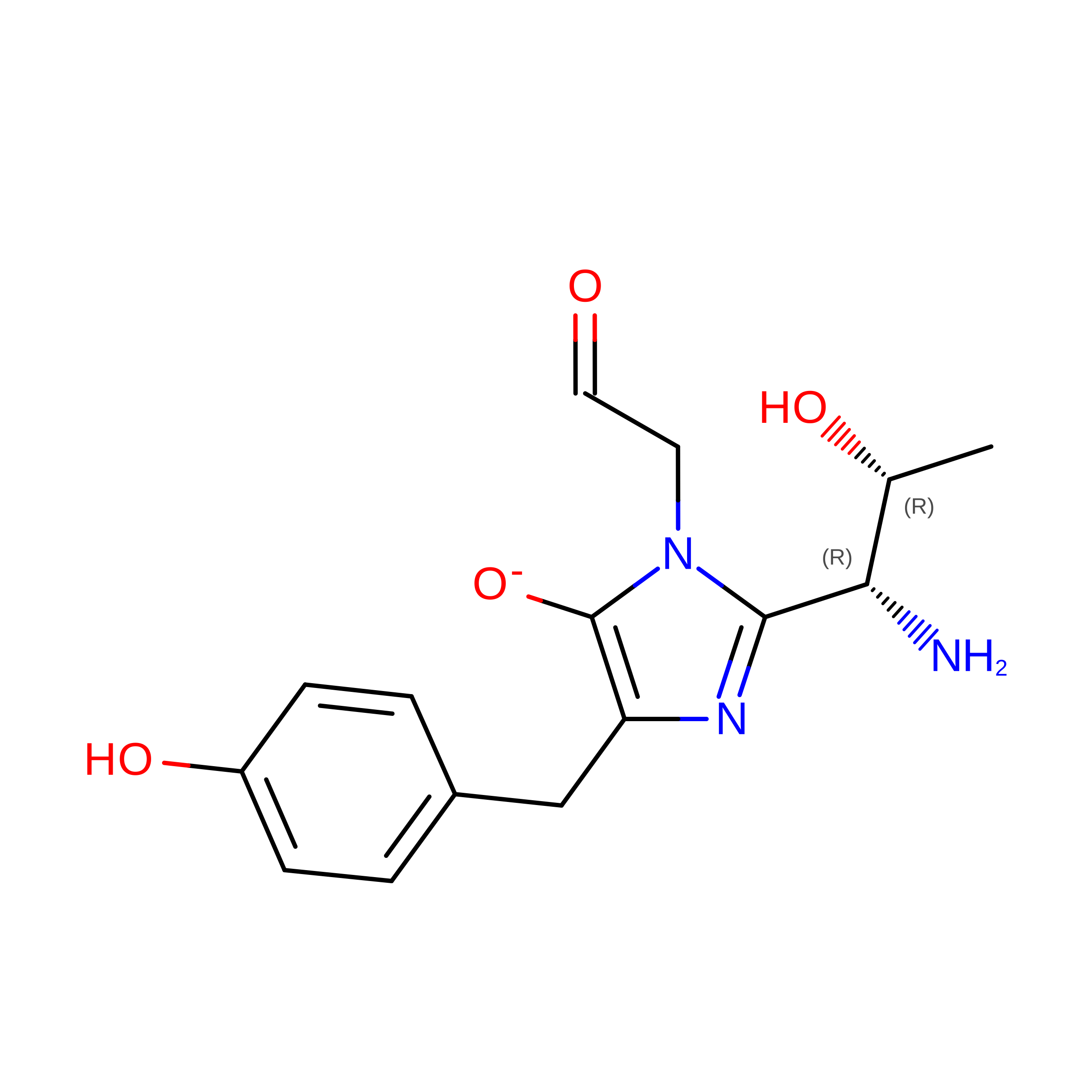
Modified Residues  1 Unique
IDChains TypeFormula2D DiagramParent
C12
Query on C12
A, B
L-PEPTIDE LINKINGC15 H18 N3 O5THR, TYR, GLY

Biologically Interesting Molecules (External Reference) 

1 Unique

Experimental Data & Validation

Experimental Data

  • Method: X-RAY DIFFRACTION
  • Resolution: 2.00 Å
  • R-Value Free:  0.226 (Depositor), 0.233 (DCC) 
  • R-Value Work:  0.183 (Depositor), 0.193 (DCC) 
  • R-Value Observed: 0.185 (Depositor) 
Space Group: P 1 21 1
Unit Cell:
Length ( Å )Angle ( ˚ )
a = 56.825α = 90
b = 74.813β = 97.52
c = 171.504γ = 90
Software Package:
Software NamePurpose
specdata collection
PHASERphasing
REFMACrefinement
MOSFLMdata reduction
SCALAdata scaling

Structure Validation

View Full Validation Report


Entry History 

Deposition Data

Revision History  (Full details and data files)

  • Version 1.0: 2011-10-26
    Type: Initial release
  • Version 1.1: 2013-05-08
    Changes: Database references
  • Version 1.2: 2017-06-21
    Changes: Database references, Source and taxonomy, Structure summary
  • Version 2.0: 2020-07-29
    Type: Remediation
    Reason: Carbohydrate remediation
    Changes: Atomic model, Data collection, Database references, Derived calculations, Non-polymer description, Structure summary
  • Version 2.1: 2023-09-06
    Changes: Data collection, Database references, Refinement description, Structure summary
  • Version 2.2: 2023-12-06
    Changes: Data collection
  • Version 3.0: 2024-07-10
    Changes: Data collection, Non-polymer description, Structure summary
  • Version 3.1: 2024-10-30
    Changes: Structure summary
  • Version 4.0: 2026-03-18
    Changes: Polymer sequence