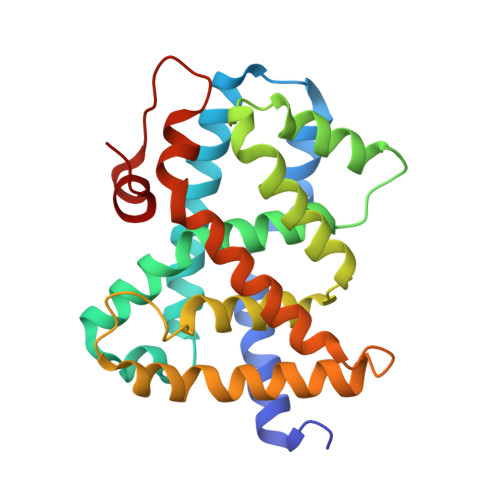
3OOK | pdb_00003ook

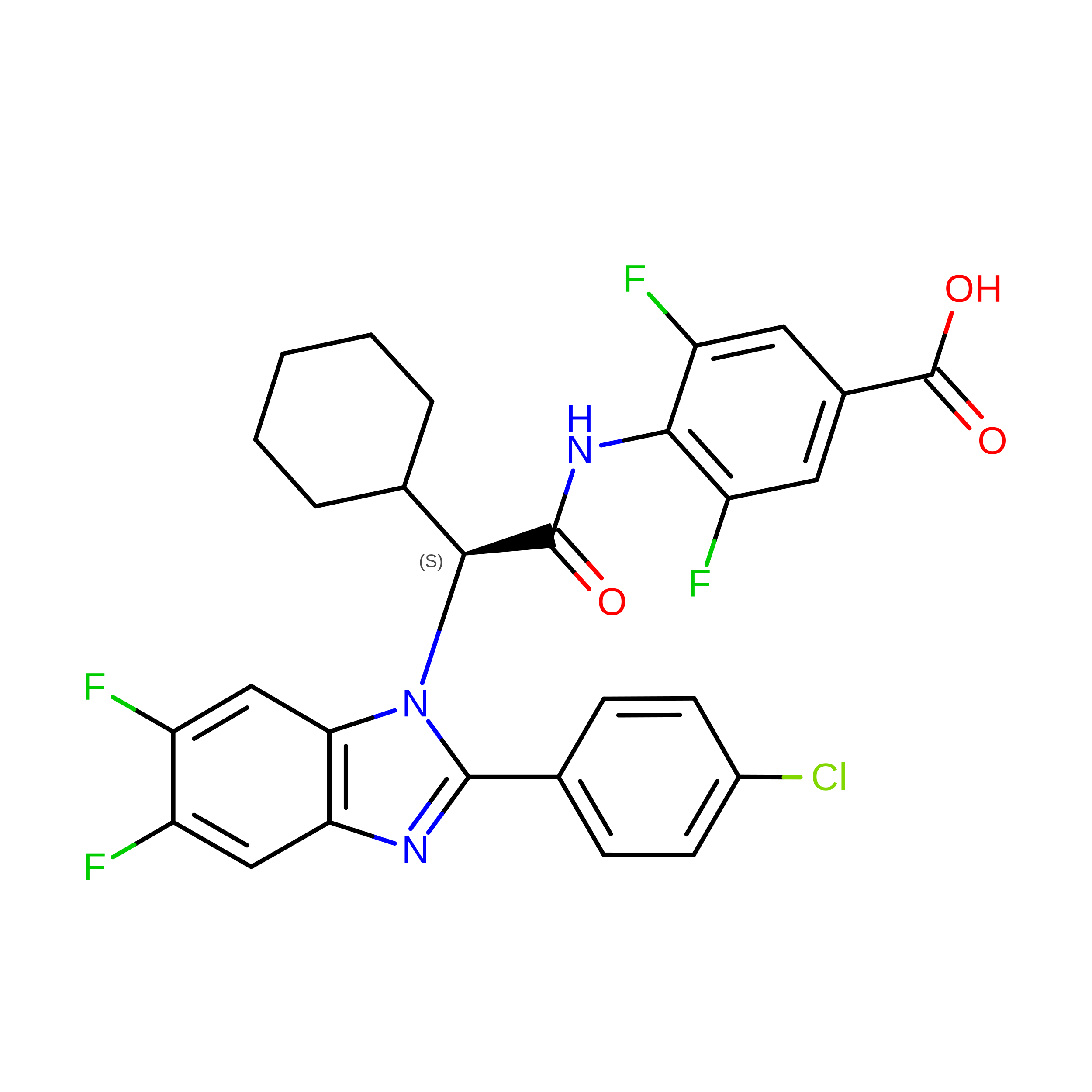
Crystal structure of human FXR in complex with 4-({(2S)-2-[2-(4-chlorophenyl)-5,6-difluoro-1H-benzimidazol-1-yl]-2-cyclohexylacetyl}amino)-3,5-difluorobenzoic acid


Experimental Data Snapshot

  • Method: X-RAY DIFFRACTION
  • Resolution: 2.29 Å
  • R-Value Free: 
    0.271 (Depositor), 0.264 (DCC) 
  • R-Value Work: 
    0.229 (Depositor), 0.214 (DCC) 
  • R-Value Observed: 
    0.231 (Depositor) 

Starting Model: other
View more details

wwPDB Validation 3D Report Full Report

Validation slider image for 3OOK

Ligand Structure Quality Assessment 


This is version 1.4 of the entry. See complete history

Literature

Optimization of a novel class of benzimidazole-based farnesoid X receptor (FXR) agonists to improve physicochemical and ADME properties

Richter, H.G.F.Benson, G.M.Bleicher, K.H.Blum, D.Chaput, E.Clemann, N.Feng, S.Gardes, C.Grether, U.Hartman, P.Kuhn, B.Martin, R.E.Plancher, J.M.Rudolph, M.G.Schuler, F.Taylor, S.

(2011) Bioorg Med Chem Lett 21: 1134-1140

  • DOI: https://doi.org/10.1016/j.bmcl.2010.12.123
  • Primary Citation Related Structures: 
    3OLF, 3OMK, 3OMM, 3OOF, 3OOK

  • PubMed Abstract: 

    Structure-guided lead optimization of recently described benzimidazolyl acetamides addressed the key liabilities of the previous lead compound 1. These efforts culminated in the discovery of 4-{(S)-2-[2-(4-chloro-phenyl)-5,6-difluoro-benzoimidazol-1-yl]-2-cyclohexyl-acetylamino}-3-fluoro-benzoic acid 7g, a highly potent and selective FXR agonist with excellent physicochemical and ADME properties and potent lipid lowering activity after oral administration to LDL receptor deficient mice.


  • Organizational Affiliation
    • F. Hoffmann-La Roche Ltd, Pharmaceutical Research, Grenzacherstrasse, CH-4070 Basel, Switzerland. hans.richter@roche.com

Macromolecule Content 

  • Total Structure Weight: 58.9 kDa 
  • Atom Count: 4,212 
  • Modeled Residue Count: 483 
  • Deposited Residue Count: 494 
  • Unique protein chains: 2

Macromolecules

Find similar proteins by:|  3D Structure
Entity ID: 1
MoleculeChains  Sequence LengthOrganismDetailsImage
Bile acid receptor
A, C
233Homo sapiensMutation(s): 2 
Gene Names: NR1H4HCG_20893
UniProt & NIH Common Fund Data Resources
Find proteins for Q96RI1 (Homo sapiens)
Explore Q96RI1 
Go to UniProtKB:  Q96RI1
PHAROS:  Q96RI1
GTEx:  ENSG00000012504 
Entity Groups
Sequence Clusters30% Identity50% Identity70% Identity90% Identity95% Identity100% Identity
UniProt GroupQ96RI1
Sequence Annotations
Expand
Reference Sequence
Find similar proteins by:  Sequence   |   3D Structure  
Entity ID: 2
MoleculeChains  Sequence LengthOrganismDetailsImage
peptide of Nuclear receptor coactivator 1
B, D
14N/AMutation(s): 0 
EC: 2.3.1.48
UniProt & NIH Common Fund Data Resources
Find proteins for Q15788 (Homo sapiens)
Explore Q15788 
Go to UniProtKB:  Q15788
PHAROS:  Q15788
GTEx:  ENSG00000084676 
Entity Groups
Sequence Clusters30% Identity50% Identity70% Identity90% Identity95% Identity100% Identity
UniProt GroupQ15788
Sequence Annotations
Expand
Reference Sequence

Small Molecules

Ligands 1 Unique
IDChains Name / Formula / InChI Key2D Diagram3D Interactions
OOK

Query on OOK


Download:Ideal Coordinates CCD File
E [auth A],
F [auth C]
4-({(2S)-2-[2-(4-chlorophenyl)-5,6-difluoro-1H-benzimidazol-1-yl]-2-cyclohexylacetyl}amino)-3,5-difluorobenzoic acid
C28 H22 Cl F4 N3 O3
MRVUTCGFXDGVGC-VWLOTQADSA-N

Experimental Data & Validation

Experimental Data

  • Method: X-RAY DIFFRACTION
  • Resolution: 2.29 Å
  • R-Value Free:  0.271 (Depositor), 0.264 (DCC) 
  • R-Value Work:  0.229 (Depositor), 0.214 (DCC) 
  • R-Value Observed: 0.231 (Depositor) 
Space Group: C 2 2 21
Unit Cell:
Length ( Å )Angle ( ˚ )
a = 72.477α = 90
b = 83.288β = 90
c = 190.007γ = 90
Software Package:
Software NamePurpose
PHASERphasing
BUSTERrefinement
DENZOdata reduction
SADABSdata scaling

Structure Validation

View Full Validation Report


Ligand Structure Quality Assessment 


Entry History 

Deposition Data

Revision History  (Full details and data files)

  • Version 1.0: 2011-01-19
    Type: Initial release
  • Version 1.1: 2011-07-13
    Changes: Version format compliance
  • Version 1.2: 2014-02-26
    Changes: Database references
  • Version 1.3: 2024-03-20
    Changes: Data collection, Database references, Derived calculations
  • Version 1.4: 2024-04-03
    Changes: Refinement description