3IYL | pdb_00003iyl

Atomic CryoEM Structure of a Nonenveloped Virus Suggests How Membrane Penetration Protein is Primed for Cell Entry


Experimental Data Snapshot

  • Method: ELECTRON MICROSCOPY
  • Resolution: 3.30 Å
  • Aggregation State: PARTICLE 
  • Reconstruction Method: SINGLE PARTICLE 

wwPDB Validation 3D Report Full Report

Validation slider image for 3IYL

This is version 1.3 of the entry. See complete history

Literature

3.3 A cryo-EM structure of a nonenveloped virus reveals a priming mechanism for cell entry.

Zhang, X.Jin, L.Fang, Q.Hui, W.H.Zhou, Z.H.

(2010) Cell 141: 472-482

  • DOI: https://doi.org/10.1016/j.cell.2010.03.041
  • Primary Citation Related Structures: 
    3IYL

  • PubMed Abstract: 

    To achieve cell entry, many nonenveloped viruses must transform from a dormant to a primed state. In contrast to the membrane fusion mechanism of enveloped viruses (e.g., influenza virus), this membrane penetration mechanism is poorly understood. Here, using single-particle cryo-electron microscopy, we report a 3.3 A structure of the primed, infectious subvirion particle of aquareovirus. The density map reveals side-chain densities of all types of amino acids (except glycine), enabling construction of a full-atom model of the viral particle. Our structure and biochemical results show that priming involves autocleavage of the membrane penetration protein and suggest that Lys84 and Glu76 may facilitate this autocleavage in a nucleophilic attack. We observe a myristoyl group, covalently linked to the N terminus of the penetration protein and embedded in a hydrophobic pocket. These results suggest a well-orchestrated process of nonenveloped virus entry involving autocleavage of the penetration protein prior to exposure of its membrane-insertion finger.


  • Organizational Affiliation
    • Department of Microbiology, Immunology & Molecular Genetics, University of California, Los Angeles, Los Angeles, CA 90095-7364, USA.

Macromolecule Content 

  • Total Structure Weight: 1,870.35 kDa 
  • Atom Count: 80,985 
  • Modeled Residue Count: 10,728 
  • Deposited Residue Count: 17,511 
  • Unique protein chains: 4

Macromolecules

Find similar proteins by:|  3D Structure
Entity ID: 1
MoleculeChains  Sequence LengthOrganismDetailsImage
Outer capsid VP4
A, B, C, D, E
A, B, C, D, E, F, G, H, I, J, K, L, M, N, O, P, Q, R, S, T
648Grass carp reovirusMutation(s): 0 
Find similar proteins by:|  3D Structure
Entity ID: 2
MoleculeChains  Sequence LengthOrganismDetailsImage
Core protein VP6
U, V
412Grass carp reovirusMutation(s): 0 
Find similar proteins by:|  3D Structure
Entity ID: 3
MoleculeChains  Sequence LengthOrganismDetailsImage
VP11,299Grass carp reovirusMutation(s): 0 
Find similar proteins by:|  3D Structure
Entity ID: 4
MoleculeChains  Sequence LengthOrganismDetailsImage
VP3
X, Y
1,214Grass carp reovirusMutation(s): 0 

Small Molecules

Ligands 1 Unique
IDChains Name / Formula / InChI Key2D Diagram3D Interactions
MYR

Query on MYR


Download:Ideal Coordinates CCD File
AA [auth C]
BA [auth E]
CA [auth G]
DA [auth I]
EA [auth K]
AA [auth C],
BA [auth E],
CA [auth G],
DA [auth I],
EA [auth K],
FA [auth M],
GA [auth O],
HA [auth Q],
IA [auth S],
Z [auth A]
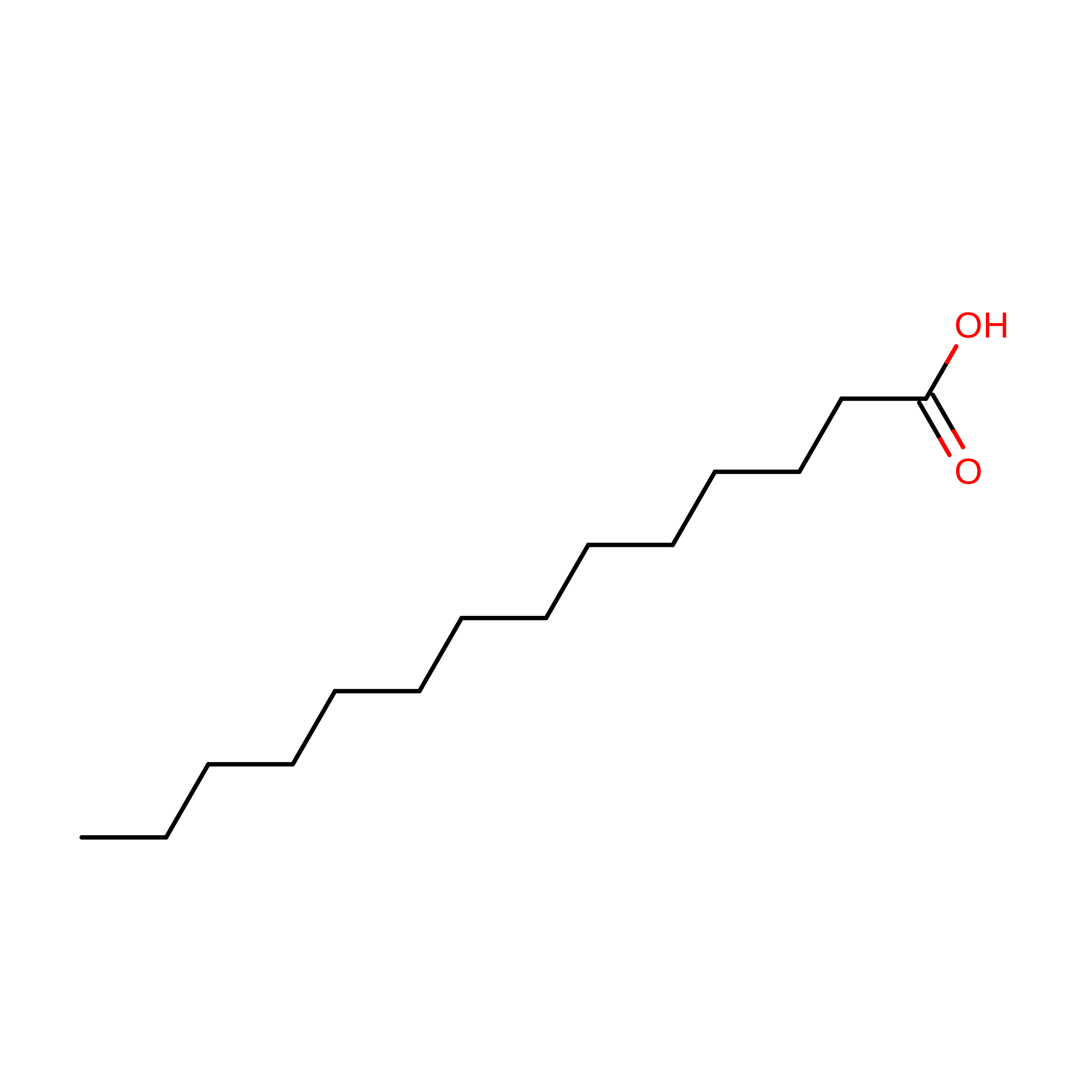
MYRISTIC ACID
C14 H28 O2
TUNFSRHWOTWDNC-UHFFFAOYSA-N

Experimental Data & Validation

Experimental Data

  • Method: ELECTRON MICROSCOPY
  • Resolution: 3.30 Å
  • Aggregation State: PARTICLE 
  • Reconstruction Method: SINGLE PARTICLE 
EM Software:
TaskSoftware PackageVersion
RECONSTRUCTIONFREALIGN
RECONSTRUCTIONIMIRS

Structure Validation

View Full Validation Report


Entry History 

Deposition Data

Revision History  (Full details and data files)

  • Version 1.0: 2010-05-12
    Type: Initial release
  • Version 1.1: 2011-07-13
    Changes: Version format compliance
  • Version 1.2: 2018-07-18
    Changes: Data collection
  • Version 1.3: 2024-11-20
    Changes: Data collection, Database references, Derived calculations, Structure summary