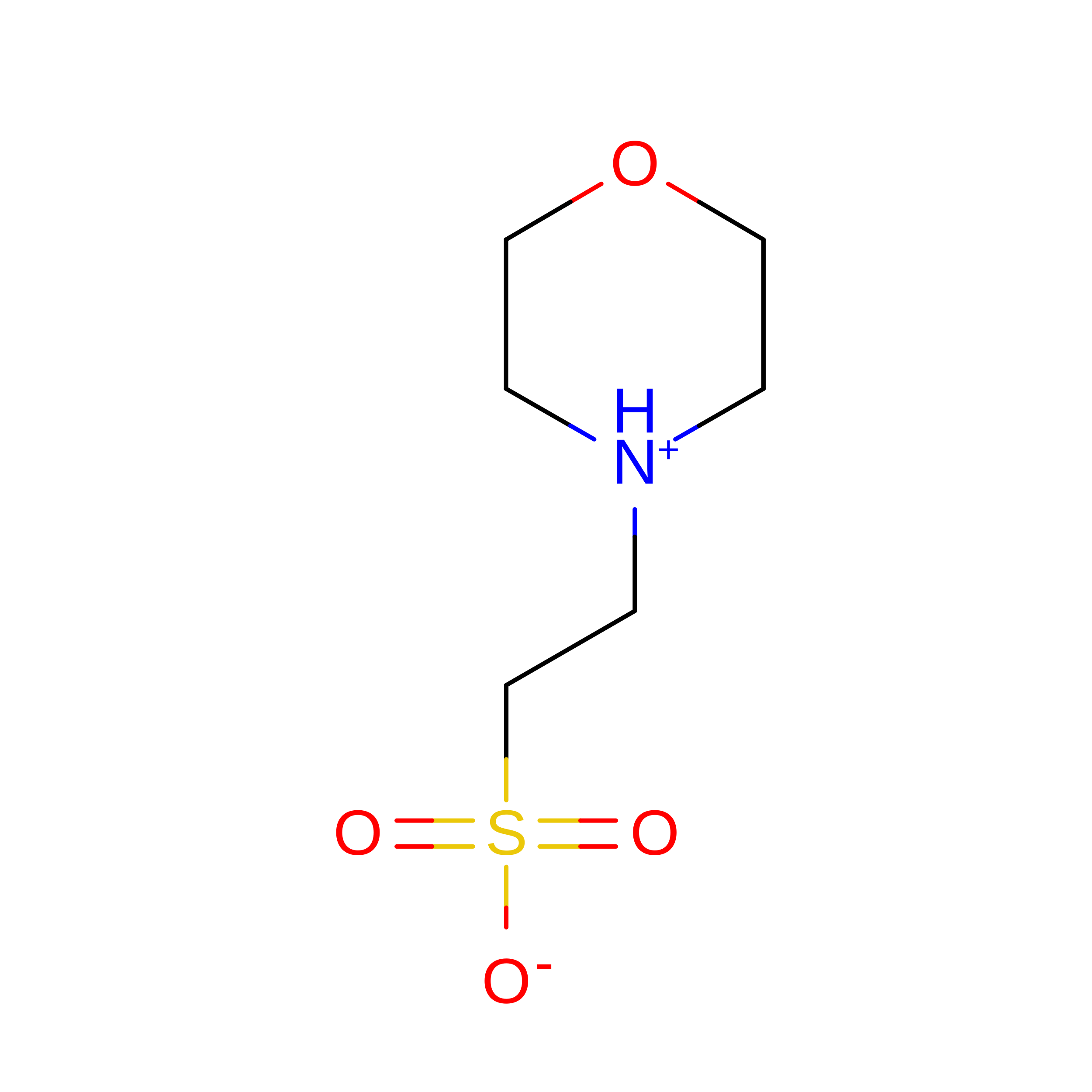
3G69 | pdb_00003g69

The crystal structure of Streptococcus pneumoniae Sortase C provides novel insights into catalysis as well as pilin substrate specificity


Experimental Data Snapshot

  • Method: X-RAY DIFFRACTION
  • Resolution: 2.00 Å
  • R-Value Free: 
    0.258 (Depositor), 0.257 (DCC) 
  • R-Value Work: 
    0.192 (Depositor), 0.193 (DCC) 
  • R-Value Observed: 
    0.196 (Depositor) 

Starting Model: experimental
View more details

wwPDB Validation 3D Report Full Report

Validation slider image for 3G69

This is version 1.2 of the entry. See complete history

Literature

Two crystal structures of pneumococcal pilus sortase C provide novel insights into catalysis and substrate specificity.

Neiers, F.Madhurantakam, C.Falker, S.Manzano, C.Dessen, A.Normark, S.Henriques-Normark, B.Achour, A.

(2009) J Mol Biology 393: 704-716

  • DOI: https://doi.org/10.1016/j.jmb.2009.08.058
  • Primary Citation Related Structures: 
    3G66, 3G69

  • PubMed Abstract: 

    The respiratory tract pathogen Streptococcus pneumoniae is a primary cause of morbidity and mortality worldwide. Pili enhance initial adhesion as well as the capacity of pneumococci to cause pneumonia and bacteremia. Pilus-associated sortases (SrtB, SrtC, and SrtD) are involved in the biogenesis of pneumococcal pili, composed of repeating units of RrgB that create the stalk to which the RrgA adhesin and the preferential pilus tip subunit RrgC are covalently associated. Using single sortase-expressing strains, we demonstrate that both pilin-polymerizing sortases SrtB and SrtC can covalently link pili to the peptidoglycan cell wall, a property shared with the non-pilus-polymerizing enzyme SrtD and the housekeeping sortase SrtA. Comparative analysis of the crystal structures of S. pneumoniae SrtC and SrtB revealed structural differences explaining the incapacity of SrtC, but not of SrtB, to incorporate RrgC into the pilus. Accordingly, site-directed mutagenesis of Thr(160) in SrtB to an arginine as in SrtC (Arg(160)) partially converted its substrate specificity into that of SrtC. Solving two crystal structures for SrtC suggests that an opening of a flexible lid and a concomitant cysteine rotation are important for catalysis and the activation of the catalytic cysteine of pilus-associated sortases.


  • Organizational Affiliation
    • Department of Microbiology, Tumor and Cell Biology, Karolinska Institutet, Solna, Sweden.

Macromolecule Content 

  • Total Structure Weight: 48.67 kDa 
  • Atom Count: 3,577 
  • Modeled Residue Count: 389 
  • Deposited Residue Count: 424 
  • Unique protein chains: 1

Macromolecules

Find similar proteins by:|  3D Structure
Entity ID: 1
MoleculeChains  Sequence LengthOrganismDetailsImage
Sortase C
A, B
212Streptococcus pneumoniaeMutation(s): 0 
Gene Names: SP_0467srtC
UniProt
Find proteins for A7KT63 (Streptococcus pneumoniae)
Explore A7KT63 
Go to UniProtKB:  A7KT63
Entity Groups
Sequence Clusters30% Identity50% Identity70% Identity90% Identity95% Identity100% Identity
UniProt GroupA7KT63
Sequence Annotations
Expand
Reference Sequence

Experimental Data & Validation

Experimental Data

  • Method: X-RAY DIFFRACTION
  • Resolution: 2.00 Å
  • R-Value Free:  0.258 (Depositor), 0.257 (DCC) 
  • R-Value Work:  0.192 (Depositor), 0.193 (DCC) 
  • R-Value Observed: 0.196 (Depositor) 
Space Group: P 21 21 21
Unit Cell:
Length ( Å )Angle ( ˚ )
a = 48.578α = 90
b = 96.554β = 90
c = 98.818γ = 90
Software Package:
Software NamePurpose
ADSCdata collection
PHASERphasing
REFMACrefinement
MOSFLMdata reduction
SCALAdata scaling

Structure Validation

View Full Validation Report


Entry History 

Deposition Data

Revision History  (Full details and data files)

  • Version 1.0: 2009-09-01
    Type: Initial release
  • Version 1.1: 2011-07-13
    Changes: Version format compliance
  • Version 1.2: 2023-09-06
    Changes: Data collection, Database references, Derived calculations, Refinement description