3EJJ | pdb_00003ejj

Structure of M-CSF bound to the first three domains of FMS


Experimental Data Snapshot

  • Method: X-RAY DIFFRACTION
  • Resolution: 2.40 Å
  • R-Value Free: 
    0.265 (Depositor), 0.253 (DCC) 
  • R-Value Work: 
    0.238 (Depositor), 0.250 (DCC) 
  • R-Value Observed: 
    0.241 (Depositor) 

Starting Model: experimental
View more details

wwPDB Validation 3D Report Full Report

Validation slider image for 3EJJ

This is version 2.2 of the entry. See complete history

Literature

Structure of macrophage colony stimulating factor bound to FMS: diverse signaling assemblies of class III receptor tyrosine kinases.

Chen, X.Liu, H.Focia, P.J.Shim, A.H.He, X.

(2008) Proc Natl Acad Sci U S A 105: 18267-18272

  • DOI: https://doi.org/10.1073/pnas.0807762105
  • Primary Citation Related Structures: 
    3EJJ

  • PubMed Abstract: 

    Macrophage colony stimulating factor (M-CSF), through binding to its receptor FMS, a class III receptor tyrosine kinase (RTK), regulates the development and function of mononuclear phagocytes, and plays important roles in innate immunity, cancer and inflammation. We report a 2.4 A crystal structure of M-CSF bound to the first 3 domains (D1-D3) of FMS. The ligand binding mode of FMS is surprisingly different from KIT, another class III RTK, in which the major ligand-binding domain of FMS, D2, uses the CD and EF loops, but not the beta-sheet on the opposite side of the Ig domain as in KIT, to bind ligand. Calorimetric data indicate that M-CSF cannot dimerize FMS without receptor-receptor interactions mediated by FMS domains D4 and D5. Consistently, the structure contains only 1 FMS-D1-D3 molecule bound to a M-CSF dimer, due to a weak, hydrophilic M-CSF:FMS interface, and probably a conformational change of the M-CSF dimer in which binding to the second site is rendered unfavorable by FMS binding at the first site. The partial, intermediate complex suggests that FMS may be activated in two steps, with the initial engagement step distinct from the subsequent dimerization/activation step. Hence, the formation of signaling class III RTK complexes can be diverse, engaging various modes of ligand recognition and various mechanistic steps for dimerizing and activating receptors.


  • Organizational Affiliation
    • Department of Molecular Pharmacology and Biological Chemistry, Feinberg School of Medicine, Searle 8-417, Northwestern University, 303 East Chicago Avenue, Chicago, IL 60611, USA.

Macromolecule Content 

  • Total Structure Weight: 69.29 kDa 
  • Atom Count: 5,213 
  • Modeled Residue Count: 565 
  • Deposited Residue Count: 599 
  • Unique protein chains: 2

Macromolecules

Find similar proteins by:|  3D Structure
Entity ID: 1
MoleculeChains  Sequence LengthOrganismDetailsImage
Colony stimulating factor-1
A, B
155Mus musculusMutation(s): 0 
Gene Names: Csf1
UniProt
Find proteins for P07141 (Mus musculus)
Explore P07141 
Go to UniProtKB:  P07141
Entity Groups
Sequence Clusters30% Identity50% Identity70% Identity90% Identity95% Identity100% Identity
UniProt GroupP07141
Sequence Annotations
Expand
Reference Sequence
Find similar proteins by:|  3D Structure
Entity ID: 2
MoleculeChains  Sequence LengthOrganismDetailsImage
Macrophage colony-stimulating factor 1 receptorC [auth X]289Mus musculusMutation(s): 0 
Gene Names: Csf1rCsfmrFms
EC: 2.7.10.1
UniProt & NIH Common Fund Data Resources
Find proteins for P09581 (Mus musculus)
Explore P09581 
Go to UniProtKB:  P09581
IMPC:  MGI:1339758
Entity Groups
Sequence Clusters30% Identity50% Identity70% Identity90% Identity95% Identity100% Identity
UniProt GroupP09581
Glycosylation
Glycosylation Sites: 2Go to GlyGen: P09581-1
Sequence Annotations
Expand
Reference Sequence

Oligosaccharides

Help  
Entity ID: 3
MoleculeChains Length2D Diagram GlycosylationD Interactions
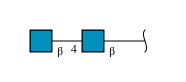
2-acetamido-2-deoxy-beta-D-glucopyranose-(1-4)-2-acetamido-2-deoxy-beta-D-glucopyranoseD [auth C],
E [auth D]
2N-Glycosylation
Glycosylation Resources
GlyTouCan: G42666HT
GlyCosmos: G42666HT
GlyGen: G42666HT

Experimental Data & Validation

Experimental Data

  • Method: X-RAY DIFFRACTION
  • Resolution: 2.40 Å
  • R-Value Free:  0.265 (Depositor), 0.253 (DCC) 
  • R-Value Work:  0.238 (Depositor), 0.250 (DCC) 
  • R-Value Observed: 0.241 (Depositor) 
Space Group: H 3 2
Unit Cell:
Length ( Å )Angle ( ˚ )
a = 158.848α = 90
b = 158.848β = 90
c = 237.953γ = 120
Software Package:
Software NamePurpose
HKL-2000data collection
PHASERphasing
CNSrefinement
HKL-2000data reduction
HKL-2000data scaling

Structure Validation

View Full Validation Report


Entry History 

Deposition Data

Revision History  (Full details and data files)

  • Version 1.0: 2008-12-09
    Type: Initial release
  • Version 1.1: 2011-07-13
    Changes: Non-polymer description, Version format compliance
  • Version 2.0: 2020-07-29
    Type: Remediation
    Reason: Carbohydrate remediation
    Changes: Advisory, Atomic model, Data collection, Database references, Derived calculations, Structure summary
  • Version 2.1: 2023-08-30
    Changes: Data collection, Database references, Refinement description, Structure summary
  • Version 2.2: 2024-11-20
    Changes: Structure summary