3E7J | pdb_00003e7j

HeparinaseII H202A/Y257A double mutant complexed with a heparan sulfate tetrasaccharide substrate


Experimental Data Snapshot

  • Method: X-RAY DIFFRACTION
  • Resolution: 2.10 Å
  • R-Value Free: 
    0.234 (Depositor), 0.238 (DCC) 
  • R-Value Work: 
    0.199 (Depositor), 0.207 (DCC) 
  • R-Value Observed: 
    0.201 (Depositor) 

Starting Model: experimental
View more details

wwPDB Validation 3D Report Full Report

Validation slider image for 3E7J

This is version 2.2 of the entry. See complete history

Literature

Catalytic mechanism of heparinase II investigated by site-directed mutagenesis and the crystal structure with its substrate.

Shaya, D.Zhao, W.Garron, M.L.Xiao, Z.Cui, Q.Zhang, Z.Sulea, T.Linhardt, R.J.Cygler, M.

(2010) J Biological Chem 285: 20051-20061

  • DOI: https://doi.org/10.1074/jbc.M110.101071
  • Primary Citation Related Structures: 
    3E7J, 3E80

  • PubMed Abstract: 

    Heparinase II (HepII) is an 85-kDa dimeric enzyme that depolymerizes both heparin and heparan sulfate glycosaminoglycans through a beta-elimination mechanism. Recently, we determined the crystal structure of HepII from Pedobacter heparinus (previously known as Flavobacterium heparinum) in complex with a heparin disaccharide product, and identified the location of its active site. Here we present the structure of HepII complexed with a heparan sulfate disaccharide product, proving that the same binding/active site is responsible for the degradation of both uronic acid epimers containing substrates. The key enzymatic step involves removal of a proton from the C5 carbon (a chiral center) of the uronic acid, posing a topological challenge to abstract the proton from either side of the ring in a single active site. We have identified three potential active site residues equidistant from C5 and located on both sides of the uronate product and determined their role in catalysis using a set of defined tetrasaccharide substrates. HepII H202A/Y257A mutant lost activity for both substrates and we determined its crystal structure complexed with a heparan sulfate-derived tetrasaccharide. Based on kinetic characterization of various mutants and the structure of the enzyme-substrate complex we propose residues participating in catalysis and their specific roles.


  • Organizational Affiliation
    • Department of Biochemistry, McGill University, Montréal, Québec H3G 1Y6, Canada.

Macromolecule Content 

  • Total Structure Weight: 171.58 kDa 
  • Atom Count: 12,784 
  • Modeled Residue Count: 1,486 
  • Deposited Residue Count: 1,498 
  • Unique protein chains: 1

Macromolecules

Find similar proteins by:|  3D Structure
Entity ID: 1
MoleculeChains  Sequence LengthOrganismDetailsImage
Heparinase II protein
A, B
749Pedobacter heparinusMutation(s): 2 
EC: 4.2.2.8 (UniProt), 4.2.2.7 (UniProt)
UniProt
Find proteins for C6XZB6 (Pedobacter heparinus (strain ATCC 13125 / DSM 2366 / CIP 104194 / JCM 7457 / NBRC 12017 / NCIMB 9290 / NRRL B-14731 / HIM 762-3))
Explore C6XZB6 
Go to UniProtKB:  C6XZB6
Entity Groups
Sequence Clusters30% Identity50% Identity70% Identity90% Identity95% Identity100% Identity
UniProt GroupC6XZB6
Sequence Annotations
Expand
Reference Sequence

Oligosaccharides

Help  
Entity ID: 2
MoleculeChains Length2D Diagram GlycosylationD Interactions
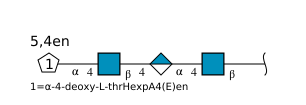
4-deoxy-alpha-L-threo-hex-4-enopyranuronic acid-(1-4)-2-acetamido-2-deoxy-beta-D-glucopyranose-(1-4)-alpha-D-glucopyranuronic acid-(1-4)-2-acetamido-2-deoxy-beta-D-glucopyranose
C, D
4N/A
Glycosylation Resources
GlyTouCan: G74165GY
GlyCosmos: G74165GY

Experimental Data & Validation

Experimental Data

  • Method: X-RAY DIFFRACTION
  • Resolution: 2.10 Å
  • R-Value Free:  0.234 (Depositor), 0.238 (DCC) 
  • R-Value Work:  0.199 (Depositor), 0.207 (DCC) 
  • R-Value Observed: 0.201 (Depositor) 
Space Group: P 1 21 1
Unit Cell:
Length ( Å )Angle ( ˚ )
a = 51.951α = 90
b = 162.21β = 105.97
c = 93.838γ = 90
Software Package:
Software NamePurpose
DENZOdata reduction
SCALEPACKdata scaling
REFMACrefinement
PDB_EXTRACTdata extraction
HKL-2000data reduction
HKL-2000data scaling

Structure Validation

View Full Validation Report


Entry History 

Deposition Data

Revision History  (Full details and data files)

  • Version 1.0: 2008-12-30
    Type: Initial release
  • Version 1.1: 2011-07-13
    Changes: Advisory, Version format compliance
  • Version 1.2: 2017-10-25
    Changes: Refinement description
  • Version 1.3: 2018-08-29
    Changes: Data collection, Source and taxonomy, Structure summary
  • Version 2.0: 2020-07-29
    Type: Remediation
    Reason: Carbohydrate remediation
    Changes: Advisory, Atomic model, Data collection, Derived calculations, Structure summary
  • Version 2.1: 2021-10-20
    Changes: Database references, Structure summary
  • Version 2.2: 2023-08-30
    Changes: Data collection, Refinement description