3BQ1 | pdb_00003bq1

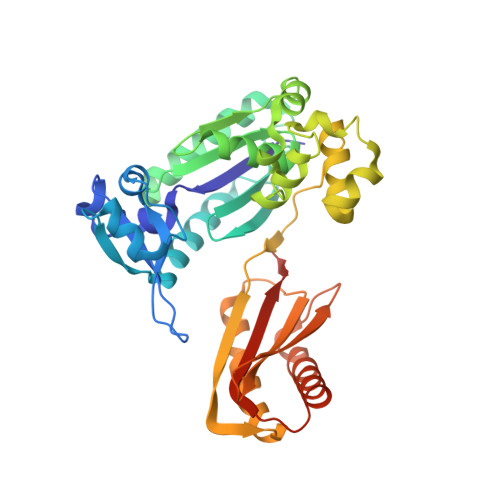
Insertion ternary complex of Dbh DNA polymerase


Experimental Data Snapshot

  • Method: X-RAY DIFFRACTION
  • Resolution: 2.70 Å
  • R-Value Free: 
    0.267 (Depositor), 0.194 (DCC) 
  • R-Value Work: 
    0.204 (Depositor), 0.202 (DCC) 
  • R-Value Observed: 
    0.207 (Depositor) 

Starting Models: experimental
View more details

wwPDB Validation 3D Report Full Report

Validation slider image for 3BQ1

Ligand Structure Quality Assessment 


This is version 1.2 of the entry. See complete history

Literature

Structural insights into the generation of single-base deletions by the Y family DNA polymerase dbh.

Wilson, R.C.Pata, J.D.

(2008) Mol Cell 29: 767-779

  • DOI: https://doi.org/10.1016/j.molcel.2008.01.014
  • Primary Citation Related Structures: 
    3BQ0, 3BQ1, 3BQ2

  • PubMed Abstract: 

    Dbh is a Y family translesion DNA polymerase that accurately bypasses some damaged forms of deoxyguanosine, but also generates single-base deletion errors at frequencies of up to 50%, in specific hot spot sequences. We describe preinsertion binary, insertion ternary, and postinsertion binary crystal structures of Dbh synthesizing DNA after making a single-base deletion. The skipped template base adopts an extrahelical conformation stabilized by interactions with the C-terminal domain of the enzyme. DNA translocation and positioning of the next templating base at the active site, with space opposite to accommodate incoming nucleotide, occur independently of nucleotide binding, incorporation, and pyrophosphate release. We also show that Dbh creates single-base deletions more rapidly when the skipped base is located two or three bases upstream of the nascent base pair than when it is directly adjacent to the templating base, indicating that Dbh predominantly creates single-base deletions by template slippage rather than by dNTP-stabilized misalignment.


  • Organizational Affiliation
    • Division of Molecular Medicine, Wadsworth Center, New York State Department of Health, The State University of New York at Albany, Albany, NY 12201-0509, USA.

Macromolecule Content 

  • Total Structure Weight: 48.15 kDa 
  • Atom Count: 3,257 
  • Modeled Residue Count: 368 
  • Deposited Residue Count: 379 
  • Unique protein chains: 1
  • Unique nucleic acid chains: 2

Macromolecules


Find similar proteins by:|  3D Structure
Entity ID: 3
MoleculeChains  Sequence LengthOrganismDetailsImage
DNA polymerase IVC [auth A]354Sulfolobus acidocaldariusMutation(s): 0 
Gene Names: dbh
EC: 2.7.7.7
UniProt
Find proteins for Q4JB80 (Sulfolobus acidocaldarius (strain ATCC 33909 / DSM 639 / JCM 8929 / NBRC 15157 / NCIMB 11770))
Explore Q4JB80 
Go to UniProtKB:  Q4JB80
Entity Groups
Sequence Clusters30% Identity50% Identity70% Identity90% Identity95% Identity100% Identity
UniProt GroupQ4JB80
Sequence Annotations
Expand
Reference Sequence
Find similar nucleic acids by:  Sequence
Entity ID: 1
MoleculeChains LengthOrganismImage
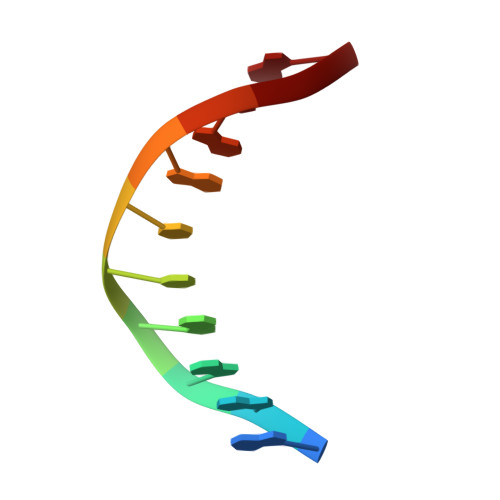
DNA (5'-D(*DGP*DAP*DAP*DGP*DCP*DCP*DGP*DGP*DCP*DG)-3')A [auth P]10N/A
Sequence Annotations
Expand
Reference Sequence
Find similar nucleic acids by:  Sequence
Entity ID: 2
MoleculeChains LengthOrganismImage
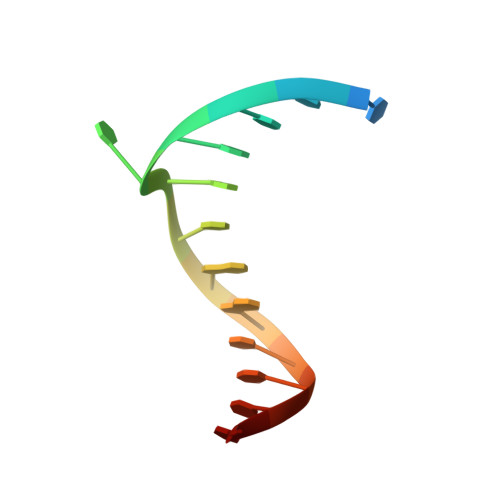
DNA (5'-D(*DT*DTP*DCP*DCP*DGP*DCP*DCP*DCP*DGP*DGP*DCP*DTP*DTP*DCP*DC)-3')B [auth T]15N/A
Sequence Annotations
Expand
Reference Sequence

Small Molecules

Experimental Data & Validation

Experimental Data

  • Method: X-RAY DIFFRACTION
  • Resolution: 2.70 Å
  • R-Value Free:  0.267 (Depositor), 0.194 (DCC) 
  • R-Value Work:  0.204 (Depositor), 0.202 (DCC) 
  • R-Value Observed: 0.207 (Depositor) 
Space Group: P 41 21 2
Unit Cell:
Length ( Å )Angle ( ˚ )
a = 124.96α = 90
b = 124.96β = 90
c = 70.21γ = 90
Software Package:
Software NamePurpose
REFMACrefinement
PDB_EXTRACTdata extraction
CBASSdata collection
HKL-2000data reduction
HKL-2000data scaling
PHASERphasing

Structure Validation

View Full Validation Report


Ligand Structure Quality Assessment 


Entry History 

Deposition Data

Revision History  (Full details and data files)

  • Version 1.0: 2008-04-08
    Type: Initial release
  • Version 1.1: 2011-07-13
    Changes: Advisory, Version format compliance
  • Version 1.2: 2023-08-30
    Changes: Data collection, Database references, Derived calculations, Refinement description