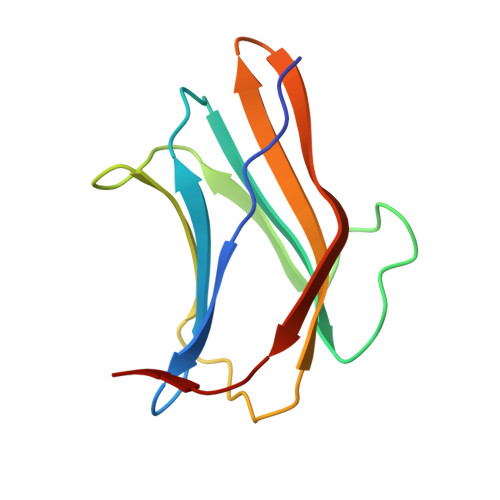
3AQX | pdb_00003aqx

Crystal structure of Bombyx mori beta-GRP/GNBP3 N-terminal domain with laminarihexaoses


Experimental Data Snapshot

  • Method: X-RAY DIFFRACTION
  • Resolution: 2.05 Å
  • R-Value Free: 
    0.216 (Depositor), 0.220 (DCC) 
  • R-Value Work: 
    0.174 (Depositor), 0.176 (DCC) 
  • R-Value Observed: 
    0.177 (Depositor) 

Starting Model: experimental
View more details

wwPDB Validation 3D Report Full Report

Validation slider image for 3AQX

This is version 2.1 of the entry. See complete history

Literature

Structural insights into recognition of triple-helical beta-glucans by an insect fungal receptor

Kanagawa, M.Satoh, T.Ikeda, A.Adachi, Y.Ohno, N.Yamaguchi, Y.

(2011) J Biological Chem 286: 29158-29165

  • DOI: https://doi.org/10.1074/jbc.M111.256701
  • Primary Citation Related Structures: 
    3AQX, 3AQY, 3AQZ

  • PubMed Abstract: 

    The innate ability to detect pathogens is achieved by pattern recognition receptors, which recognize non-self-components such as β1,3-glucan. β1,3-Glucans form a triple-helical structure stabilized by interchain hydrogen bonds. β1,3-Glucan recognition protein (βGRP)/gram-negative bacteria-binding protein 3 (GNBP3), one of the pattern recognition receptors, binds to long, structured β1,3-glucan to initiate innate immune response. However, binding details and how specificity is achieved in such receptors remain important unresolved issues. We solved the crystal structures of the N-terminal β1,3-glucan recognition domain of βGRP/GNBP3 (βGRP-N) in complex with the β1,3-linked glucose hexamer, laminarihexaose. In the crystals, three structured laminarihexaoses simultaneously interact through six glucose residues (two from each chain) with one βGRP-N. The spatial arrangement of the laminarihexaoses bound to βGRP-N is almost identical to that of a β1,3-glucan triple-helical structure. Therefore, our crystallographic structures together with site-directed mutagenesis data provide a structural basis for the unique recognition by such receptors of the triple-helical structure of β1,3-glucan.


  • Organizational Affiliation
    • Structural Glycobiology Team, Systems Glycobiology Research Group, Chemical Biology Department, RIKEN, Advanced Science Institute, 2-1 Hirosawa Wako, Saitama 351-0198, Japan and.

Macromolecule Content 

  • Total Structure Weight: 25.7 kDa 
  • Atom Count: 2,113 
  • Modeled Residue Count: 201 
  • Deposited Residue Count: 208 
  • Unique protein chains: 1

Macromolecules

Find similar proteins by:|  3D Structure
Entity ID: 1
MoleculeChains  Sequence LengthOrganismDetailsImage
Beta-1,3-glucan-binding protein
A, B
104Bombyx moriMutation(s): 0 
UniProt
Find proteins for Q9NL89 (Bombyx mori)
Explore Q9NL89 
Go to UniProtKB:  Q9NL89
Entity Groups
Sequence Clusters30% Identity50% Identity70% Identity90% Identity95% Identity100% Identity
UniProt GroupQ9NL89
Sequence Annotations
Expand
Reference Sequence

Oligosaccharides

Help  
Entity ID: 2
MoleculeChains Length2D Diagram GlycosylationD Interactions
beta-D-glucopyranose-(1-3)-beta-D-glucopyranose-(1-3)-beta-D-glucopyranose-(1-3)-beta-D-glucopyranose-(1-3)-beta-D-glucopyranose-(1-3)-beta-D-glucopyranose
C, D
6N/A
Glycosylation Resources
GlyTouCan: G41202OE
GlyCosmos: G41202OE
GlyGen: G41202OE

Small Molecules

Ligands 1 Unique
IDChains Name / Formula / InChI Key2D Diagram3D Interactions
GOL

Query on GOL


Download:Ideal Coordinates CCD File
E [auth B]GLYCEROL
C3 H8 O3
PEDCQBHIVMGVHV-UHFFFAOYSA-N

Experimental Data & Validation

Experimental Data

  • Method: X-RAY DIFFRACTION
  • Resolution: 2.05 Å
  • R-Value Free:  0.216 (Depositor), 0.220 (DCC) 
  • R-Value Work:  0.174 (Depositor), 0.176 (DCC) 
  • R-Value Observed: 0.177 (Depositor) 
Space Group: P 41
Unit Cell:
Length ( Å )Angle ( ˚ )
a = 74.21α = 90
b = 74.21β = 90
c = 47.603γ = 90
Software Package:
Software NamePurpose
HKL-2000data collection
MOLREPphasing
REFMACrefinement
DENZOdata reduction
SCALEPACKdata scaling

Structure Validation

View Full Validation Report


Entry History 

Deposition Data

Revision History  (Full details and data files)

  • Version 1.0: 2011-06-22
    Type: Initial release
  • Version 1.1: 2011-07-13
    Changes: Version format compliance
  • Version 1.2: 2013-06-19
    Changes: Database references, Derived calculations
  • Version 2.0: 2020-07-29
    Type: Remediation
    Reason: Carbohydrate remediation
    Changes: Atomic model, Data collection, Database references, Derived calculations, Structure summary
  • Version 2.1: 2023-11-01
    Changes: Data collection, Database references, Refinement description, Structure summary