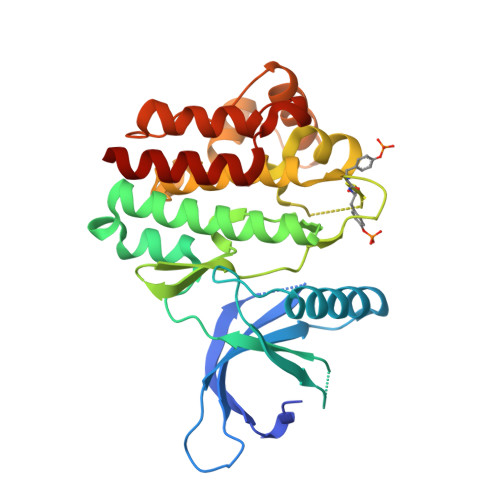
2XA4 | pdb_00002xa4

Inhibitors of Jak2 Kinase domain


Experimental Data Snapshot

  • Method: X-RAY DIFFRACTION
  • Resolution: 2.04 Å
  • R-Value Free: 
    0.245 (Depositor), 0.255 (DCC) 
  • R-Value Work: 
    0.197 (Depositor), 0.206 (DCC) 
  • R-Value Observed: 
    0.200 (Depositor) 

wwPDB Validation 3D Report Full Report

Validation slider image for 2XA4

Ligand Structure Quality Assessment 


This is version 1.5 of the entry. See complete history. 

Literature

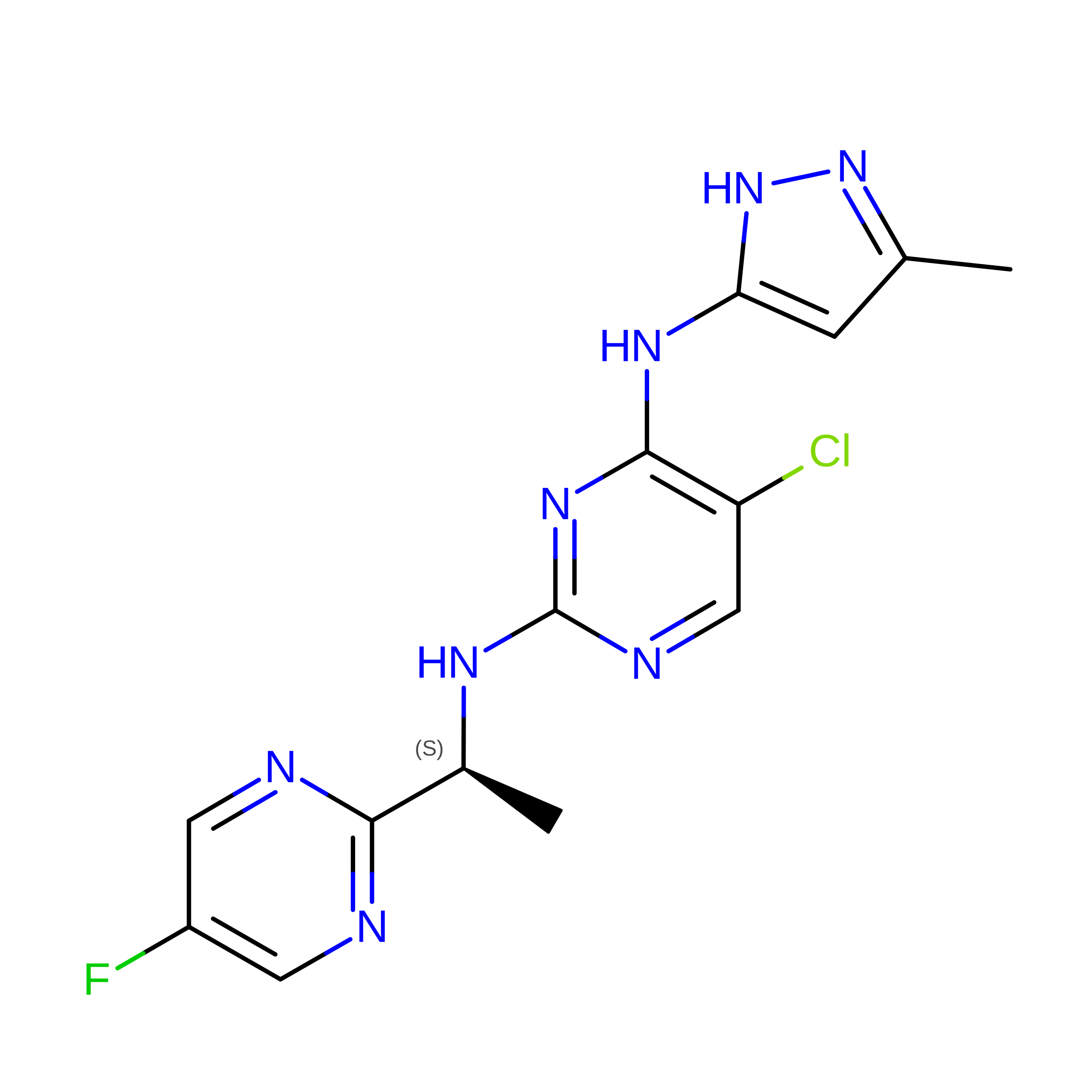
Discovery of 5-Chloro-N2-[(1S)-1-(5-Fluoropyrimidin-2-Yl) Ethyl]-N4-(5-Methyl-1H-Pyrazol-3-Yl)Pyrimidine-2,4-Diamine (Azd1480) as a Novel Inhibitor of the Jak/Stat Pathway

Ioannidis, S., Lamb, M.L., Wang, T., Almeida, L., Block, M.H., Davies, A.M., Peng, B., Su, M., Zhang, H., Hoffmann, E., Rivard, C., Green, I., Howard, T., Pollard, H., Read, J., Alimzhanov, M., Bebernitz, G., Bell, K., Ye, M., Huszar, D., Zinda, M.

(2011) J Med Chem 54: 262

  • DOI: https://doi.org/10.1021/jm1011319
  • Primary Citation Related Structures: 
    2XA4

  • PubMed Abstract: 

    The myeloproliferative neoplasms, polycythemia vera, essential thrombocythemia, and idiopathic myelofibrosis are a heterogeneous but related group of hematological malignancies characterized by clonal expansion of one or more myeloid lineages. The discovery of the Jak2 V617F gain of function mutation highlighted Jak2 as a potential therapeutic target in the MPNs. Herein, we disclose the discovery of a series of pyrazol-3-yl pyrimidin-4-amines and the identification of 9e (AZD1480) as a potent Jak2 inhibitor. 9e inhibits signaling and proliferation of Jak2 V617F cell lines in vitro, demonstrates in vivo efficacy in a TEL-Jak2 model, has excellent physical properties and preclinical pharmacokinetics, and is currently being evaluated in Phase I clinical trials.


  • Organizational Affiliation: 
    • Department of Cancer Chemistry, AstraZeneca R&D, Boston, Massachusetts, United States. stephanos.ioannidis@astrazeneca.com

Macromolecule Content 

  • Total Structure Weight: 70.86 kDa 
  • Atom Count: 4,871 
  • Modeled Residue Count: 555 
  • Deposited Residue Count: 596 
  • Unique protein chains: 1

Macromolecules

Find similar proteins by:|  3D Structure
Entity ID: 1
MoleculeChains  Sequence LengthOrganismDetailsImage
TYROSINE-PROTEIN KINASE JAK2
A, B
298Homo sapiensMutation(s): 2 
EC: 2.7.1.112 (PDB Primary Data), 2.7.10.2 (PDB Primary Data)
UniProt & NIH Common Fund Data Resources
Find proteins for O60674 (Homo sapiens)
Explore O60674 
Go to UniProtKB:  O60674
PHAROS:  O60674
GTEx:  ENSG00000096968 
Entity Groups
Sequence Clusters30% Identity50% Identity70% Identity90% Identity95% Identity100% Identity
UniProt GroupO60674
Sequence Annotations
Expand
Reference Sequence

Small Molecules

Ligands 1 Unique
IDChains Name / Formula / InChI Key2D Diagram3D Interactions
AZ5

Query on AZ5


Download:Ideal Coordinates CCD File
C [auth A],
D [auth B]
5-CHLORO-N2-[(1S)-1-(5-FLUOROPYRIMIDIN-2-YL)ETHYL]-N4-(5-METHYL-1H-PYRAZOL-3-YL)PYRIMIDINE-2,4-DIAMINE
C14 H14 Cl F N8
PDOQBOJDRPLBQU-QMMMGPOBSA-N
Modified Residues  1 Unique
IDChains TypeFormula2D DiagramParent
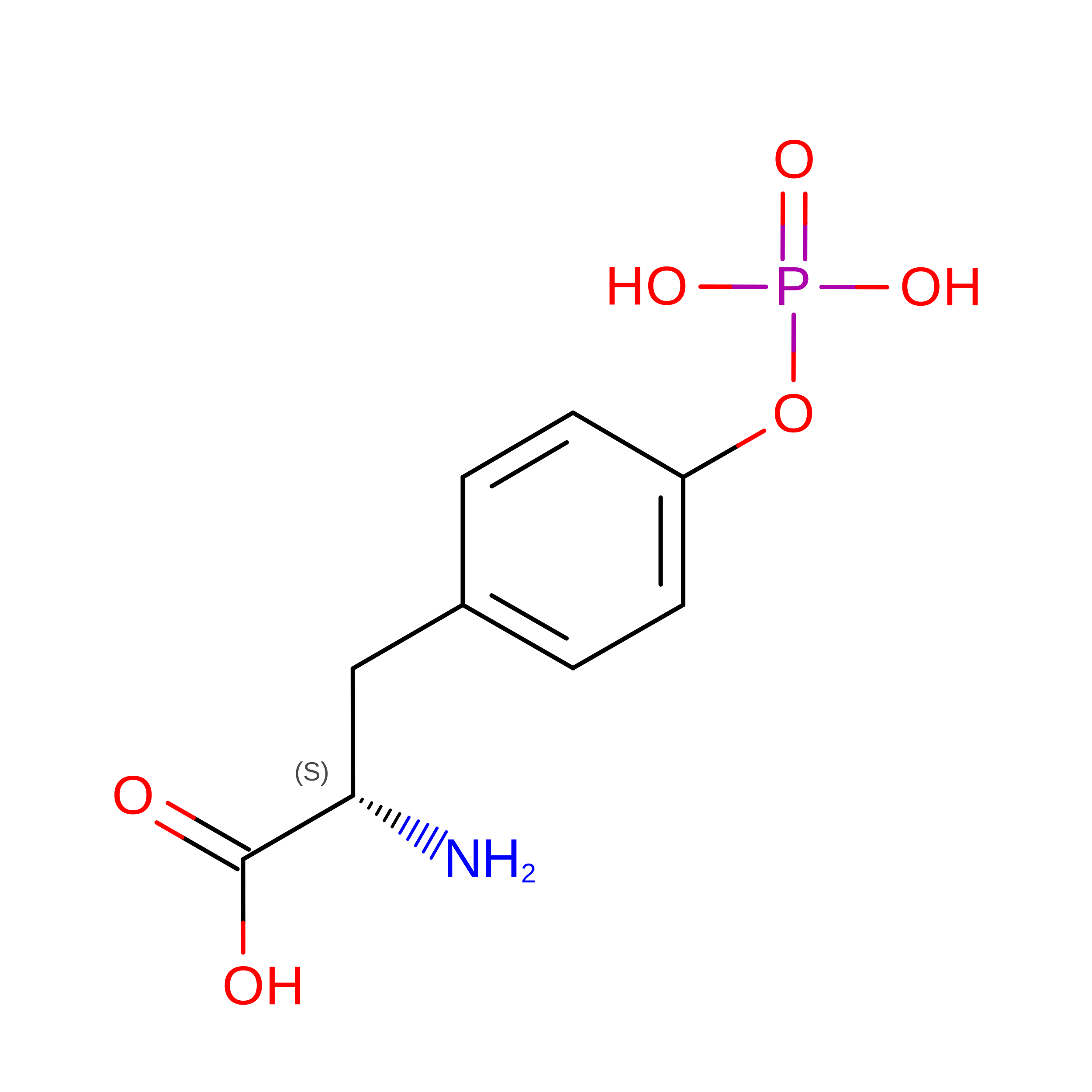
PTR
Query on PTR
A, B
L-PEPTIDE LINKINGC9 H12 N O6 PTYR

Experimental Data & Validation

Experimental Data

  • Method: X-RAY DIFFRACTION
  • Resolution: 2.04 Å
  • R-Value Free:  0.245 (Depositor), 0.255 (DCC) 
  • R-Value Work:  0.197 (Depositor), 0.206 (DCC) 
  • R-Value Observed: 0.200 (Depositor) 
Space Group: C 1 2 1
Unit Cell:
Length ( Å )Angle ( ˚ )
a = 43.854α = 90
b = 126.741β = 97.04
c = 134.342γ = 90
Software Package:
Software NamePurpose
REFMACrefinement
MOSFLMdata reduction
SCALAdata scaling
AMoREphasing

Structure Validation

View Full Validation Report


Ligand Structure Quality Assessment 


Entry History 

Deposition Data

Revision History  (Full details and data files)

  • Version 1.0: 2010-12-15
    Type: Initial release
  • Version 1.1: 2011-10-12
    Changes: Database references, Derived calculations, Refinement description, Version format compliance
  • Version 1.2: 2015-04-01
    Changes: Database references
  • Version 1.3: 2018-03-07
    Changes: Source and taxonomy
  • Version 1.4: 2019-05-08
    Changes: Data collection, Derived calculations, Experimental preparation
  • Version 1.5: 2024-11-06
    Changes: Data collection, Database references, Derived calculations, Other, Structure summary