Download Mendeley
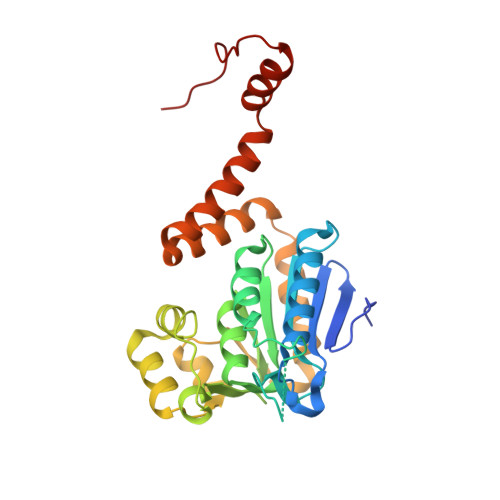
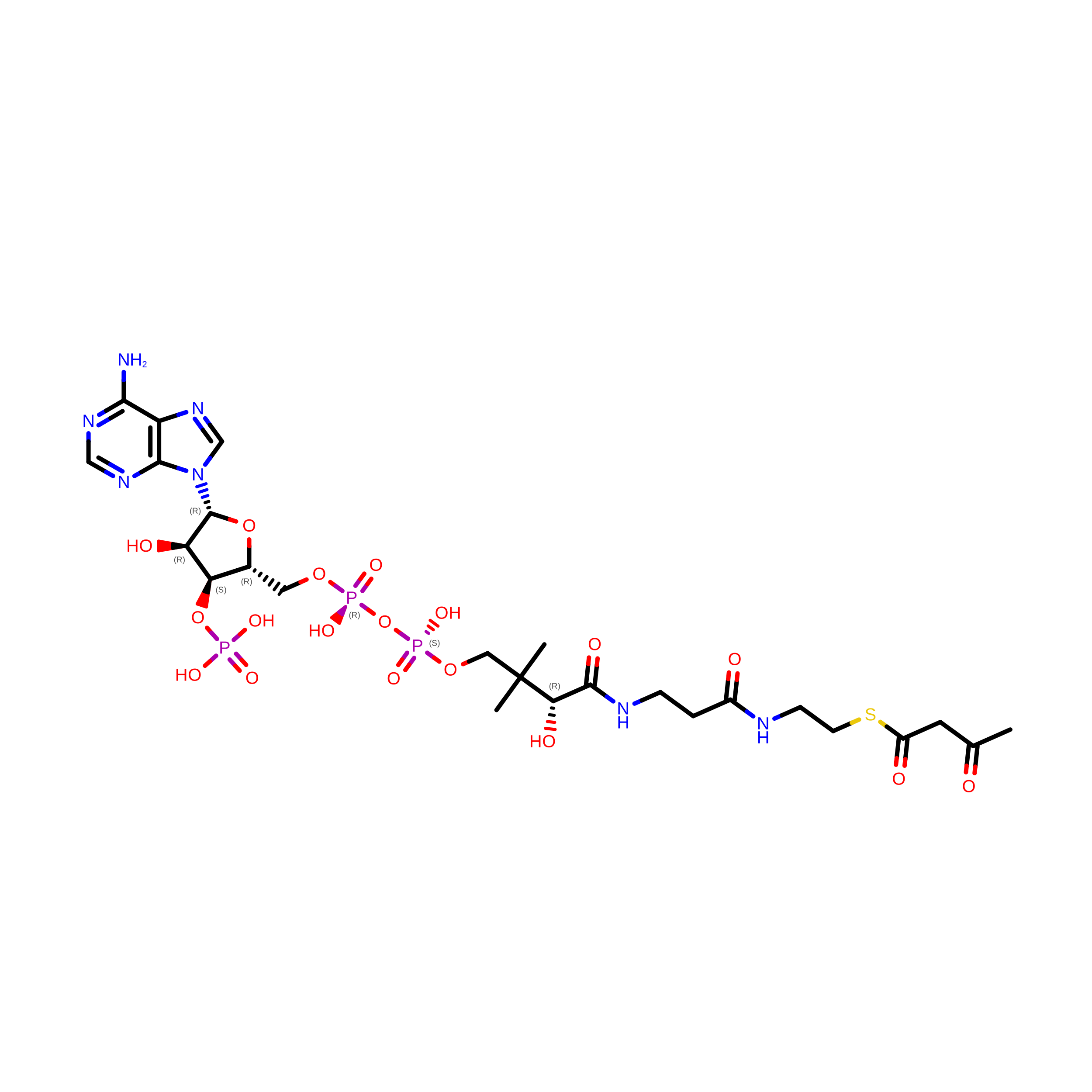
Structure of Staphylococcus Aureus1,4-Dihydroxy-2-Naphthoyl-Coa Synthase (Menb) in Complex with Acetoacetyl-Coa.
Ulaganathan, V., Agacan, M.F., Buetow, L., Tulloch, L.B., Hunter, W.N.(2007) Acta Crystallogr Sect F Struct Biol Cryst Commun 63: 908
- PubMed: 18007038 Search on PubMedSearch on PubMed Central
- DOI: https://doi.org/10.1107/S1744309107047720
- Primary Citation Related Structures:
2UZF - PubMed Abstract:
Vitamin K(2), or menaquinone, is an essential cofactor for many organisms and the enzymes involved in its biosynthesis are potential antimicrobial drug targets. One of these enzymes, 1,4-dihydroxy-2-naphthoyl-CoA synthase (MenB) from the pathogen Staphylococcus aureus, has been obtained in recombinant form and its quaternary structure has been analyzed in solution. Cubic crystals of the enzyme allowed a low-resolution structure (2.9 A) to be determined. The asymmetric unit consists of two subunits and a crystallographic threefold axis of symmetry generates a hexamer consistent with size-exclusion chromatography. Analytical ultracentrifugation indicates the presence of six states in solution, monomeric through to hexameric, with the dimer noted as being particularly stable. MenB displays the crotonase-family fold with distinct N- and C-terminal domains and a flexible segment of structure around the active site. The smaller C-terminal domain plays an important role in oligomerization and also in substrate binding. The presence of acetoacetyl-CoA in one of the two active sites present in the asymmetric unit indicates how part of the substrate binds and facilitates comparisons with the structure of Mycobacterium tuberculosis MenB.
- Division of Biological Chemistry and Drug Discovery, College of Life Sciences, University of Dundee, Dundee DD1 5EH, Tayside, Scotland.
Organizational Affiliation: