2UVK | pdb_00002uvk

Structure of YjhT


Experimental Data Snapshot

  • Method: X-RAY DIFFRACTION
  • Resolution: 1.50 Å
  • R-Value Free: 
    0.219 (Depositor), 0.220 (DCC) 
  • R-Value Work: 
    0.180 (Depositor), 0.186 (DCC) 
  • R-Value Observed: 
    0.182 (Depositor) 

wwPDB Validation 3D Report Full Report

Validation slider image for 2UVK

This is version 1.3 of the entry. See complete history

Literature

Sialic Acid Mutarotation is Catalyzed by the Escherichia Coli Beta-Propeller Protein Yjht.

Severi, E.Muller, A.Potts, J.R.Leech, A.Williamson, D.Wilson, K.S.Thomas, G.H.

(2008) J Biological Chem 283: 4841

  • DOI: https://doi.org/10.1074/jbc.M707822200
  • Primary Citation Related Structures: 
    2UVK

  • PubMed Abstract: 

    The acquisition of host-derived sialic acid is an important virulence factor for some bacterial pathogens, but in vivo this sugar acid is sequestered in sialoconjugates as the alpha-anomer. In solution, however, sialic acid is present mainly as the beta-anomer, formed by a slow spontaneous mutarotation. We studied the Escherichia coli protein YjhT as a member of a family of uncharacterized proteins present in many sialic acid-utilizing pathogens. This protein is able to accelerate the equilibration of the alpha- and beta-anomers of the sialic acid N-acetylneuraminic acid, thus describing a novel sialic acid mutarotase activity. The structure of this periplasmic protein, solved to 1.5A resolution, reveals a dimeric 6-bladed unclosed beta-propeller, the first of a bacterial Kelch domain protein. Mutagenesis of conserved residues in YjhT demonstrated an important role for Glu-209 and Arg-215 in mutarotase activity. We also present data suggesting that the ability to utilize alpha-N-acetylneuraminic acid released from complex sialoconjugates in vivo provides a physiological advantage to bacteria containing YjhT.


  • Organizational Affiliation
    • Department of Biology (Area 10), York Structural Biology Laboratory, University of York, York YO10 5YW, United Kingdom.

Macromolecule Content 

  • Total Structure Weight: 77.75 kDa 
  • Atom Count: 6,030 
  • Modeled Residue Count: 691 
  • Deposited Residue Count: 714 
  • Unique protein chains: 1

Macromolecules

Find similar proteins by:|  3D Structure
Entity ID: 1
MoleculeChains  Sequence LengthOrganismDetailsImage
YJHT
A, B
357Escherichia coli BL21Mutation(s): 0 
EC: 5.1.3.24
UniProt
Find proteins for P39371 (Escherichia coli (strain K12))
Explore P39371 
Go to UniProtKB:  P39371
Entity Groups
Sequence Clusters30% Identity50% Identity70% Identity90% Identity95% Identity100% Identity
UniProt GroupP39371
Sequence Annotations
Expand
Reference Sequence

Small Molecules

Modified Residues  1 Unique
IDChains TypeFormula2D DiagramParent
MSE
Query on MSE
A, B
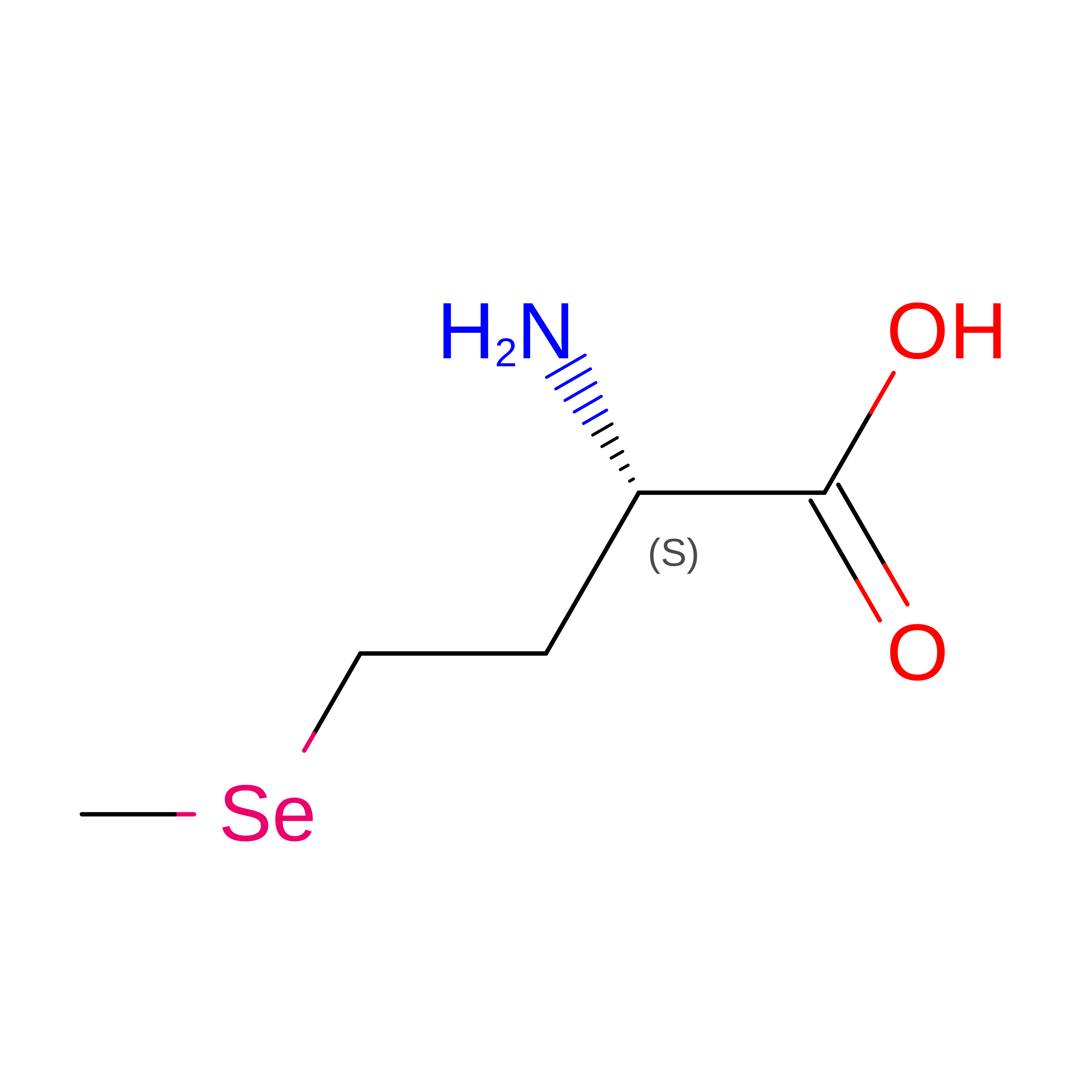
L-PEPTIDE LINKINGC5 H11 N O2 SeMET

Experimental Data & Validation

Experimental Data

  • Method: X-RAY DIFFRACTION
  • Resolution: 1.50 Å
  • R-Value Free:  0.219 (Depositor), 0.220 (DCC) 
  • R-Value Work:  0.180 (Depositor), 0.186 (DCC) 
  • R-Value Observed: 0.182 (Depositor) 
Space Group: P 1 21 1
Unit Cell:
Length ( Å )Angle ( ˚ )
a = 44.758α = 90
b = 105.659β = 99.95
c = 74.222γ = 90
Software Package:
Software NamePurpose
REFMACrefinement
MOSFLMdata reduction
SCALAdata scaling
SHELXCDphasing
SHELXEphasing

Structure Validation

View Full Validation Report


Entry History 

Deposition Data

Revision History  (Full details and data files)

  • Version 1.0: 2007-12-04
    Type: Initial release
  • Version 1.1: 2011-05-08
    Changes: Version format compliance
  • Version 1.2: 2011-07-13
    Changes: Version format compliance
  • Version 1.3: 2024-10-23
    Changes: Data collection, Database references, Derived calculations, Other, Structure summary