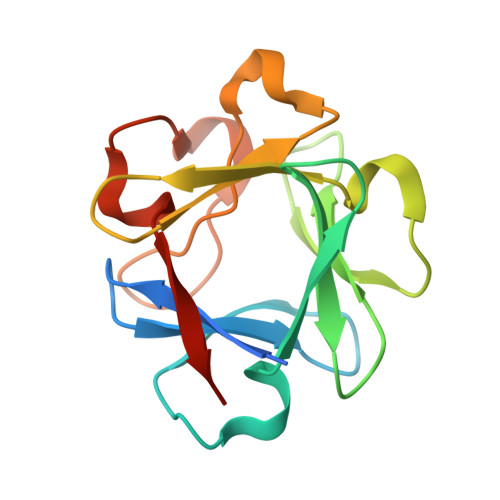
2Q9X | pdb_00002q9x

Crystal structure of highly stable mutant Q40P/S47I/H93G of human fibroblast growth factor-1


Experimental Data Snapshot

  • Method: X-RAY DIFFRACTION
  • Resolution: 1.70 Å
  • R-Value Free: 
    0.245 (Depositor), 0.240 (DCC) 
  • R-Value Work: 
    0.207 (Depositor), 0.210 (DCC) 
  • R-Value Observed: 
    0.209 (Depositor) 

Starting Model: experimental
View more details

wwPDB Validation   3D Report Full Report


This is version 1.4 of the entry. See complete history


Literature

Structure of a highly stable mutant of human fibroblast growth factor 1.

Szlachcic, A.Zakrzewska, M.Krowarsch, D.Os, V.Helland, R.Smalas, A.O.Otlewski, J.

(2009) Acta Crystallogr D Biol Crystallogr 65: 67-73

  • DOI: https://doi.org/10.1107/S0907444908039486
  • Primary Citation of Related Structures:  
    2Q9X

  • PubMed Abstract: 

    Fibroblast growth factors (FGFs) are involved in diverse cellular processes such as cell migration, angiogenesis, osteogenesis, wound healing and embryonic and foetal development. Human acidic fibroblast growth factor (FGF-1) is the only member of the FGF family that binds with high affinity to all four FGF receptors and thus is considered to be the human mitogen with the broadest specificity. However, pharmacological applications of FGF-1 are limited owing to its low stability. It has previously been reported that the introduction of single mutations can significantly improve the stability of FGF-1 and its resistance to proteolytic degradation. Here, the structure of the Q40P/S47I/H93G triple mutant of FGF-1, which exhibits much higher stability, a prolonged half-life and enhanced mitogenic activity, is presented. Compared with the wild-type structure, three localized conformational changes in the stable triple mutant were observed, which is in agreement with the perfect energetic additivity of the single mutations described in a previous study. The huge change in FGF-1 stability (the denaturation temperature increased by 21.5 K, equivalent to DeltaDeltaG(den) = 24.3 kJ mol(-1)) seems to result from the formation of a short 3(10)-helix (position 40), an improvement in the propensity of amino acids to form beta-sheets (position 47) and the rearrangement of a local hydrogen-bond network (positions 47 and 93).


  • Organizational Affiliation
    • Department of Protein Engineering, Faculty of Biotechnology, University of Wroclaw, Wroclaw, Poland.

Macromolecules
Find similar proteins by:  (by identity cutoff)  |  3D Structure
Entity ID: 1
MoleculeChains Sequence LengthOrganismDetailsImage
Heparin-binding growth factor 1140Homo sapiensMutation(s): 3 
Gene Names: FGF1FGFA
UniProt & NIH Common Fund Data Resources
Find proteins for P05230 (Homo sapiens)
Explore P05230 
Go to UniProtKB:  P05230
PHAROS:  P05230
GTEx:  ENSG00000113578 
Entity Groups  
Sequence Clusters30% Identity50% Identity70% Identity90% Identity95% Identity100% Identity
UniProt GroupP05230
Sequence Annotations
Expand
  • Reference Sequence
Small Molecules
Ligands 1 Unique
IDChains Name / Formula / InChI Key2D Diagram3D Interactions
GOL
Query on GOL

Download Ideal Coordinates CCD File 
B [auth A]GLYCEROL
C3 H8 O3
PEDCQBHIVMGVHV-UHFFFAOYSA-N
Experimental Data & Validation

Experimental Data

  • Method: X-RAY DIFFRACTION
  • Resolution: 1.70 Å
  • R-Value Free:  0.245 (Depositor), 0.240 (DCC) 
  • R-Value Work:  0.207 (Depositor), 0.210 (DCC) 
  • R-Value Observed: 0.209 (Depositor) 
Space Group: P 21 21 21
Unit Cell:
Length ( Å )Angle ( ˚ )
a = 34.61α = 90
b = 57.599β = 90
c = 57.716γ = 90
Software Package:
Software NamePurpose
SCALAdata scaling
MOLREPphasing
REFMACrefinement
PDB_EXTRACTdata extraction
MAR345dtbdata collection
MOSFLMdata reduction

Structure Validation

View Full Validation Report


Entry History 

Deposition Data

Revision History  (Full details and data files)

  • Version 1.0: 2008-07-01
    Type: Initial release
  • Version 1.1: 2011-07-13
    Changes: Non-polymer description, Version format compliance
  • Version 1.2: 2021-10-20
    Changes: Database references, Derived calculations
  • Version 1.3: 2023-08-30
    Changes: Data collection, Refinement description
  • Version 1.4: 2025-11-12
    Changes: Database references, Structure summary