Download Mendeley
Synthetic biology of proteins: tuning GFPs folding and stability with fluoroproline.
Steiner, T., Hess, P., Bae, J.H., Wiltschi, B., Moroder, L., Budisa, N.(2008) PLoS One 3: e1680-e1680
- PubMed: 18301757 Search on PubMedSearch on PubMed Central
- DOI: https://doi.org/10.1371/journal.pone.0001680
- Primary Citation Related Structures:
2Q6P - PubMed Abstract:
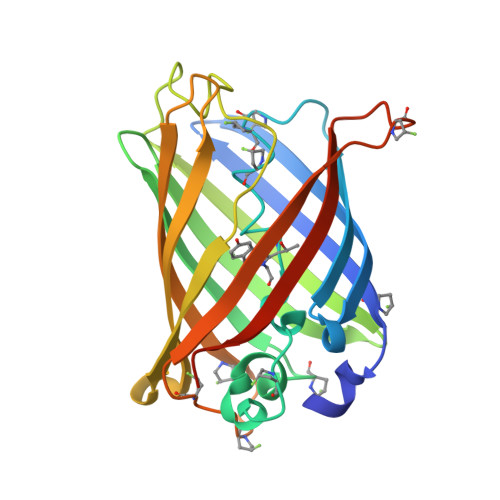
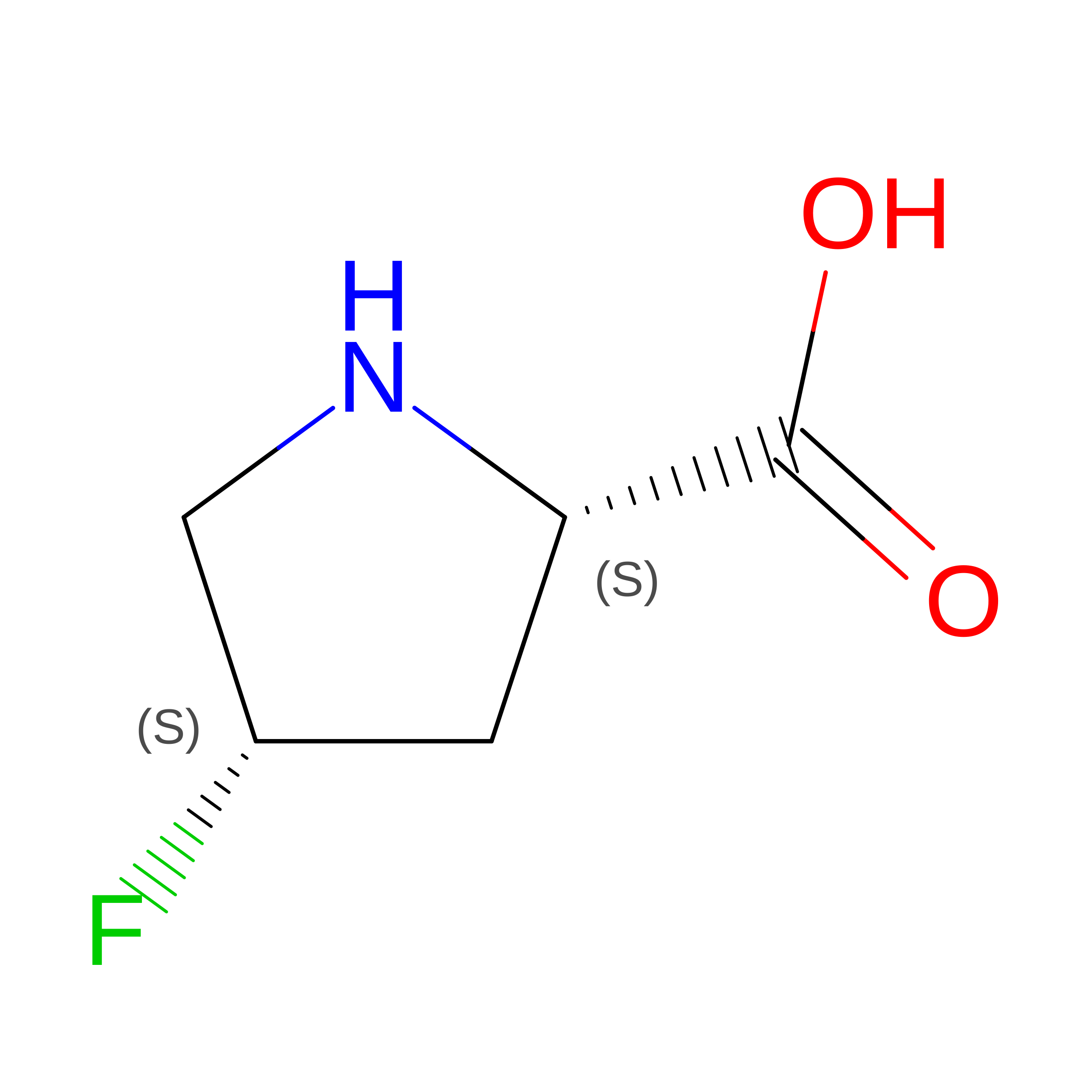
Proline residues affect protein folding and stability via cis/trans isomerization of peptide bonds and by the C(gamma)-exo or -endo puckering of their pyrrolidine rings. Peptide bond conformation as well as puckering propensity can be manipulated by proper choice of ring substituents, e.g. C(gamma)-fluorination. Synthetic chemistry has routinely exploited ring-substituted proline analogs in order to change, modulate or control folding and stability of peptides. In order to transmit this synthetic strategy to complex proteins, the ten proline residues of enhanced green fluorescent protein (EGFP) were globally replaced by (4R)- and (4S)-fluoroprolines (FPro). By this approach, we expected to affect the cis/trans peptidyl-proline bond isomerization and pyrrolidine ring puckering, which are responsible for the slow folding of this protein. Expression of both protein variants occurred at levels comparable to the parent protein, but the (4R)-FPro-EGFP resulted in irreversibly unfolded inclusion bodies, whereas the (4S)-FPro-EGFP led to a soluble fluorescent protein. Upon thermal denaturation, refolding of this variant occurs at significantly higher rates than the parent EGFP. Comparative inspection of the X-ray structures of EGFP and (4S)-FPro-EGFP allowed to correlate the significantly improved refolding with the C(gamma)-endo puckering of the pyrrolidine rings, which is favored by 4S-fluorination, and to lesser extents with the cis/trans isomerization of the prolines. We discovered that the folding rates and stability of GFP are affected to a lesser extent by cis/trans isomerization of the proline bonds than by the puckering of pyrrolidine rings. In the C(gamma)-endo conformation the fluorine atoms are positioned in the structural context of the GFP such that a network of favorable local interactions is established. From these results the combined use of synthetic amino acids along with detailed structural knowledge and existing protein engineering methods can be envisioned as a promising strategy for the design of complex tailor-made proteins and even cellular structures of superior properties compared to the native forms.
- Max Planck Institute of Biochemistry, Martinsried, Germany.
Organizational Affiliation: