Download Mendeley
Interaction with synphilin-1 promotes inclusion formation of alpha-synuclein: mechanistic insights and pathological implication.
Xie, Y.Y., Zhou, C.J., Zhou, Z.R., Hong, J., Che, M.X., Fu, Q.S., Song, A.X., Lin, D.H., Hu, H.Y.(2010) FASEB J 24: 196-205
- PubMed: 19762560 Search on PubMed
- DOI: https://doi.org/10.1096/fj.09-133082
- Primary Citation Related Structures:
2JN5, 2KES - PubMed Abstract:
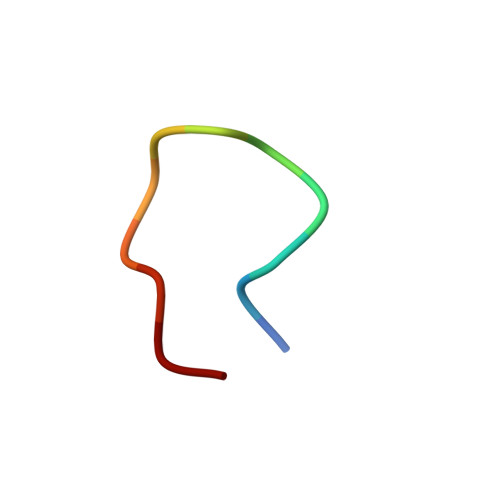
alpha-Synuclein (alpha-Syn) is the major component of Lewy bodies (LBs) deposited in the brains of patients with Parkinson's disease. Synphilin-1 (Sph1) is a novel alpha-Syn-interacting protein also present in the LBs. However, the roles of alpha-Syn-Sph1 interaction in LB formation and in the related pathogenesis are still unclear. We have studied the interaction between alpha-Syn and Sph1 by biochemical and structural approaches and found that the central coiled-coil domain of Sph1 specifically interacts with the N-terminal stretch of alpha-Syn. When overexpressed in HEK 293T cells, Sph1 forms inclusions together with alpha-Syn, but the Sph1-positive inclusions cannot recruit the N-terminally truncated alpha-Syn. The central portion of Sph1 can also recruit alpha-Syn and induce inclusion formation through its coiled-coil domain. These observations demonstrate that the alpha-Syn-Sph1 interaction significantly promotes the formation of cytoplasmic alpha-Syn inclusions, which may have implications for LB formation in neural cells. We have also elucidated solution structure of the coiled-coil domain of Sph1 and its interaction with the N-terminal peptide of alpha-Syn. The specific interaction between alpha-Syn and Sph1 provides mechanistic insights into the inclusion-body formation in cells and pathological implication in Parkinson's disease.
- State Key Laboratory of Molecular Biology, Institute of Biochemistry and Cell Biology, Shanghai Institutes for Biological Sciences, Chinese Academy of Sciences, 320 Yueyang Road, Shanghai, China.
Organizational Affiliation: