Download Mendeley
The N-Terminal Subdomain of Insulin-like Growth Factor (IGF) Binding Protein 6. Structure and Interaction with IGFs
Chandrashekaran, I.R., Yao, S., Wang, C.C., Bansal, P.S., Alewood, P.F., Forbes, B.E., Wallace, J.C., Bach, L.A., Norton, R.S.(2007) Biochemistry 46: 3065-3074
- PubMed: 17305365 Search on PubMed
- DOI: https://doi.org/10.1021/bi0619876
- Primary Citation Related Structures:
2JM2 - PubMed Abstract:
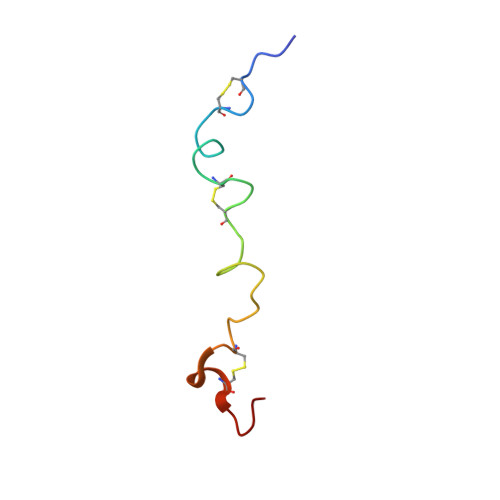
Insulin-like growth factor binding proteins (IGFBPs) modulate the activity and distribution of insulin-like growth factors (IGFs). IGFBP-6 differs from other IGFBPs in being a relatively specific inhibitor of IGF-II actions. Another distinctive feature of IGFBP-6 is its unique N-terminal disulfide linkages; the N-domains of IGFBPs 1-5 contain six disulfides and share a conserved GCGCC motif, but IGFBP-6 lacks the two adjacent cysteines in this motif, so its first three N-terminal disulfide linkages differ from those of the other IGFBPs. The contributions of the N- and C-domains of IGFBP-6 to its IGF binding properties and their structure-function relationships have been characterized in part, but the structure and function of the distinctive N-terminal subdomain of IGFBP-6 are unknown. Here we report the solution structure of a polypeptide corresponding to residues 1-45 of the N-terminal subdomain of IGFBP-6 (NN-BP-6). The extended structure of the N-terminal subdomain of IGFBP-6 is very different from that of the short two-stranded beta-sheet of the N-terminal subdomain of IGFBP-4 and, by implication, the other IGFBPs. NN-BP-6 contains a potential cation-binding motif; lanthanide ion binding was observed, but no significant interaction was found with physiologically relevant metal ions like calcium or magnesium. However, this subdomain of IGFBP-6 has a higher affinity for IGF-II than IGF-I, suggesting that it may contribute to the marked IGF-II binding preference of IGFBP-6. The extended structure and flexibility of this subdomain of IGFBP-6 could play a role in enhancing the rate of ligand association and thereby be significant in IGF recognition.
- The Walter and Eliza Hall Institute of Medical Research, 1G Royal Parade, Parkville 3050, Australia.
Organizational Affiliation: