2IH3 | pdb_00002ih3

Ion selectivity in a semi-synthetic K+ channel locked in the conductive conformation


Experimental Data Snapshot

  • Method: X-RAY DIFFRACTION
  • Resolution: 1.72 Å
  • R-Value Free: 
    0.242 (Depositor), 0.243 (DCC) 
  • R-Value Work: 
    0.233 (Depositor), 0.229 (DCC) 
  • R-Value Observed: 
    0.233 (Depositor) 

wwPDB Validation 3D Report Full Report

Validation slider image for 2IH3

Ligand Structure Quality Assessment 


This is version 1.5 of the entry. See complete history

Literature

Ion Selectivity in a Semisynthetic K+ Channel Locked in the Conductive Conformation.

Valiyaveetil, F.I.Leonetti, M.Muir, T.W.Mackinnon, R.

(2006) Science 314: 1004-1007

  • DOI: https://doi.org/10.1126/science.1133415
  • Primary Citation Related Structures: 
    2IH1, 2IH3

  • PubMed Abstract: 

    Potassium channels are K+-selective protein pores in cell membrane. The selectivity filter is the functional unit that allows K+ channels to distinguish potassium (K+) and sodium (Na+) ions. The filter's structure depends on whether K+ or Na+ ions are bound inside it. We synthesized a K+ channel containing the d-enantiomer of alanine in place of a conserved glycine and found by x-ray crystallography that its filter maintains the K+ (conductive) structure in the presence of Na+ and very low concentrations of K+. This channel conducts Na+ in the absence of K+ but not in the presence of K+. These findings demonstrate that the ability of the channel to adapt its structure differently to K+ and Na+ is a fundamental aspect of ion selectivity, as is the ability of multiple K+ ions to compete effectively with Na+ for the conductive filter.


  • Organizational Affiliation
    • Laboratories of Molecular Neurobiology and Biophysics and Synthetic Protein Chemistry, Rockefeller University and Howard Hughes Medical Institute, 1230 York Avenue, New York, NY 10021, USA.

Macromolecule Content 

  • Total Structure Weight: 60.59 kDa 
  • Atom Count: 4,338 
  • Modeled Residue Count: 529 
  • Deposited Residue Count: 553 
  • Unique protein chains: 3

Macromolecules

Find similar proteins by:|  3D Structure
Entity ID: 1
MoleculeChains  Sequence LengthOrganismDetailsImage
FAB Heavy Chain219Mus musculusMutation(s): 0 
Find similar proteins by:|  3D Structure
Entity ID: 2
MoleculeChains  Sequence LengthOrganismDetailsImage
FAB Light Chain212Mus musculusMutation(s): 0 
Find similar proteins by:|  3D Structure
Entity ID: 3
MoleculeChains  Sequence LengthOrganismDetailsImage
Voltage-gated potassium channel122Streptomyces lividansMutation(s): 3 
Gene Names: kcsAskc1
Membrane Entity: Yes 
UniProt
Find proteins for P0A334 (Streptomyces lividans)
Explore P0A334 
Go to UniProtKB:  P0A334
Entity Groups
Sequence Clusters30% Identity50% Identity70% Identity90% Identity95% Identity100% Identity
UniProt GroupP0A334
Sequence Annotations
Expand
Reference Sequence

Small Molecules

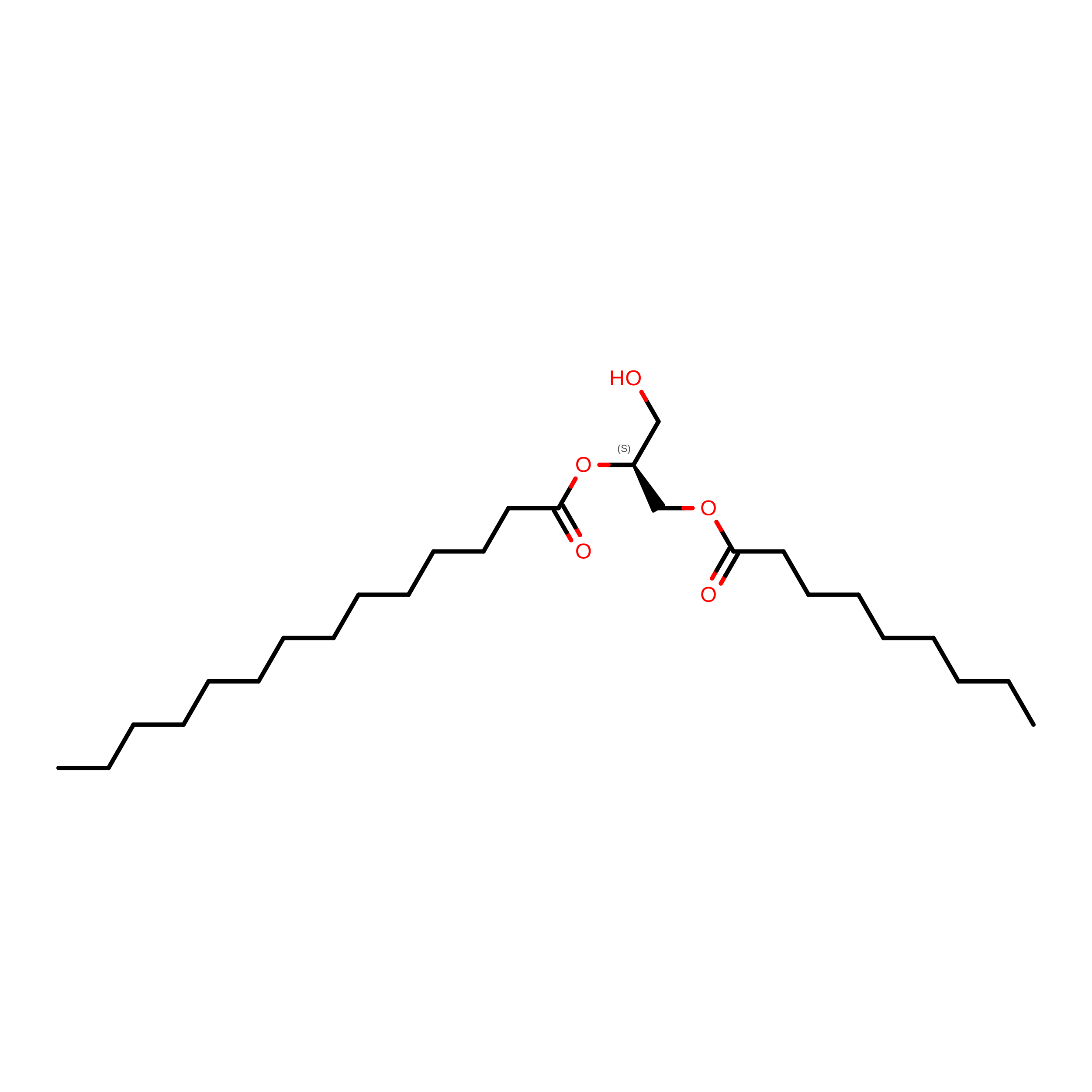
Ligands 2 Unique
IDChains Name / Formula / InChI Key2D Diagram3D Interactions
1EM

Query on 1EM


Download:Ideal Coordinates CCD File
K [auth C](1S)-2-HYDROXY-1-[(NONANOYLOXY)METHYL]ETHYL MYRISTATE
C26 H50 O5
IHUWMVGHYXVIRN-DEOSSOPVSA-N
K

Query on K


Download:Ideal Coordinates CCD File
D [auth C]
E [auth C]
F [auth C]
G [auth C]
H [auth C]
D [auth C],
E [auth C],
F [auth C],
G [auth C],
H [auth C],
I [auth C],
J [auth C]
POTASSIUM ION
K
NPYPAHLBTDXSSS-UHFFFAOYSA-N

Experimental Data & Validation

Experimental Data

  • Method: X-RAY DIFFRACTION
  • Resolution: 1.72 Å
  • R-Value Free:  0.242 (Depositor), 0.243 (DCC) 
  • R-Value Work:  0.233 (Depositor), 0.229 (DCC) 
  • R-Value Observed: 0.233 (Depositor) 
Space Group: I 4
Unit Cell:
Length ( Å )Angle ( ˚ )
a = 155.724α = 90
b = 155.724β = 90
c = 75.741γ = 90
Software Package:
Software NamePurpose
CNSrefinement
PDB_EXTRACTdata extraction
CBASSdata collection
DENZOdata reduction
SCALEPACKdata scaling

Structure Validation

View Full Validation Report


Ligand Structure Quality Assessment 


Entry History 

Deposition Data

Revision History  (Full details and data files)

  • Version 1.0: 2006-11-21
    Type: Initial release
  • Version 1.1: 2008-05-01
    Changes: Version format compliance
  • Version 1.2: 2011-07-13
    Changes: Derived calculations, Version format compliance
  • Version 1.3: 2011-11-16
    Changes: Atomic model
  • Version 1.4: 2021-10-20
    Changes: Database references, Derived calculations
  • Version 1.5: 2024-10-30
    Changes: Data collection, Structure summary