2H9J | pdb_00002h9j

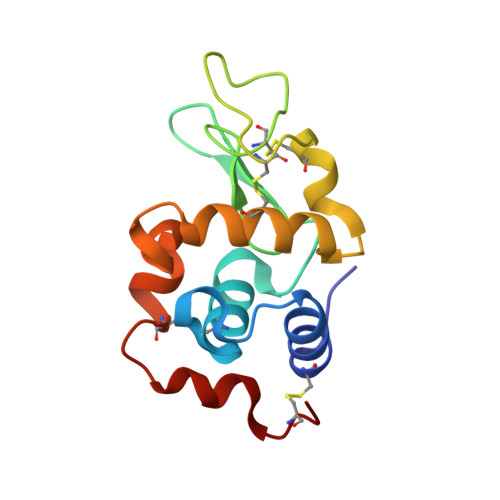
Structure of Hen egg white lysozyme soaked with Ni2-Xylylbicyclam


Experimental Data Snapshot

  • Method: X-RAY DIFFRACTION
  • Resolution: 1.75 Å
  • R-Value Free: 
    0.232 (Depositor), 0.230 (DCC) 
  • R-Value Work: 
    0.184 (Depositor), 0.180 (DCC) 
  • R-Value Observed: 
    0.187 (Depositor) 

Starting Model: experimental
View more details

wwPDB Validation   3D Report Full Report


Ligand Structure Quality Assessment 


This is version 1.4 of the entry. See complete history


Literature

Configurations of nickel-cyclam antiviral complexes and protein recognition.

Hunter, T.M.McNae, I.W.Simpson, D.P.Smith, A.M.Moggach, S.White, F.Walkinshaw, M.D.Parsons, S.Sadler, P.J.

(2007) Chemistry 13: 40-50

  • DOI: https://doi.org/10.1002/chem.200601334
  • Primary Citation of Related Structures:  
    2H9J, 2H9K

  • PubMed Abstract: 

    Nickel(II)-xylylbicyclam is a potent anti-HIV agent and binds strongly to the CXCR4 co-receptor. We have investigated configurational equilibria of Ni(II)-cyclam derivatives, since these are important for receptor recognition. Crystallographic studies show that both trans and cis configurations are readily formed: [Ni(cyclam)(OAc)(2)] x H(2)O adopts the trans-III configuration with axial monodentate acetates, as does [Ni(benzylcyclam)(NO(3))(2)] with axial nitrate ligands, whereas [Ni(benzylcyclam)(OAc)](OAc)2 x H(2)O has an unusual folded cis-V configuration with Ni(II) coordination to bidentate acetate. UV/Vis and NMR studies show that the octahedral trans-III configuration slowly converts to square-planar trans-I in aqueous solution. For Ni(II)-xylylbicyclam, a mixture of cis-V and trans-I configurations was detected in solution. X-ray diffraction studies showed that crystals of lysozyme soaked in Ni(II)-cyclam or Ni(II) (2)-xylylbicyclam contain two major binding sites, one involving Ni(II) coordination to Asp101 and hydrophobic interactions between the cyclam ring and Trp62 and Trp63, and the second hydrophobic interactions with Trp123. For Ni(II)-cyclam bound to Asp101, the cis-V configuration predominates.


  • Organizational Affiliation
    • School of Chemistry, University of Edinburgh, West Mains Road, Edinburgh EH9 3JJ, UK.

Macromolecules
Find similar proteins by:  (by identity cutoff)  |  3D Structure
Entity ID: 1
MoleculeChains Sequence LengthOrganismDetailsImage
Lysozyme C129Gallus gallusMutation(s): 0 
Gene Names: LYZ
EC: 3.2.1.17
UniProt
Find proteins for P00698 (Gallus gallus)
Explore P00698 
Go to UniProtKB:  P00698
Entity Groups  
Sequence Clusters30% Identity50% Identity70% Identity90% Identity95% Identity100% Identity
UniProt GroupP00698
Sequence Annotations
Expand
  • Reference Sequence
Small Molecules
Ligands 4 Unique
IDChains Name / Formula / InChI Key2D Diagram3D Interactions
MM5
Query on MM5

Download Ideal Coordinates CCD File 
F [auth A],
G [auth A]
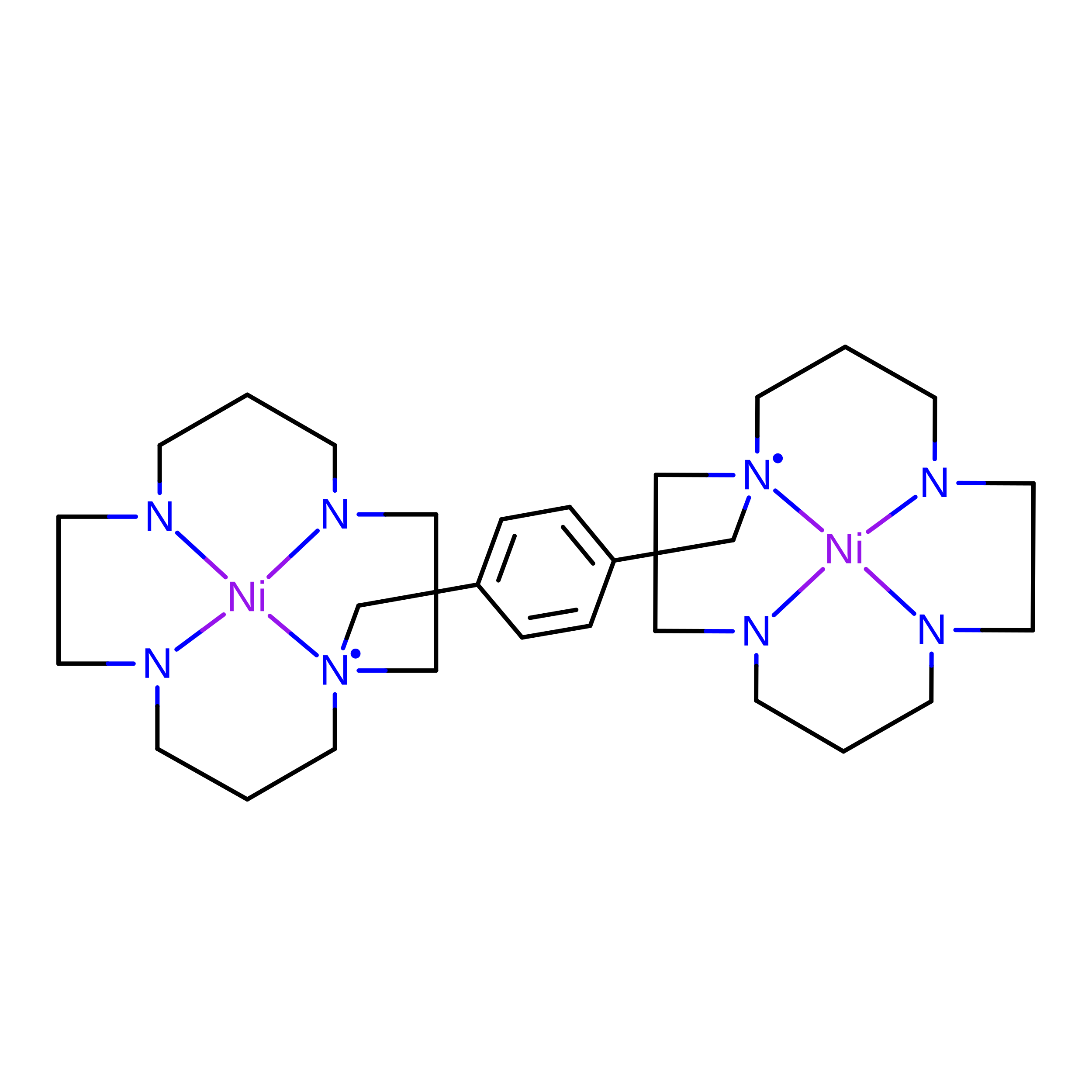
1,1'-[1,4-PHENYLENEBIS(METHYLENE)]BIS[1,4,8,11-TETRAAZACYCLOTETRADECANE]NI(II)
C28 H48 N8 Ni2
XVYSAVBBVPTNSF-UHFFFAOYSA-N
NI
Query on NI

Download Ideal Coordinates CCD File 
E [auth A]NICKEL (II) ION
Ni
VEQPNABPJHWNSG-UHFFFAOYSA-N
CL
Query on CL

Download Ideal Coordinates CCD File 
B [auth A],
C [auth A]
CHLORIDE ION
Cl
VEXZGXHMUGYJMC-UHFFFAOYSA-M
NA
Query on NA

Download Ideal Coordinates CCD File 
D [auth A]SODIUM ION
Na
FKNQFGJONOIPTF-UHFFFAOYSA-N
Experimental Data & Validation

Experimental Data

  • Method: X-RAY DIFFRACTION
  • Resolution: 1.75 Å
  • R-Value Free:  0.232 (Depositor), 0.230 (DCC) 
  • R-Value Work:  0.184 (Depositor), 0.180 (DCC) 
  • R-Value Observed: 0.187 (Depositor) 
Space Group: P 43 21 2
Unit Cell:
Length ( Å )Angle ( ˚ )
a = 77.577α = 90
b = 77.577β = 90
c = 38.355γ = 90
Software Package:
Software NamePurpose
REFMACrefinement

Structure Validation

View Full Validation Report


Ligand Structure Quality Assessment 


Entry History 

Deposition Data

Revision History  (Full details and data files)

  • Version 1.0: 2007-04-10
    Type: Initial release
  • Version 1.1: 2008-05-01
    Changes: Version format compliance
  • Version 1.2: 2011-07-13
    Changes: Version format compliance
  • Version 1.3: 2023-08-30
    Changes: Data collection, Database references, Derived calculations, Refinement description
  • Version 1.4: 2024-11-20
    Changes: Structure summary