2DPR | pdb_00002dpr

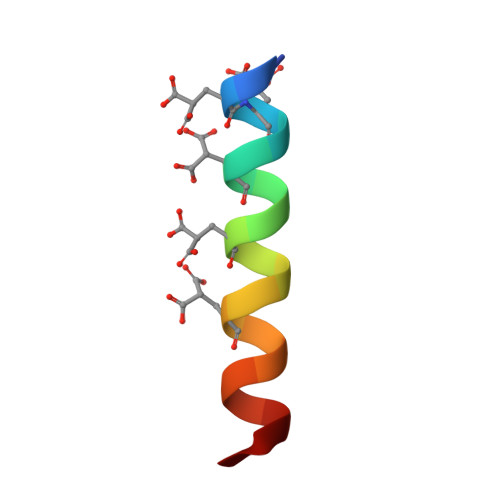
The crystal structures of the calcium-bound con-G and con-T(K7Glu) dimeric peptides demonstrate a novel metal-dependent helix-forming motif


Experimental Data Snapshot

  • Method: X-RAY DIFFRACTION
  • Resolution: 1.70 Å
  • R-Value Free: 
    0.186 (Depositor), 0.202 (DCC) 
  • R-Value Work: 
    0.133 (Depositor), 0.168 (DCC) 
  • R-Value Observed: 
    0.133 (Depositor) 

Starting Model: in silico
View more details

wwPDB Validation 3D Report Full Report

Validation slider image for 2DPR

This is version 1.5 of the entry. See complete history

Literature

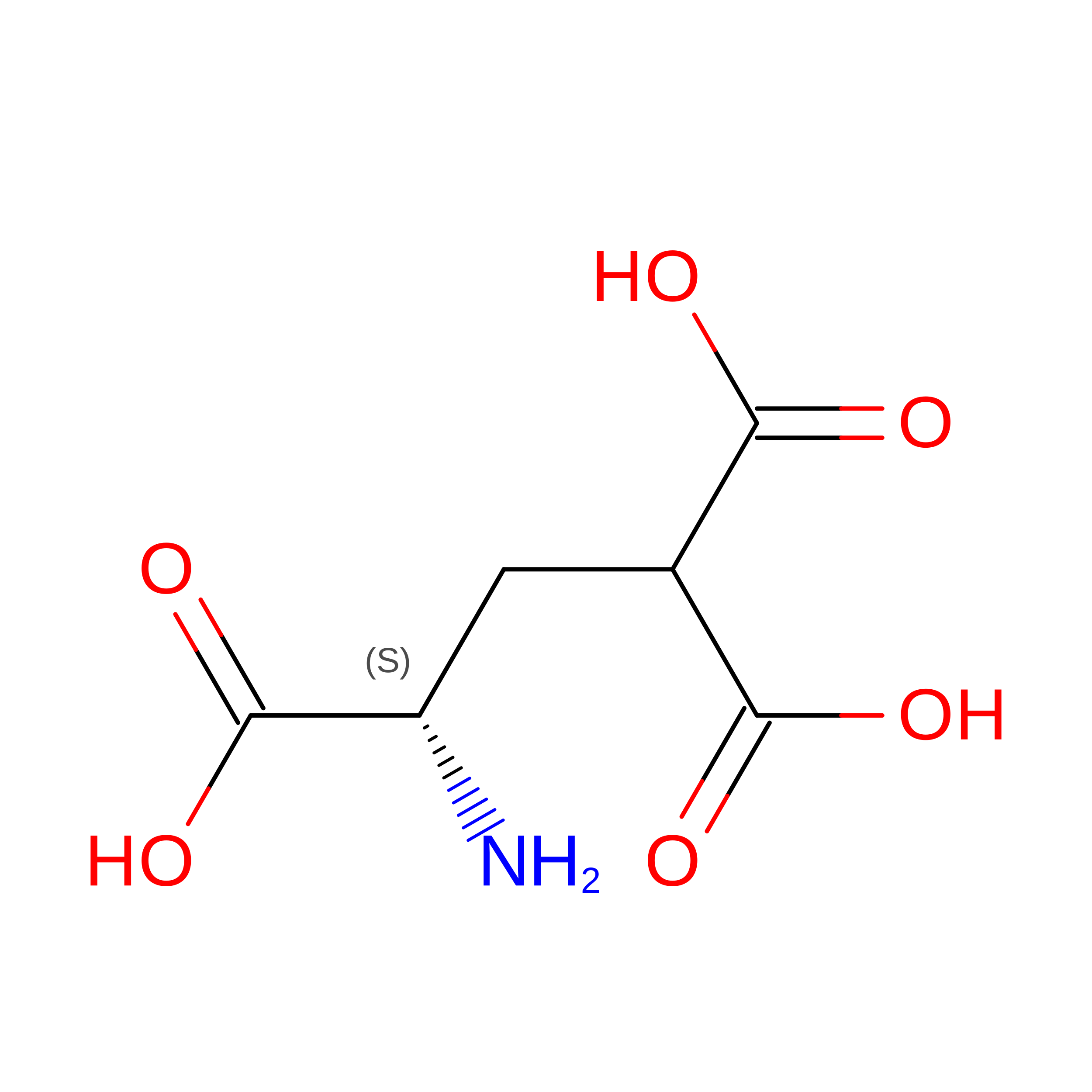
The crystal structures of the calcium-bound con-G and con-T[K7gamma] dimeric peptides demonstrate a metal-dependent helix-forming motif

Cnudde, S.E.Prorok, M.Dai, Q.Castellino, F.J.Geiger, J.H.

(2007) J Am Chem Soc 129: 1586-1593

  • DOI: https://doi.org/10.1021/ja065722q
  • Primary Citation Related Structures: 
    2DPQ, 2DPR

  • PubMed Abstract: 

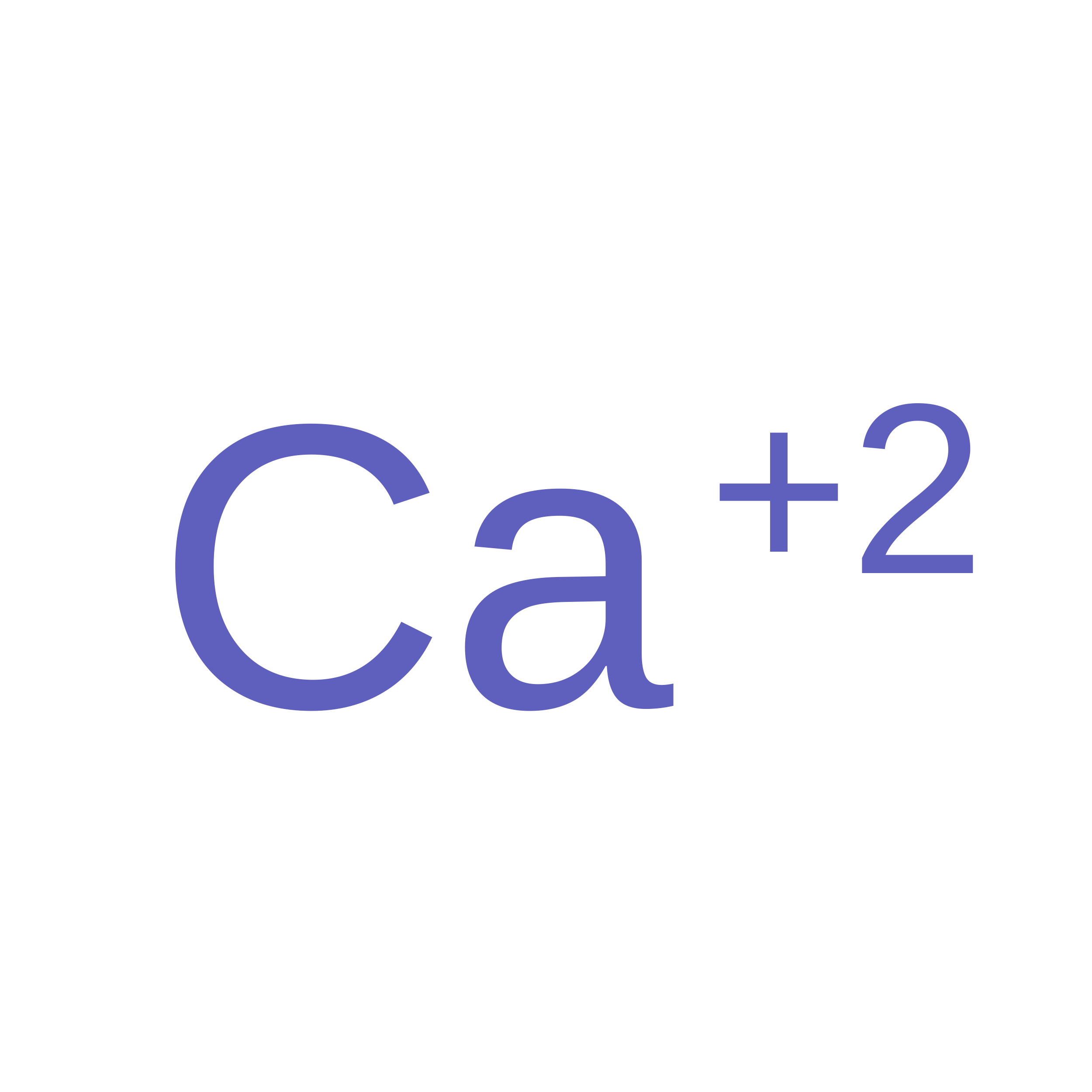
    Short peptides that have the ability to form stable alpha-helices in solution are rare, and a number of strategies have been used to produce them, including the use of metal chelation to stabilize folding of the backbone. However, no example exists of a structurally well-defined helix stabilized exclusively through metal ion chelation. Conantokins (con)-G and -T are short peptides that are potent antagonists of N-methyl-D-aspartate receptor channels. While con-G exhibits no helicity alone, it undergoes a structural transition to a helical conformation in the presence of a variety of multivalent cations, especially Mg2+ and Ca2+. This complexation also results in antiparallel dimerization of two peptide helices in the presence of Ca2+, but not Mg2+. A con-T variant, con-T[K7gamma], displays very similar behavior. We have solved the crystal structures of both Ca2+/con-G and Ca2+/con-T [K7gamma] at atomic resolution. These structures clearly show the nature of the metal-dependent dimerization and helix formation and surprisingly also show that the con-G dimer interface is completely different from the con-T[K7gamma] interface, even though the metal chelation is similar in the two peptides. This represents a new paradigm in helix stabilization completely independent of the hydrophobic effect, which we define as the "metallo-zipper."


  • Organizational Affiliation
    • Department of Biochemistry, Michigan State University, East Lansing, Michigan 48824, USA.

Macromolecule Content 

  • Total Structure Weight: 5.63 kDa 
  • Atom Count: 531 
  • Modeled Residue Count: 42 
  • Deposited Residue Count: 42 
  • Unique protein chains: 1

Macromolecules

Find similar proteins by:  Sequence   |   3D Structure  
Entity ID: 1
MoleculeChains  Sequence LengthOrganismDetailsImage
Conantokin-T
A, B
21Conus tulipaMutation(s): 1 
UniProt
Find proteins for P17684 (Conus tulipa)
Explore P17684 
Go to UniProtKB:  P17684
Entity Groups
Sequence Clusters30% Identity50% Identity70% Identity90% Identity95% Identity100% Identity
UniProt GroupP17684
Sequence Annotations
Expand
Reference Sequence

Experimental Data & Validation

Experimental Data

  • Method: X-RAY DIFFRACTION
  • Resolution: 1.70 Å
  • R-Value Free:  0.186 (Depositor), 0.202 (DCC) 
  • R-Value Work:  0.133 (Depositor), 0.168 (DCC) 
  • R-Value Observed: 0.133 (Depositor) 
Space Group: P 43 3 2
Unit Cell:
Length ( Å )Angle ( ˚ )
a = 89.013α = 90
b = 89.013β = 90
c = 89.013γ = 90
Software Package:
Software NamePurpose
DENZOdata reduction
SCALEPACKdata scaling
SHELXrefinement
PDB_EXTRACTdata extraction
AUTOMARdata reduction
PHASERphasing
SHELXLrefinement

Structure Validation

View Full Validation Report


Entry History 

Deposition Data

Revision History  (Full details and data files)

  • Version 1.0: 2007-04-24
    Type: Initial release
  • Version 1.1: 2008-04-01
    Changes: Version format compliance
  • Version 1.2: 2011-07-13
    Changes: Derived calculations, Version format compliance
  • Version 1.3: 2013-07-24
    Changes: Database references, Structure summary
  • Version 1.4: 2017-10-11
    Changes: Advisory, Refinement description
  • Version 1.5: 2024-04-03
    Changes: Advisory, Data collection, Database references, Derived calculations, Refinement description