Download Mendeley
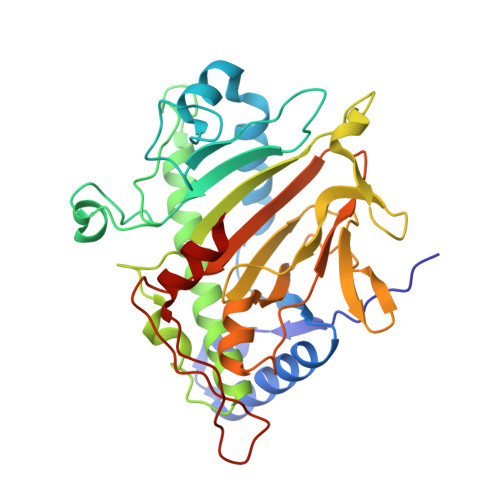
Terminally Truncated Isopenicillin N Synthase Generates a Dithioester Product: Evidence for a Thioaldehyde Intermediate during Catalysis and a New Mode of Reaction for Non-Heme Iron Oxidases.
McNeill, L.A., Brown, T.J.N., Sami, M., Clifton, I.J., Burzlaff, N.I., Claridge, T.D.W., Adlington, R.M., Baldwin, J.E., Rutledge, P.J., Schofield, C.J.(2017) Chemistry 23: 12815-12824
- PubMed: 28703303 Search on PubMedSearch on PubMed Central
- DOI: https://doi.org/10.1002/chem.201701592
- Primary Citation Related Structures:
2BJS - PubMed Abstract:
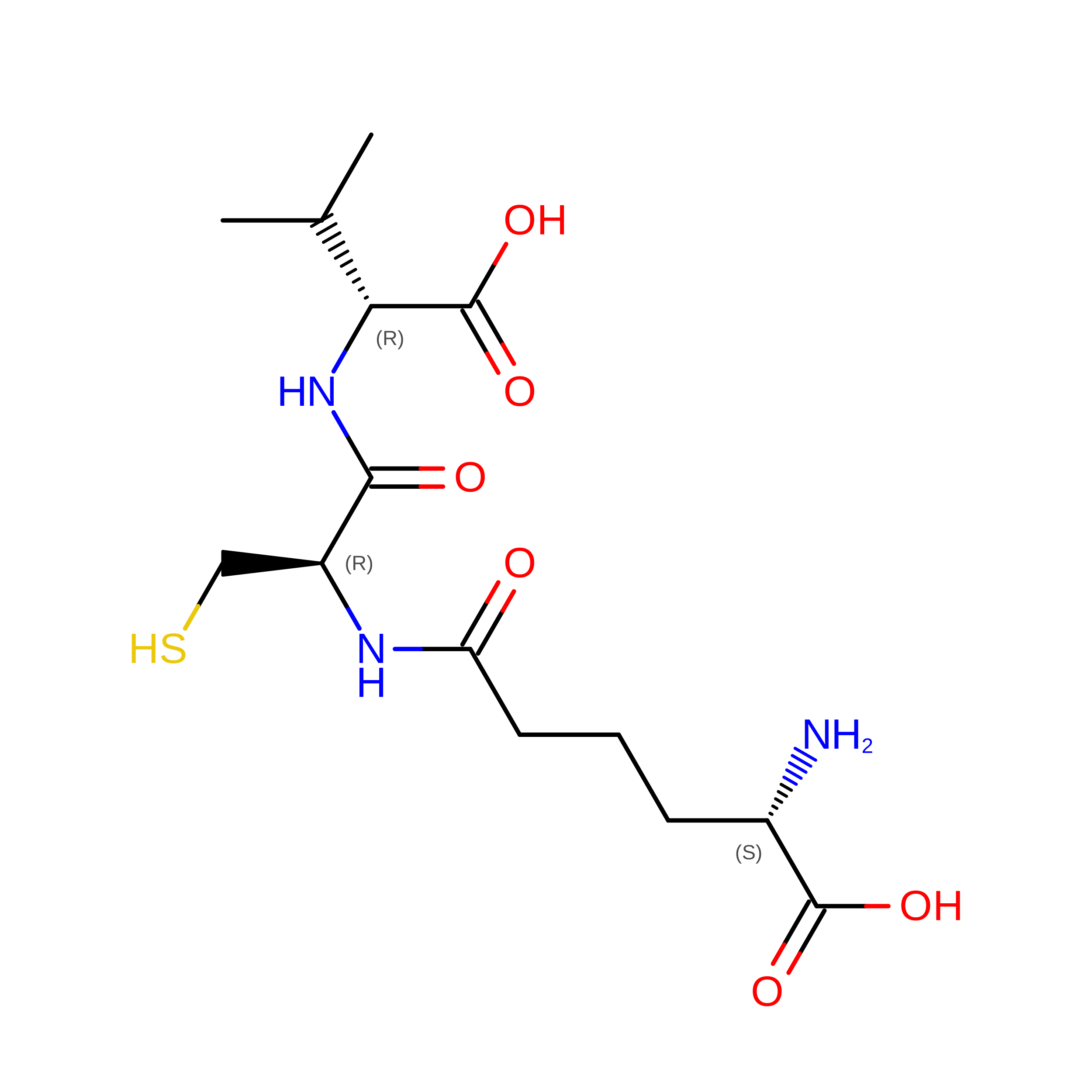
Isopenicillin N synthase (IPNS) catalyses the four-electron oxidation of a tripeptide, l-δ-(α-aminoadipoyl)-l-cysteinyl-d-valine (ACV), to give isopenicillin N (IPN), the first-formed β-lactam in penicillin and cephalosporin biosynthesis. IPNS catalysis is dependent upon an iron(II) cofactor and oxygen as a co-substrate. In the absence of substrate, the carbonyl oxygen of the side-chain amide of the penultimate residue, Gln330, co-ordinates to the active-site metal iron. Substrate binding ablates the interaction between Gln330 and the metal, triggering rearrangement of seven C-terminal residues, which move to take up a conformation that extends the final α-helix and encloses ACV in the active site. Mutagenesis studies are reported, which probe the role of the C-terminal and other aspects of the substrate binding pocket in IPNS. The hydrophobic nature of amino acid side-chains around the ACV binding pocket is important in catalysis. Deletion of seven C-terminal residues exposes the active site and leads to formation of a new type of thiol oxidation product. The isolated product is shown by LC-MS and NMR analyses to be the ene-thiol tautomer of a dithioester, made up from two molecules of ACV linked between the thiol sulfur of one tripeptide and the oxidised cysteinyl β-carbon of the other. A mechanism for its formation is proposed, supported by an X-ray crystal structure, which shows the substrate ACV bound at the active site, its cysteinyl β-carbon exposed to attack by a second molecule of substrate, adjacent. Formation of this product constitutes a new mode of reaction for IPNS and non-heme iron oxidases in general.
- Oxford Centre for Molecular Sciences and the Department of Chemistry, Chemistry Research Laboratory, Mansfield Road, Oxford, OX1 3TA, UK.
Organizational Affiliation: